Four Days on São Miguel: West, East, Center and the Wild Nordeste Coast
Route Overview: Four Loops, One Island
This itinerary spreads São Miguel’s four natural quarters — west, east, center and the wild northeastern tip — across four driving days, each built around a single caldera, coastline or massif rather than a checklist of stops. Days 1 and 2 follow the two loops most visitors already know: Sete Cidades in the west, then Furnas and Vila Franca do Campo in the east.
Day 3 stays in the middle of the island at Lagoa do Fogo and the Caldeira Velha thermal waterfall. Day 4 is the addition that a shorter trip usually cuts: a full circuit of Nordeste, up through the laurel forest of Serra da Tronqueira — the only home of the endemic priolo — to the foot of Pico da Vara, the island’s 1,103 m summit.
A rental car is assumed throughout; this is not a route that works on the island’s bus network, which runs on school and work timetables rather than sightseeing ones. Base yourself in Ponta Delgada for the whole four days, or split the stay with a night near Furnas — either works, since no single day here requires more than a couple of hours of driving.
São Miguel earns its nickname, the Ilha Verde — the green island — on a drive like this one: roughly 65 km end to end and rarely more than 15 km wide, but packed with four distinct landscapes that a shorter loop can’t fit into one trip. None of the four days above requires long stretches of driving on its own; the added distance comes from doing all four in one visit rather than cherry-picking two or three.
Day 1: Ponta Delgada and the Sete Cidades Caldera
Start in Ponta Delgada itself before the roads west get busy. The old town’s basalt-and-limestone streets, the Portas da Cidade arches and the harbourfront at Portas do Mar are easily covered on foot in an hour or two. Travellers who’d rather have the history explained than piece it together themselves can join the Lagarta Historic Tour through Ponta Delgada’s old streets before heading out of town.
With a little more time before heading out, the fortified walls of the Forte de São Brás and the twin-towered Igreja Matriz de São Sebastião fill out the old town beyond the arches, and the Mercado da Graça is worth a pass for fruit, cheese and pastries to take on the road. On the edge of town, the Gruta do Carvão lava tube makes an easy detour for anyone curious about the volcanic ground the whole island sits on; see the Gruta do Carvão guide for visiting details.
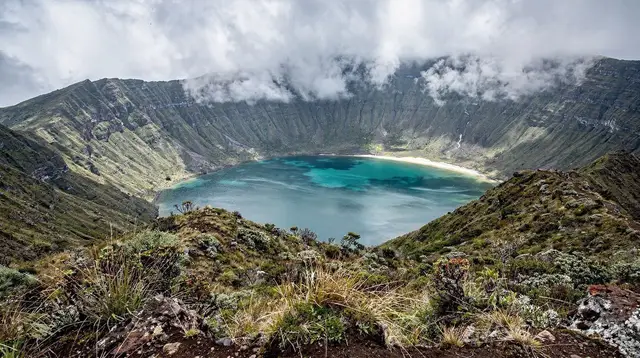
By mid-morning, drive west into the Sete Cidades caldera. The village sits inside the crater itself, ringed by the twin lakes Lagoa Azul and Lagoa Verde — one connected body of water whose blue and green halves come from light and depth, not two different lakes. Stop at Vista do Rei for the classic overview, then continue on to the quieter Boca do Inferno viewpoint above Lagoa do Canário and the short walk at Grota do Inferno.
If you’d rather not drive the caldera rim yourself, a guided half-day tour of Sete Cidades and its viewpoints covers the same ground with commentary included. For a written walkthrough of the loop, see the Sete Cidades half-day guide.
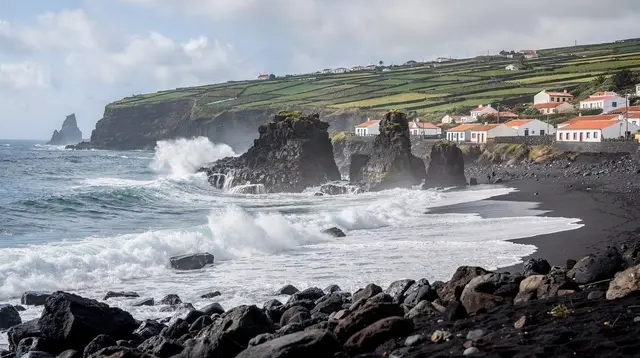
In the afternoon, drop down to the coast at Mosteiros for its black-sand beach and sea stacks, or push further to Ponta da Ferraria, where a hot spring meets the open Atlantic — usable only around low tide, and worth checking tide times before you commit the drive. Either stop works as a loop back to Ponta Delgada by early evening. Photographers chasing hydrangea season should time this day for June through September; see the Sete Cidades hydrangea photo guide for where the flowers line the caldera road.
Day 2: Furnas, Vila Franca do Campo and Terra Nostra
Day 2 crosses to the east side of the island. Furnas sits inside its own active caldera, and the village earns the detour on volcanic activity alone: steaming caldeiras dot the streets, and the Lagoa das Furnas is where the pots of cozido go into the hot ground each morning, cooking five to seven hours on volcanic heat with no fire, to be hauled out at midday. Book a restaurant in advance if you want to eat it — the ground isn’t yours to reserve, the kitchen’s booking is. The Furnas cozido guide covers how to order it and where.
Spend the late morning at the Terra Nostra garden, whose iron-rich thermal pool runs a murky orange at around 35-40°C and stains swimwear permanently — bring an old suit, not a good one. The Terra Nostra thermal pool guide has the practical detail. Travellers who’d rather have the caldera walk, the lake and the garden strung together by a guide, without worrying about parking or timing, can book a private tour combining the Furnas lake hike with Terra Nostra Park.
On the way back to Ponta Delgada, stop in Vila Franca do Campo, the island’s capital until 1522, when an earthquake-triggered landslide buried the original town and Ponta Delgada took over. Its harbour looks out at the Ilhéu de Vila Franca, a sunken crater islet reachable by boat in season — that crossing is deliberately left off this itinerary, since it depends on visitor caps and sea conditions rather than a fixed schedule; treat it as an optional add-on if the weather cooperates, and the Vila Franca former-capital guide has more on the town’s history and the islet crossing.
Furnas has no beach of its own — the caldera sits inland — so travellers who want to end the day by the sea can continue past Vila Franca do Campo to Ribeira Quente, Furnas’ beach on the far side of the ridge. It’s a quieter stop than the caldera villages, useful as a wind-down after a day of thermal pools and cozido rather than a headline attraction in its own right.
Day 3: The Island’s Center — Lagoa do Fogo and Caldeira Velha
Day 3 turns inward to the crater at the heart of São Miguel. Lagoa do Fogo sits in the middle of the island with no café, no ticket office, no toilets and no bins — it is a nature reserve, not a facility, and it is frequently sitting inside a cloud. Check conditions before driving up, since the access road is sometimes closed in poor weather, and treat a clear view as a bonus rather than a guarantee. The Lagoa do Fogo day-trip guide and the no-facilities note are worth reading before you go.
Come back down towards Água de Pau and stop at Caldeira Velha, a thermal waterfall and a set of warm pools set into the forest on the lower slope of the same massif — a shorter, easier stop than Lagoa do Fogo and a good way to close the loop with something to actually get into. See the Caldeira Velha thermal waterfall guide for opening times and what to bring. Travellers who’d rather combine the crater lake and Sete Cidades into one guided day, rather than split them across two days as this itinerary does, can look at a full-day tour linking Sete Cidades and Lagoa do Fogo as an alternative structure.
With the afternoon free, either return to Ponta Delgada or use the extra time to explore Ribeira Grande, the island’s second town, on the north coast nearby.
Ribeira Grande has its own draws beyond a change of scenery: the surf beach at Praia de Santa Bárbara, and the tea and tourism trade that fills its historic center. The Ribeira Grande guide covers the town in more depth for anyone stretching Day 3 into the afternoon.
Day 4: The Nordeste Circuit, the Priolo’s Forest and Pico da Vara
Fuel up before you leave — this is the one piece of planning that trips up more visitors than anything else on this route. Petrol stations thin out fast once you’re past Povoação, and running low on the mountain roads around the Serra da Tronqueira is not where you want to discover it. Fill the tank in Ponta Delgada, Ribeira Grande or Povoação.
The Nordeste circuit is the payoff for the extra day. Work the coast road out through the viewpoints of Ponta do Sossego and Ponta da Madrugada, both looking down sheer, terraced cliffs to the Atlantic, and detour to the Farol do Arnel lighthouse at the island’s easternmost point. Stop at Ribeira dos Caldeirões, a small waterfall park with an old watermill, an easy walk rather than a hike. The Nordeste coastal day-trip guide lays out the full loop stop by stop.
From Nordeste, climb inland into the Serra da Tronqueira, São Miguel’s laurel forest and the only place on Earth where the priolo, the Azores bullfinch, survives. It is one of Europe’s rarest birds, and it is not something you see from the road or the car park — it keeps to dense cover and takes a quiet, patient walk to have any chance of spotting.
No page can promise a sighting, and this one won’t either; the Serra da Tronqueira priolo trail guide and the priolo background note explain what the forest protects and why. The approach road continues to the base of Pico da Vara, São Miguel’s high point at 1,103 m — this itinerary drives to the foot of the mountain and its viewpoints; reaching the actual summit is a marked trail on foot, covered in the Pico da Vara summit guide.
If you’d rather have a driver handle the Nordeste circuit’s narrow roads and know exactly where to stop, a private jeep tour through the Nordeste adventure route covers the same ground without the navigation. Either way, allow the whole day — Nordeste is the farthest point from Ponta Delgada on the island, and the roads reward a slow pace more than a rushed one.
Practical Notes for This Route
Distances on São Miguel are short on paper and longer in practice: narrow roads, fog on the passes and slow-moving traffic through villages all add time that a map doesn’t show. Build in buffer rather than stacking stops back to back, especially on Day 4, when the return drive from Nordeste to Ponta Delgada can take over an hour on its own.
Weather changes from one side of the island to the other within the same hour — it is entirely possible to leave rain in Furnas and arrive to sun in Ponta Delgada, or the reverse. Treat any single-day forecast as a rough guide, not a guarantee, and keep a change of clothes and a rain layer in the car regardless of the season.
This four-day structure assumes good general fitness for short walks (Ribeira dos Caldeirões, Caldeira Velha, the viewpoints) but no technical hiking. Travellers wanting to push further into the Serra da Tronqueira or up to the Pico da Vara summit itself should budget extra time beyond what this itinerary allots for Day 4.
Where you sleep matters less on this route than on a slower trip, since no day strays far from Ponta Delgada, but it’s still worth deciding in advance rather than on arrival — the where-to-stay guide compares the options across the island.
Pack for four seasons in one bag regardless of when you travel: swimwear you don’t mind staining at the thermal stops, sturdy shoes for the short walks, and a proper rain layer for the passes. The São Miguel packing list goes through it stop by stop.
tours.4 days
Verified deep-linked GetYourGuide tours. Book through these links and we earn a small commission at no cost to you.
GetYourGuide does not provide a product photo for this activity — the image shows the meeting point, photographed by us.