Gruta do Carvão: São Miguel's Lava Tube on the Edge of Ponta Delgada
What is the Gruta do Carvão?
It is a lava tube on the northern edge of Ponta Delgada, a long cave formed when the outer skin of a flowing lava stream cooled and hardened while the molten rock inside kept draining away. It has been cold, stable rock for centuries and is unrelated to the still-active caldeiras of Furnas or Lagoa do Fogo elsewhere on the island.
A Cold Cave on the Edge of a Warm Island
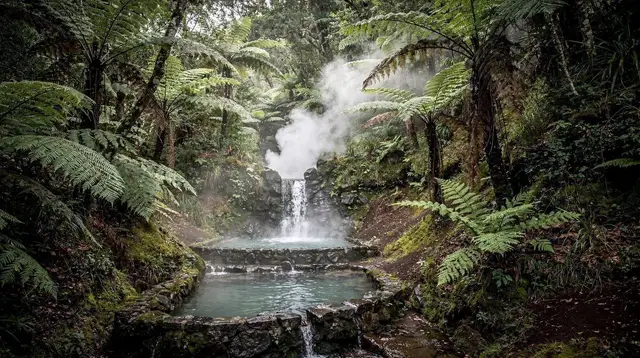
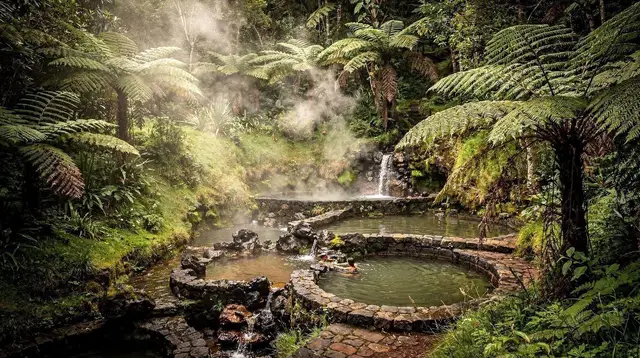
Most of what draws people underground or into the ground on São Miguel involves heat: the steaming caldeiras of Furnas, the thermal waterfall at Caldeira Velha, the hot spring meeting the sea at Ponta da Ferraria. The Gruta do Carvão is the exception, and it sits, almost by The hot spring at Ponta da Ferraria lies in the sea at the foot of a lava flow, safe for bathing only around low tide, so check tide times beforehand.
contrast, just outside the busiest town on the island. It is a lava tube — a long, mostly horizontal cave formed not by a crater collapsing but by a river of molten rock flowing, cooling on the outside, and hollowing out from within once the flow stopped. What’s left is a stone pipe: solid, dry-to-the-touch rock that has been cold for a very long time.
That distinction matters more than it might seem. Visitors arriving from Furnas or planning a day around Lagoa do Fogo sometimes expect every below-ground or crater-adjacent site on the island to behave the same way, with warm ground, sulphur in the air, or steam vents nearby. The Gruta do Carvão has none of that. It shares an island with active geothermal ground, but it is not part of that system.
If you want the fuller picture of how the two kinds of volcanic feature differ — why one is a collapsed, sometimes-active crater and the other a drained, permanently cold conduit — that comparison is covered on its own, in a dedicated explainer. This page stays with the cave itself: how it formed, what a visit looks like, and how it fits into time spent around Ponta Delgada.
Where the Gruta do Carvão Sits
The tube runs beneath the northern edge of Ponta Delgada, in the direction of Fajã de Cima, only a few kilometres from the harbourfront and the old town. That proximity is the site’s main practical advantage: it’s one of the few natural features on São Miguel you can reach without driving out toward Sete Cidades, Furnas, or the north coast. A taxi or a short drive covers it in minutes; a bicycle or a determined walk from the centre is workable too, though the last stretch climbs gently out of town.
Because it sits so close to the capital, the cave tends to get folded into city-based itineraries rather than treated as a standalone excursion. A morning built around the old town, the Portas da Cidade, and the marina can easily absorb an hour or so at the lava tube without reshaping the rest of the day.
How the Tube Formed
Lava tubes form during effusive eruptions, when runny basaltic lava flows downhill in a channel rather than exploding outward. The surface of that flow, exposed to air, cools and crusts over first, insulating the still-molten lava moving underneath. When the eruption feeding the flow stops or the lava drains onward and empties out, the crust is left standing as a roof, and the space where the molten rock used to be becomes the tube.
The Gruta do Carvão formed this way as part of a much older eruptive episode tied to the volcanic system beneath Ponta Delgada, long before the town existed. Nothing about the process it represents is unique to São Miguel — lava tubes exist wherever basaltic eruptions have flowed downhill and drained — but this one happens to sit within easy reach of an island capital, which is unusual. For a wider view of how this fits the island’s volcanic record more broadly, from the calderas at Sete Cidades and Furnas to the crater lake at Lagoa do Fogo, see the island-wide volcanic history overview.
What You’ll Actually See Inside
The tube is long, dark, and irregular rather than smooth — its walls and ceiling still carry the texture of flowing rock frozen mid-motion, with ropey folds in places and drips of once-molten stone that solidified as they fell. Sections vary in height; some stretches allow you to walk upright comfortably, others require ducking. A managed walkway and lighting cover the visitable portion, which is a fraction of the tube’s full length — much of the system continues beyond the public route and isn’t open to visitors.
Inside, the air is markedly cooler than outside and slightly humid, the way any enclosed cave tends to be, regardless of season. That’s worth repeating plainly: there is no warmth rising from below, no mineral smell of sulphur, nothing resembling the geothermal ground at Furnas. It is, simply, a cold cave.
| Feature | Gruta do Carvão | Furnas caldeiras |
|---|---|---|
| Type | Cooled lava tube | Active geothermal caldera |
| Ground temperature | Cold, stable | Hot, sometimes near boiling |
| What you notice | Cool, damp air, dark rock | Steam, sulphur smell, warm soil |
| Access | Short walkway, managed lighting | Open-air viewing around fenced vents |
| Location | Edge of Ponta Delgada | Furnas village, island interior |
If a guided visit to Furnas is also on your plan, it’s worth reading the caldera and fumaroles guide before you go, so the contrast between the two sites is clear going in rather than confusing on the day.
Visiting Practicalities
Opening hours at the Gruta do Carvão are limited compared with the island’s outdoor sights, and the site can close temporarily for maintenance or safety checks — lava tubes are natural structures, not built infrastructure, and access is managed accordingly. It’s sensible to check current hours in the days before you plan to go rather than assume it will be open on arrival.
Entry has historically been low-cost or free for the managed walkway section, and no swimming gear, hiking boots, or specialist equipment is required — this isn’t a caving expedition. What does help:
- Closed, flat shoes with grip. The floor is uneven volcanic rock, occasionally damp, and flip-flops or open sandals aren’t practical.
- A light layer. The temperature drop from outside to inside is noticeable even in summer.
- A phone light as backup. The managed route is lit, but a backup light is a reasonable habit in any cave.
- Realistic expectations on time. The visitable stretch is short — most visits run well under an hour, which is exactly what makes it easy to slot into a town-based day rather than needing one of its own.
The cave is not stroller-accessible, and the combination of low ceilings, uneven footing, and enclosed space makes it a genuinely difficult visit for anyone uncomfortable in confined spaces. It suits older children fine on a supervised walk, but it isn’t the kind of open, wander-freely site that toddlers manage easily.
What the Gruta do Carvão Is Not
Because it’s often mentioned in the same breath as São Miguel’s other underground and crater-adjacent sights, it’s worth being direct about what it isn’t. It is not connected to any still-active volcanic vent, and nothing about the site involves rising heat, thermal water, or mineral springs — those all belong to the caldera systems at Furnas, Lagoa do Fogo, and the hot spring at Ponta da Ferraria, each a genuinely different kind of geology.
It is also not a deep, technical caving system requiring ropes or crawling; the public section is a managed walkway. And it’s not the island’s only lava tube in a general sense — the Azores sit on volcanic ground throughout — but it is the one that happens to be walkable from a hotel room in central Ponta Delgada in under fifteen minutes by car.
Combining It With Ponta Delgada
Most visitors treat the Gruta do Carvão as one stop within a wider morning or afternoon around the capital, rather than a dedicated outing. A workable sequence: start in the old town among the Portas da Cidade and the Igreja Matriz, walk or drive out to the lava tube for under an hour, then return for lunch near the Mercado da Graça or the Portas do Mar waterfront.
Cruise passengers with a few free hours before reboarding sometimes fit the same loop in, since the cave sits closer to the port than most of the island’s other sights. If you’re planning that kind of shore day in detail, the cruise shore excursion guide lays out timing more specifically, and the car-free day in Ponta Delgada itinerary works well if you don’t want to rent a vehicle just to see the town and its edges.
The cave’s indoor, weather-proof nature also makes it a sensible fallback on a wet morning, when the island’s viewpoints and caldera walks lose most of their appeal under cloud and rain. If your trip lands in a stretch of unsettled weather, the rainy day alternative itinerary is built around exactly that kind of substitution.
A few tour operators bundle the lava tube with other short stops rather than selling it alone, which suits how brief a visit to the cave itself tends to be. One option covers the tube alongside the gardens and coastal scenery near Rabo de Peixe: a half-day tour pairing the Gruta do Carvão with the gardens and coast around Rabo de Peixe.
Another route pairs it with a botanical setting closer to town: a combined botanical gardens and cave tour. If you’d rather explore the town centre on your own schedule before or after the cave, a self-paced option is a self-guided Ponta Delgada city tour with an audio guide, which lets you build the lava tube into a walking loop at whatever pace suits you.
Nearby: Rabo de Peixe and Capelas
The Gruta do Carvão sits roughly between central Ponta Delgada and two working coastal towns worth knowing about if you’re already out this way. Rabo de Peixe is a fishing town with none of the polish of the capital’s waterfront — it’s a genuine working harbour, and some tours through the area, including the one already mentioned above, use its gardens and coastline as a stop alongside the cave.
Further along the coast toward the north, Capelas keeps the old whaling station that once anchored the island’s whaling industry before it ended in the 1980s; the Capelas whaling station guide covers that history in more depth if a coastal detour appeals after the cave.
If the Site Is Closed When You Visit
Because access to the Gruta do Carvão depends on site management rather than a fixed, guaranteed schedule, it’s worth having a fallback in mind rather than building an entire morning around it. The caves and lava tubes category on this site lists other underground features on São Miguel if the tube itself is unavailable, and the broader things to do in Ponta Delgada hub covers plenty within the same short radius of town — the old town streets, the Forte de São Brás, the Portas do Mar marina, and the Mercado da Graça among them. None of those require the cave to be open to make for a full, worthwhile few hours in and around the capital.
For a different kind of Ponta Delgada evening entirely, once the cave and the town’s daytime sights are covered, an option worth knowing about is an evening sailing tour out of Ponta Delgada’s marina, which trades cold volcanic rock for open water and, on a clear evening, a view of the town lights from the sea.
Gruta do Carvão: Practical Questions
Is the Gruta do Carvão hot inside?
No. It is a cooled, solidified lava tube, not an active volcanic feature. The air inside is cool and slightly humid year-round, similar to any cave, with none of the steam or warm ground found at Furnas.
How far is the Gruta do Carvão from central Ponta Delgada?
A few kilometres, on the town’s northern edge toward Fajã de Cima. It’s a short drive or taxi ride, and a manageable cycle or long walk if you don’t have a car.
Do I need to book in advance?
Independent visits are usually possible on the spot, but the site has limited opening hours and can close for maintenance or safety reasons, so checking ahead the same week you plan to go is worth it. A guided tour that includes it removes that uncertainty.
Is the lava tube suitable for children or claustrophobic visitors?
Older children generally manage the visit well on a supervised, guided walkway, but the tube is enclosed, dimly lit, and has low sections, which is difficult for anyone uncomfortable in confined spaces. It is not a stroller-friendly site.
What should I wear to visit?
Closed, flat shoes with grip, since the floor is uneven volcanic rock and can be damp. A light layer helps, as the tube stays noticeably cooler than the air outside.
Is the Gruta do Carvão the same kind of place as Furnas or Lagoa do Fogo?
No. Furnas and Lagoa do Fogo sit inside calderas — collapsed volcanic craters that are still geothermally active in places. The Gruta do Carvão is a lava tube: a drained volcanic pipe with no heat, no fumaroles, and no connection to either caldera system.
Can I combine it with other things to do in Ponta Delgada?
Yes. It’s close enough to the town centre to pair with a half-day covering the old town, the marina, and a short cave visit, without needing a full day set aside.
Caves & Lava Tubes on GetYourGuide
Verified deep-linked GetYourGuide tours. Book through these links and we earn a small commission at no cost to you.
GetYourGuide does not provide a product photo for this activity — the image shows the meeting point, photographed by us.