Capelas and Its Old Whaling Station
What is there to see at Capelas' old whaling station on São Miguel?
Capelas, on the north coast west of Ponta Delgada, kept a shore-whaling station until the practice ended across the Azores in the 1980s. Visitors today find the old factory buildings, slipway and lookout points along the harbour, plus a small village with a coastal walking path and sea views, rather than any working whaling activity.
A Fishing Village With a Whaling Past
Capelas sits on São Miguel’s north coast, a short drive west of Ponta Delgada on the road toward Mosteiros. It is a working fishing village first and a historic site second, which is part of why it rewards a slow half hour more than a rushed photo stop. For most of the twentieth century, Capelas was one of several shore stations around the Azores where boats went out after sperm whales, and where the catch was hauled in, processed and rendered down on land.
That trade ended everywhere in the archipelago in the 1980s, and it has not returned in any form, here or anywhere else on São Miguel. What is left in Capelas today is a layer of buildings, stone lookout points and local memory sitting quietly inside an otherwise ordinary coastal village.
This page stays with the village itself: what physically remains of the whaling station, how the settlement grew up around that industry, and what a visitor sees on the ground now. It does not go into how the old shore lookouts function within today’s whale-watching trips, which is a live, active subject covered fully in a dedicated guide to the vigias, nor does it walk through booking or joining a whale-watching boat, which belongs to the island-wide whale and dolphin watching guide.
Where the Old Factory Stood
The whaling station at Capelas was a shore-based operation, not a fleet of factory ships. Small open boats, rowed and later motorised, went out from the harbour when a sighting was called in from land. Once a whale was taken, it was towed back to the station, where it was hauled up a slipway and processed on site: the blubber rendered into oil in large iron cauldrons, other parts dried or otherwise put to use, and very little wasted. The buildings that supported this work were plain and functional rather than grand — storage sheds, the rendering house, workers’ quarters — built low and close to the water because everything about the trade depended on getting the animal out of the sea and processed quickly.
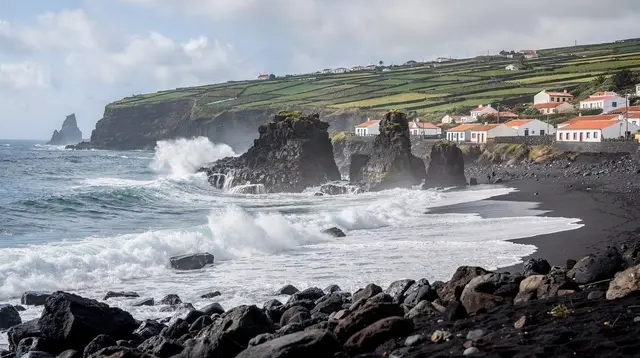
Walking the harbour area in Capelas today, some of that footprint is still legible: stretches of old stone walling, a slipway shape in the rock, and structures that have been repurposed for ordinary village use rather than preserved as a formal exhibit. There is no large interpretive centre here of the kind found at some whaling museums elsewhere in the Azores. What Capelas offers instead is the physical setting largely intact around a village that carried on living and working after the industry it was built on disappeared. That plainness is honest to the place: this was never a monument, it was infrastructure, and it has aged the way working infrastructure does when its original purpose ends.
From Harpoon to Lookout: Why Whaling Ended
Commercial whaling continued in the Azores well after it had stopped in most of the world, in part because the local method — small boats, hand harpoons, land-based lookouts — was labour-intensive and low-yield compared to industrial fleets, and in part because it remained economically marginal but locally embedded. It finally ended across the whole archipelago in the 1980s, a shift covered in more general terms on the blog post on why Azorean whaling ended when it did.
Capelas’ station closed along with the others on São Miguel and on the other islands; there was no later restart, no partial continuation, and nothing operating today resembles the historic trade in even a limited or ceremonial form. Any activity a visitor sees involving whales around Capelas or elsewhere on the island now is observation, not hunting.
What makes the closure interesting locally is less the date itself and more what the villages did with the skills and infrastructure they were left holding. Boats, harbour knowledge and, above all, the practice of watching the sea from fixed points on land did not simply vanish with the industry. Some of it was repurposed, over the following years, into the basis of a new activity built around the same animals for a different reason.
The Vigias: Watching Then and Now
Central to shore whaling everywhere in the Azores was the vigia, the lookout stationed on high ground with a clear view out to sea, watching for the telltale signs of a surfacing whale and signalling the boat crews below. Capelas, on its stretch of coast, was one of the villages where this watching tradition was practised as a matter of daily working life rather than an occasional skill. The lookout points used for this — stone structures placed for sightlines rather than shelter — are among the more visible physical traces still standing around the village today, and they are worth pausing at for the view alone, whale or no whale.
After 1980s, when the hunting stopped, the watching did not. Vigia knowledge — reading sea conditions, recognising a blow or a fluke at distance, understanding where whales are likely to pass and when — turned out to be exactly the skill set that whale-watching operators needed once boats began going out to observe rather than to catch.
Capelas’ place in that continuity, and how the vigia role works in practice for a whale-watching trip today, is a fuller story than this page has room for; it is told properly in the guide to vigias and whaling heritage and in the history of vigias specifically tied to Capelas. What matters here is simply that the lookout points you can walk to in the village are not incidental scenery: they are the physical link between the industry that built Capelas and the very different, non-hunting activity that now brings visitors to the same stretch of coast to watch, not to take.
Walking Through Capelas Today
Beyond the old station itself, Capelas is a small, working settlement with a parish church, a harbour still used by local fishing boats, and houses built in the plain, whitewashed style common along this side of the island. A coastal path runs along part of the shoreline, giving views back toward the village and out over open Atlantic water, and it connects into a longer stretch of walkable coast covered in the Capelas coastal trail guide for anyone who wants to extend the visit into a proper walk rather than a stop.
There is no admission fee to walk the village or the harbour area, no fixed opening hours to plan around, and no need to book anything in advance simply to see the site. That makes Capelas a low-friction addition to a north-coast drive: it asks for perhaps thirty to forty-five minutes, not a half day, and it rewards arriving with some background on what the buildings were rather than expecting signage to explain everything on site. A midweek morning, when the harbour is quiet and local boats are the only activity, gives the clearest sense of a place that has settled back into ordinary life after its industry ended.
Getting to Capelas
Capelas sits directly on the coastal road connecting Ponta Delgada with Mosteiros on the island’s western side, which makes it a natural stop rather than a detour for anyone driving that route. From central Ponta Delgada, the drive takes roughly fifteen to twenty minutes; from Ribeira Grande on the other side, allow a similar amount of time along the coast road. Rabo de Peixe, another fishing town with its own working-harbour character, lies a short distance further along the same coastline and pairs naturally with a Capelas stop.
As with most of São Miguel, there is no train and bus services run on local, school-and-work schedules rather than tourist timetables, so a rental car remains the practical way to reach Capelas on your own terms and combine it with other stops along the north coast in a single outing.
Tours and Ways to Learn the History Properly
For visitors who want the whaling history explained on the ground rather than pieced together from a guidebook page, a small number of tours run specifically along this stretch of coast. The cultural route through Capelas and neighbouring Fenais da Luz is built directly around this history, walking the whaling-era sites with local context that a self-guided visit cannot easily match.
Travellers covering more of the north coast in one outing, rather than Capelas alone, often combine it with Rabo de Peixe and Mosteiros; the wider north-coast expedition taking in all three villages is built for exactly that. And for visitors basing a longer island day around their own schedule and pace, a private jeep tour that can be routed through Capelas as part of a bespoke itinerary is a flexible alternative to a fixed-route group departure.
None of these are required to see Capelas — the village and its old station are open and free to walk at any time — but for a visitor whose main interest is the history itself, a guide who can point out what a given wall or slipway actually was adds a layer that plain sightseeing cannot.
Whale Watching From Here: A Different Subject
It is worth being clear about what Capelas is not, in present-day terms: it is not a whale-watching departure point covered on this page, and nothing about visiting the old station involves boats going out after whales today. Anyone planning an actual whale-watching trip on São Miguel — from choosing a season to understanding how sightings work — should use the island-wide whale and dolphin watching guide and the guide to the best time of year to go, which cover departures, timing and what a modern trip looks like in full.
Those planning a broader trip built around whales and the sea more generally may also find the whales-and-sea itinerary useful for structuring several days around the theme. Capelas’ role in that bigger picture is historical: it is where some of the watching tradition began, not where a present-day trip departs from.
Frequently Asked Questions About Capelas’ Whaling Station
Is whaling still practised at Capelas or anywhere in the Azores?
No. Whaling ended across the whole archipelago in the 1980s and has not resumed anywhere, including at Capelas. What remains are historic buildings and the memory of the trade, not an active industry.
What can I actually see of the old whaling station in Capelas?
The former factory buildings and slipway sit near the harbour, along with stone lookout points once used to spot whales offshore. Most structures are modest and unmarked rather than a formal museum, so the interest is in walking the site and reading it in context, not in ticketed exhibits.
How do the old whale lookouts connect to whale watching today?
The historic lookout points, and the shore-based spotting system behind them, gave rise to the vigias who now guide whale-watching boats from land. Capelas’ hillside was part of that network. The present-day role of vigias at sea is covered in a dedicated guide rather than here.
Is Capelas worth a stop if I am not especially interested in whaling history?
It suits travellers driving the north coast between Ponta Delgada and Ribeira Grande who want a short, low-key stop with sea views and a working fishing harbour, rather than a headline attraction. It is not a destination to build a full day around on its own.
How far is Capelas from Ponta Delgada and how do I get there?
Capelas is roughly 15 to 20 minutes by car from central Ponta Delgada, along the coastal road toward Mosteiros. There is no train on São Miguel and buses run on local timetables rather than sightseeing ones, so a rental car is the practical way to combine it with other north-coast stops.
Are there guided tours that cover Capelas’ whaling heritage specifically?
Yes, a small number of cultural-route tours link Capelas with nearby Fenais da Luz and explain the whaling past directly, which suits visitors who want context rather than to piece the site together unaided.
Can I combine Capelas with Rabo de Peixe or Mosteiros in one trip?
Yes. All three sit along the same stretch of north coast, and several half-day tours already link them, which is an efficient way to see this side of the island without doubling back.
City Sightseeing on GetYourGuide
Verified deep-linked GetYourGuide tours. Book through these links and we earn a small commission at no cost to you.
GetYourGuide does not provide a product photo for this activity — the image shows the meeting point, photographed by us.