Capelas Coastal Trail: Cliffs and an Old Whaling Station
What is the Capelas coastal trail like?
The Capelas coastal trail follows low cliffs along São Miguel's northwest shore, linking the village's harbour area to the remains of its former whaling station, closed since whaling ended in the Azores in the 1980s. It is a short, mostly easy walk built around sea views and industrial ruins rather than a summit or a forest. Boats that go out from nearby harbours today watch wild whales and dolphins with the help of vigias, the old shore lookouts turned spotters, and no sighting is ever guaranteed.
Capelas sits on São Miguel’s north-west shoulder, a working village that spent generations facing the Atlantic for a living it no longer has. The coastal trail here is not a wilderness walk or a crater-rim spectacle like the routes further east. It is a short, low, cliff-edge path that does something those trails cannot: it takes you past the physical remains of the whaling economy that shaped this coast for most of the twentieth century, and stops well short of pretending that economy still exists.
Walking Capelas’ coast: what the trail actually is
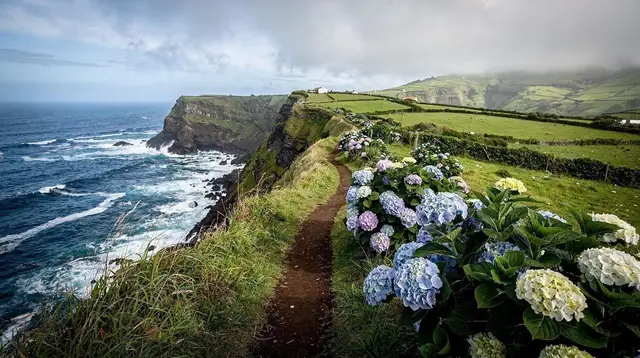
The route runs along low sea cliffs on the edge of Capelas, connecting the village’s harbour area to the old whaling station a short distance along the shore. It is not waymarked as one of the numbered PR trails that cover the island’s interior and eastern coast, and it does not need to be — the path mostly follows an obvious coastal line, with the sea on one side and pasture or low cliff scrub on the other.
Expect an out-and-back walk rather than a loop. Most people start near the village centre or the small harbour, follow the cliff path toward the whaling station ruins, spend time there, and either retrace their steps or continue further along the coast before turning back. There is no dramatic elevation change and no technical ground: this is a walk built around what you pass, not what you climb.
| Detail | What to expect |
|---|---|
| Distance | Roughly 4-6 km round trip, depending on how far you continue past the station |
| Duration | 1.5-2.5 hours at an easy pace, including stops |
| Difficulty | Easy — flat to gently undulating, unpaved and paved sections mixed |
| Terrain | Cliff-edge path, some open pasture, short unshaded stretches |
| Best footwear | Ordinary walking shoes; the ground can be uneven and damp after rain |
| Facilities | Limited — a café and shops in the village centre, nothing at the station itself |
The whaling station: what it was, and what it is now
Capelas was one of several points on São Miguel’s coast where sperm whales were hunted and processed, an industry that ran on the island well into the twentieth century and only stopped when whaling ended across the Azores in the 1980s. The station that survives here is a physical record of that period — slipway, processing buildings, rusted machinery — left largely as it was when the last whale was brought ashore.
It is worth being precise about what this site is, because it is easy to get wrong in either direction. It is not a museum with interpretive panels at every turn, and it is not a curiosity dressed up for visitors. It is also not, and this matters, a place where whaling still happens in any form. The buildings are heritage, not industry. Reading the machinery as evidence of a trade the island has closed the door on, rather than as something still ticking over somewhere out of sight, is the right way to look at it.
For the fuller history of the site and how it fits into the island’s whaling past more broadly, see the dedicated Capelas old whaling station guide and the wider whaling heritage and vigias explained.
From hunting whales to watching them: the vigias
The word that connects Capelas’ past to the present, on the water at least, is vigias. These were the shore-based lookouts who once scanned the sea from cliff posts for whale spouts, signalling to the boats below when to launch. That role did not disappear when whaling stopped — it changed jobs. The same skill at reading the sea for a whale’s presence is now used to guide whale watching boats to animals rather than to a hunt.
Capelas itself is one of the coastal points associated with this transition; the detailed account of how the role moved from hunting to spotting for tourism is covered in vigias: whale spotters’ history in Capelas. It is a genuinely useful distinction to hold onto while standing at the old station: the buildings in front of you are closed history, while somewhere along this same coastline a vigia may currently be on watch for a boat that is not hunting anything.
If you want to go from reading about this to booking a boat, the general island-wide primer on when and how whale watching works is at whale and dolphin watching on São Miguel, with season specifics at best time to go whale watching on São Miguel and a walk-through of what an actual outing looks like at whale watching boat trip: what to expect.
None of them, and this page included, will promise you a sighting — sea life does not take bookings, and no responsible operator claims otherwise. Trips can also be cut short or cancelled by sea conditions; see whale watching and weather cancellations explained before you build a single afternoon around one.
One operator active on this stretch of coast covers Capelas alongside the villages either side of it:
a coastal expedition through Rabo de Peixe, Mosteiros and Capelas gives a wider view of this shoreline than the walking trail alone, for anyone short on a full day to cover it on foot.
What you actually see along the way
Past the harbour, the path keeps close to the cliff edge for most of its length. The sea here is open Atlantic, with none of the shelter of a bay — expect spray on a breezy day and a fair amount of white water against dark volcanic rock even in calm weather. Pasture runs close to the cliff top in places, with the low stone walls and hedgerows typical of this side of the island; cattle are often visible a field or two inland.
The station itself, when you reach it, sits low against the shore rather than up on a headland — practical, since whales were hauled in and processed at sea level. The slipway is the clearest feature, running down into the water, with the outline of former storage and rendering buildings behind it. Little of it is roped off or explained on-site in detail, which is part of what makes it feel like a real place rather than an exhibit.
Beyond the station, the coast continues north-east with more of the same cliff-and-pasture character, past small coves and rock stacks. Walkers with more time sometimes extend toward the wider stretch covered in the Capelas coastal trail area more generally, or link the walk with a look at Capelas’ old whaling station as a single half-day out from Ponta Delgada.
Getting there and practical notes
Capelas lies on São Miguel’s north coast, a short drive from Ponta Delgada and closer still to Ribeira Grande. A rental car is the practical way to reach the trailhead, since there is no dedicated tourist shuttle serving this specific walk and island buses run on local timetables rather than sightseeing ones.
There is no fee to walk the trail or visit the whaling station grounds, and no ticket office to plan around. Parking is informal near the village centre and harbour; arrive with a full tank if you are continuing on to the north coast circuit afterwards, since fuel stations thin out away from the main towns.
Weather on this stretch of coast can change quickly, as it does across the island, and it is worth checking conditions rather than assuming a calm morning will hold — see the general note on is São Miguel safe: wildlife and hazards for what the real risks here are (sea and cliff edges, not animals). There is no shade for most of the route, so sun protection matters even on a cloudy-looking day, and a light rain layer is worth carrying regardless of forecast.
For walkers who want a coastal outing with a bit more built-in structure, the Praia de Santa Bárbara coastal walk a little further along the north coast is a comparable easy route, and the Ribeira Grande and Caldeira Velha day trip pairs neatly with a Capelas stop for anyone building a fuller north-coast day. The broader category page for hiking trails on São Miguel lists routes across the rest of the island for comparison.
What this walk is not
It is worth saying plainly what this page does not cover. Mosteiros and Ponta da Ferraria, with their black-sand beach, sea stacks and sea-level hot spring, sit further south along the west coast and are their own outing — see the Mosteiros and Ponta da Ferraria day trip for that route. Capelas’ trail is also not a whale watching experience by itself: it can give you a cliff-top view of the same ocean the boats work, but the reliable way to see a whale or dolphin is on the water, with a vigia’s eyes doing the work, not from this path.
And it is not a working industrial site. The whaling station’s machinery is silent, and has been since whaling ended in the Azores in the 1980s — the background on how and why that happened, island-wide, sits in whaling heritage and vigias explained and the shorter note on whaling ended in the 1980s in the Azores.
If a boat trip is part of your plan for this coast, pair the walk with the honest expectation set out in whale watching is never guaranteed: the vigias — a good operator, a clear day and a skilled spotter improve the odds, but nothing on this coast comes with a promise attached.
Capelas coastal trail: common questions
Is the whaling station at Capelas still in use?
No. It stopped operating when whaling ended across the Azores in the 1980s. What remains today is a preserved industrial site — old machinery, slipway and buildings — that tells the story of an economy the island no longer runs, not a working facility.
How long is the Capelas coastal trail?
Most walkers cover the harbour-to-whaling-station stretch and back in under two hours, generally in the 4 to 6 km range depending on how far along the cliffs you continue. It is a route you can shorten or extend rather than a fixed circuit.
Can I see whales from the Capelas coastal trail?
Occasionally, from the cliffs, but this is a walking route, not a whale watching platform. Reliable sightings come from boat trips guided by vigias out of São Miguel’s harbours, and even those never promise an animal will appear.
Is the trail suitable for families or first-time walkers?
Yes, for the main stretch. The path along the old whaling station is short, low-gradient and unshaded, with a few sections close to unfenced cliff edges that need supervision with children. It does not require hiking experience or technical gear.
Does this guide cover Mosteiros and Ponta da Ferraria?
No. Those sit further south along the west coast and are covered separately; see the Mosteiros and Ponta da Ferraria day trip guide. This page stays with Capelas and its immediate coastline.
When is the best time to walk the Capelas coastal trail?
Any time of year, since there is no indoor stop to rely on and no thermal pool to reach. Mornings tend to have calmer light and fewer clouds rolling off the Atlantic; the trail can be walked in the wetter months with a rain layer, since it stays open in weather that closes higher trails.
How do I get to Capelas from Ponta Delgada?
Capelas is a short drive along the north coast road, generally under 30 minutes from Ponta Delgada by car. There is no dedicated tourist shuttle for this trail, which is why a rental car is the practical way to reach the trailhead. For a wider look at the coastline in one outing rather than on foot, a traditional boat sunset tour or a private jeep 4x4 tour along the north coast are both ways to cover more ground than the walk alone allows.
Hiking Trails on GetYourGuide
Verified deep-linked GetYourGuide tours. Book through these links and we earn a small commission at no cost to you.
GetYourGuide does not provide a product photo for this activity — the image shows the meeting point, photographed by us.