Ribeira Grande and Caldeira Velha: A North Coast Day Trip
How do you combine Ribeira Grande and Caldeira Velha in one day?
Base yourself in Ribeira Grande in the morning to see the town centre, then drive about nine minutes up into the Água de Pau massif to Caldeira Velha for the thermal waterfall and pools, which have no café or ticket booth, only changing huts and a small paid entrance. Most visitors spend two to three hours at Caldeira Velha; arrive early or late to miss the tour-bus window.
Two Towns, One Coast Road
The north coast of São Miguel does not need a full itinerary to make sense — it needs a morning in a town and an afternoon on a volcano’s flank. Ribeira Grande is the island’s second-largest town, a working place of churches, a river mouth and daily errands rather than a resort strip, and it sits a short drive from one of the most direct volcanic experiences on São Miguel: Caldeira Velha, a hot waterfall and a chain of natural pools cut into the forest on the lower slope of the Água de Pau massif.
The two places are close enough in distance that pairing them into one day trip is mostly a question of timing, not logistics — but they are different enough in character that treating Caldeira Velha as an extension of the town, or worse, as a landscaped resort pool, misses what actually makes it worth the detour.
This guide covers exactly that pairing: what to do with a few hours in Ribeira Grande, how to get up to Caldeira Velha, and what to expect once you’re there. It does not cover the tea plantations further along this same coast, which have their own separate day — see the Gorreana day trip guide for that — and it treats Caldeira Velha here as one stop on a two-part day, not as an isolated walking route; for the short-walk version on its own, the Caldeira Velha walk guide covers that separately.
Ribeira Grande: The Island’s Second Town
Ribeira Grande takes its name from the river that splits it, and the historic centre still reads as a proper town rather than a village built for visitors. The core is walkable in an hour or so: a grid of streets around the parish church, a set of cobbled squares, black-and-white Azorean paving, and balconied townhouses that date to the town’s centuries as a centre for sugar and, later, dairy trade.
It is a working municipality of roughly the same rank as Ponta Delgada in the island’s history, and it still has the infrastructure of a real town — banks, a market, cafés that serve locals as much as travellers — rather than a curated main street. For a slower, dedicated pass through the centre with more historic detail than fits here, the Ribeira Grande town guide is the deeper reference.
The coastline itself is part of the appeal. A short walk or drive from the centre brings you to black volcanic rock, tidal pools, and — further along the same stretch of coast toward Praia de Santa Bárbara — one of the island’s main surf beaches, though surfing itself is not the point of this particular day trip. What matters for a day built around Caldeira Velha is simpler: Ribeira Grande gives you a morning of town, food and a proper coffee before you head uphill into forest and steam.
Do not expect Ribeira Grande to feel staged for tourism. Shops close for lunch, some close early, and almost everything shuts on Sundays — normal small-town Azorean rhythm, not a defect. Plan your morning walk and your lunch stop with that in mind rather than assuming late opening hours.
From the Town Centre to the Crater’s Edge
The drive from Ribeira Grande’s centre up to Caldeira Velha takes roughly nine minutes by car, climbing steadily from sea level into the forested lower slope of the Água de Pau volcano. The road is a single carriageway that narrows as it rises, with switchbacks through eucalyptus and cryptomeria plantation before opening onto the car park at the reserve entrance. There is no bus service that makes this connection on a useful schedule, and no ride-share network to speak of on this side of the island, which is one of the reasons a rental car remains the practical default for this pairing — see the general driving on São Miguel guide if you haven’t arranged one yet.
If you’d rather not drive the loop yourself, a guided route through the forest above Ribeira Grande folds the walk into the destination instead of treating it as a transfer. The guided hike from the Janela do Inferno viewpoint down to Caldeira Velha covers this exact stretch of the massif on foot, with a guide explaining the terrain rather than leaving you to read trail markers alone.
For a shorter, steeper alternative that starts closer to town, a private hike to the Salto do Cabrito waterfall from Ribeira Grande covers a different cascade on the same flank of the mountain, for those who want more walking and less soaking.
Parking at Caldeira Velha itself is limited and fills by mid-morning in July and August. Arriving before ten, or after four in the afternoon, is the single easiest way to avoid both the parking squeeze and the coach-tour crowd that passes through at midday.
Caldeira Velha: What’s Actually There
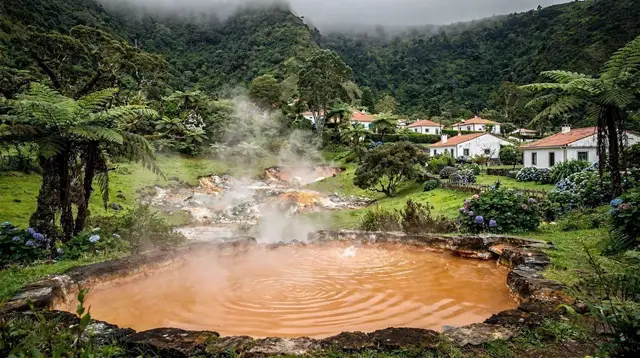
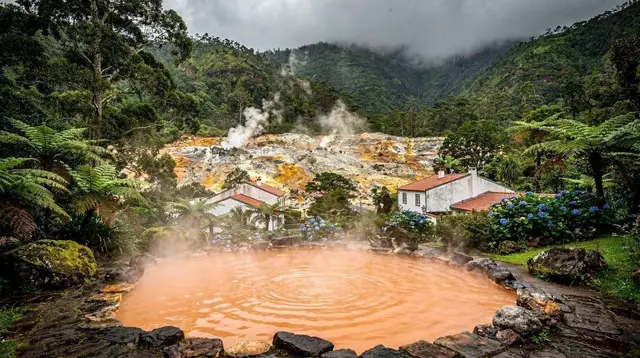
Caldeira Velha is not a resort. There is no café, no restaurant, no gift shop and no reception desk — only a ticket booth at the entrance, basic changing huts, and a network of wooden walkways threading through tree ferns and laurel to the pools themselves. The water arrives already hot, fed by a spring on the volcano’s flank, and gathers into a series of natural stone basins before spilling over a low waterfall that gives the site its photograph. A short walkway leads further up to a second, smaller and hotter pool directly under the falling water, which is the part most visitors come to stand under.
The water is naturally iron-rich, which tints both the rock and, over a few hours, your swimwear — treat an old suit as part of the packing list, not an afterthought. Temperatures sit broadly in the mid-30s Celsius, warmer than the sea and noticeably warmer than the reserve’s cool forest air, which is part of what makes the contrast worth the detour in the first place. A fuller walk-through of the pools, the walkways and what changes by season is in the dedicated Caldeira Velha thermal waterfall guide; this page keeps to how the site fits into a day built around Ribeira Grande.
Entry is paid and modest, cash or card at the gate, and there is no need to book it as a fixed time slot — you simply turn up, pay, and change. What you cannot do is treat it as unsupervised free-for-all: paths off the marked walkways lead toward genuinely hot ground, and the reserve closes the site outright after heavy rain when the paths turn to mud or the access road is at risk.
The Volcano Under Your Feet
It is easy, standing in a warm pool under tree ferns, to forget that the ground producing that heat is doing so because the volcano beneath it is active, not dormant. São Miguel sits on a chain of volcanic centres running the length of the island, and the Água de Pau massif above Ribeira Grande and Caldeira Velha is one of them — the same system, at its summit, holds the crater lake at Lagoa do Fogo. Caldeira Velha is a spring on its lower slope; the caldeiras of Furnas, on the other side of the island, are surface vents where water genuinely boils.
Neither is a metaphor. For the mechanics of how a caldera, a crater lake and a lava tube differ from each other — useful vocabulary before a day spent moving between volcanic sites — the caldeiras versus lava tubes explainer lays it out plainly, and the island-wide volcanic history overview covers how these systems formed the island’s shape over geological time.
The practical takeaway for a Caldeira Velha visit is narrower: stay on the walkways, keep to the pools that are marked for entry, and don’t assume that because one pool is a pleasant bathing temperature, the ground ten metres off the path is safe to stand on. It generally is not.
Timing It Right
| Time slot | What it looks like at Caldeira Velha |
|---|---|
| Before 10:00 | Quiet, cool morning air, easiest parking, water still warming from overnight |
| 10:30–15:00 | Coach groups pass through; pools and car park at their busiest |
| After 16:00 | Crowds thin, softer light for photos, some shorter operating hours in winter |
| Heavy rain | Site may close outright; check before driving up from Ribeira Grande |
A realistic half-day plan starts with breakfast and a walk through Ribeira Grande’s centre in the morning, a light lunch in town before the site gets busy, then the short drive up to Caldeira Velha for the early-afternoon lull, or a late-afternoon session after the coach traffic clears.
Travellers who prefer more structure than a self-drive loop can fold both stops into a single guided outing: a broader full-day trip pairing Lagoa do Fogo with Fenais da Luz covers more of the massif in one go, while the site’s own operators run shorter combinations — for a faster, engine-powered version of the coast-to-crater terrain, the buggy tour that runs out of Ribeira Grande toward Sete Cidades covers a different but overlapping stretch of the island’s volcanic interior.
What to Bring, What to Skip
Pack for a change of temperature and a change of surface underfoot: swimwear you’re willing to stain, a towel that can get muddy, sandals or reef shoes for slippery rock, and a change of dry clothes for the drive back down. Skip anything you’d mind losing to iron-tinted water — that means light-coloured swimwear and any jewellery you’re not prepared to have discolour. The full packing logic for the island’s thermal sites, including why the staining happens and how to manage it, is covered in the iron-rich thermal water packing guide.
There is no food service at Caldeira Velha itself, so eat in Ribeira Grande beforehand or bring something with you; the reserve’s category page for the island’s hot springs and thermal sites is a useful comparison point if you’re weighing Caldeira Velha against the island’s other thermal stops before committing a full day to this one.
Where This Day Fits in a Longer Stay
For travellers building a longer itinerary, Ribeira Grande and Caldeira Velha work well as a lighter, half-day counterweight to bigger days elsewhere on the island — a Sete Cidades caldera day, a full day at Furnas, or a longer hike up toward Lagoa do Fogo’s crater rim. If you have the appetite for more walking on the same massif, a proper hiking route up toward the crater lake is covered separately in the Lagoa do Fogo hiking trail guide, though that is a harder, longer outing than anything described here and deserves its own day rather than being tacked onto this one.
Travellers with a private driver or guide for the day, rather than a self-drive plan, might instead fold both stops into a broader north-coast circuit; a private jeep tour covering the north coast and the island’s volcanic interior is one way to do that without worrying about parking or road conditions yourself, and it leaves the choice of pace to the day rather than to a fixed itinerary.
Whichever way you arrange it, the core of this particular day trip stays the same: a town built for people who live there, and a volcano that happens to produce a warm place to sit in the middle of a forest.
Planning Your Ribeira Grande and Caldeira Velha Day Trip: FAQ
Is Caldeira Velha a swimming pool?
No. It is a volcanic hot spring feeding a waterfall and a series of natural rock pools on a forested slope. There is no lifeguard, no pool tiling and no temperature control — the water arrives already hot from underground, and the site is managed as a nature reserve with a paid entrance, not run as a spa.
How long does the Ribeira Grande and Caldeira Velha day trip take?
Plan half a day: an hour or two walking Ribeira Grande’s centre and having lunch, a nine-minute drive up into the massif, and two to three hours at Caldeira Velha once you count changing, soaking in the pools, and the short walkway up to the hotter upper pool under the falls.
Do I need to book Caldeira Velha in advance?
You do not need to book the site itself — it’s a walk-up nature reserve with a paid entrance at the gate, not a spa with timed sittings. If you’d rather join a guided hike that includes it, such as a route down from the Janela do Inferno viewpoint, booking ahead in July and August is worth doing, since guided groups fill faster than the site itself does.
Is Caldeira Velha open in winter or when it rains?
Yes, it stays open through the wetter months, and the spring water itself stays warm regardless of the season or the weather above ground. What changes is footing and access: the wooden walkways and the access road can turn slippery, and the reserve will close outright, temporarily, after heavy rain if there’s a landslide risk on the approach road.
Can I combine this day trip with Lagoa do Fogo?
Only if you start early and are honest with yourself about the length of the day. The crater lake sits higher on the same Água de Pau massif but is reached by a separate access road, one that’s frequently closed by fog or cloud regardless of what the coast is doing. Most visitors keep Ribeira Grande and Caldeira Velha as one outing and Lagoa do Fogo as a separate day.
Is the water at Caldeira Velha safe, and is it really volcanic?
Yes to both. The heat is geothermal, produced by magma close to the surface rather than any mechanical heating, and the water carries natural minerals rather than chlorine. It’s safe to enter within the marked pools and walkways, but the surrounding ground is not uniformly safe — some patches nearby are genuinely too hot to touch, which is exactly why the site keeps visitors on defined paths.
What should I bring to Caldeira Velha?
An old swimsuit you’re prepared to see stained by the iron-rich water, a towel, sandals or reef shoes for wet rock, a dry change of clothes for afterward, and cash or a card for the entrance fee. There’s nowhere on site to buy food, drink or forgotten gear, so come prepared from Ribeira Grande.
Is Ribeira Grande worth visiting on its own?
Yes. It’s the island’s second-largest town, with a real historic centre, a river mouth, its own stretch of black-rock coastline and the working rhythm of an Azorean town rather than a resort strip. Travellers who skip the thermal waterfall entirely still find a morning’s worth of streets, churches and cafés worth the stop.
Hot Springs on GetYourGuide
Verified deep-linked GetYourGuide tours. Book through these links and we earn a small commission at no cost to you.
GetYourGuide does not provide a product photo for this activity — the image shows the meeting point, photographed by us.