Two Places, One Name
Say “Água de Pau” to someone who knows São Miguel and you will usually need to follow up with a second question: the village, or the mountain? Both carry the same name, and both sit on the same stretch of the island, but they are not close to each other and they are not the same kind of place. Getting this straight before you plan around either one will save a confused afternoon.
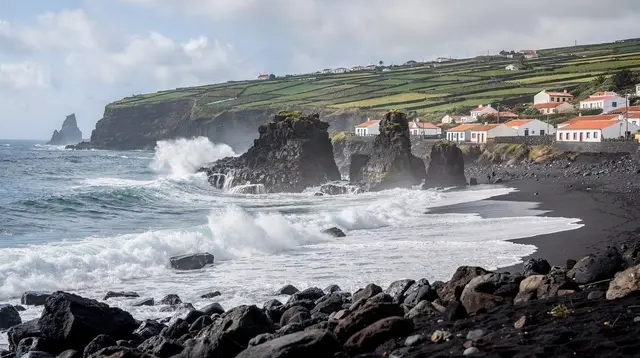
The village of Água de Pau is a small, working parish on the south coast, strung along the EN1-1A between Lagoa and Caloura, a short hop from Ponta Delgada. It has a harbour, a parish church, pasture running down almost to the cliff edge, and very little in the way of organised sightseeing. Nobody plans a whole day around it; most visitors pass through, or stop for twenty minutes, on the way to somewhere else on the south coast.
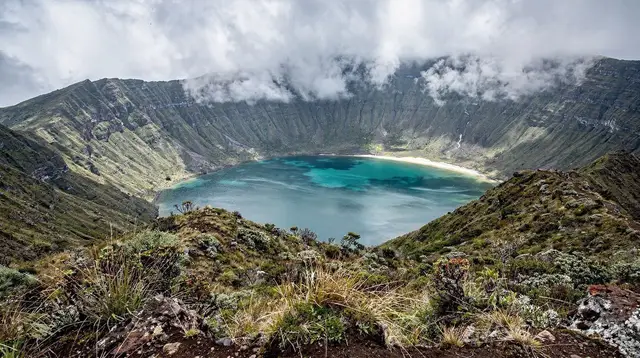
The Água de Pau massif is a different matter entirely. It is the volcanic complex that rises inland and to the north of the village, climbing steadily until it reaches Lagoa do Fogo, the crater lake at the island’s centre, and the thermal waterfall of Caldeira Velha on its northern slope.
The massif takes the village’s name because the parish’s old lands once ran up into those hills, but geographically the two are separated by several hundred metres of altitude and a genuinely different landscape — pasture and low stone walls down by the sea, cloud forest and bare crater rim higher up. This page is about the village. Where the massif matters to your plans, it says so plainly, and points you to the pages that cover it properly.
Getting There and Getting Around
There is no bus schedule built around Água de Pau and no reason to wait for one. A rental car is the practical way to see it, as it is for almost everywhere on São Miguel outside the main towns. From Ponta Delgada, the drive along the EN1-1A takes 20 to 25 minutes, passing through or skirting Lagoa on the way. From Vila Franca do Campo in the other direction it is a similarly short run, well under half an hour.
The village itself is walkable in well under an hour — a handful of streets running down to the small harbour, with the parish church as the obvious landmark. There is roadside parking near the centre; it fills up on weekends when locals come down to the harbour, but rarely enough to be a real problem. If you are continuing up into the massif toward Lagoa do Fogo, note that the access road climbs fast, narrows, and is sometimes closed in poor weather — check conditions before committing to that leg, and do not treat the two halves of a visit (village, then mountain) as one continuous 20-minute errand. Budget the drive up separately.
| Route | Approx. time | Notes |
|---|---|---|
| Ponta Delgada → Água de Pau (village) | 20-25 min | EN1-1A, via or past Lagoa |
| Água de Pau (village) → Lagoa do Fogo access road | 25-35 min | Climbs steeply; road can close in fog or wind |
| Água de Pau (village) → Vila Franca do Campo | 15-20 min | EN1-1A continues east along the coast |
| Água de Pau (village) → Caloura | 10-15 min | Short coastal detour off the main road |
What There Is to See in the Village
Água de Pau does not put on a show, and that is more or less the point of stopping there. The parish church sits above the main street, a plain whitewashed building typical of the island’s smaller towns rather than a landmark in its own right. Below it, streets drop toward a modest harbour where a handful of fishing boats still work — smaller and quieter than the harbours at Caloura or Vila Franca do Campo, with none of the tour-boat traffic either of those two sees in season.
What the village offers is texture rather than sights: stone-walled lanes, small gardens, cattle grazing on plots that run right up to the cliff edge, and sea views along the coast toward Caloura in one direction and Vila Franca do Campo and its islet in the other. A short walk or a slow drive along the coastal lane gives a clear sense of how the south coast actually lives — fishing and dairy farming side by side, with tourism a much smaller part of the picture here than it is in Ponta Delgada or Furnas. If you are trying to get a feel for the island beyond its named attractions, twenty unhurried minutes in Água de Pau does more for that than a longer stop at a busier spot.
There is no ticketed attraction in the village and nothing that requires booking ahead. Cafés and small shops keep local hours, meaning they can close early and are often shut on Sundays — plan a coffee stop for late morning rather than assuming something will be open.
The Massif Above: Where It Actually Leads
The Água de Pau massif deserves a paragraph here because its name causes the confusion, but it does not deserve a detour from this page, because it is thoroughly covered elsewhere. The short version: this is the volcanic complex whose slopes hold Lagoa do Fogo, the reserve crater lake with no facilities at all, often wrapped in cloud, and on its northern face Caldeira Velha, a thermal waterfall and bathing pool that is one of the most visited spots on the island. Both sit far closer, in practice, to Ribeira Grande on the north coast than to the village of Água de Pau on the south.
If a thermal waterfall or a crater-lake viewpoint is what brought you to this page, you want the massif, and the two guides that cover it in full: the Caldeira Velha thermal waterfall guide for the pools and the short walk around them, and the Lagoa do Fogo crater lake guide for the viewpoints, the access road, and what to expect from the weather up there.
Anyone planning to walk rather than drive up should also read the Lagoa do Fogo hiking trail guide before setting out, since the route and the road are not the same thing and the reserve has no facilities of any kind — no café, no toilets, no ticket office — at the top.
For a half-day tour that takes in the crater lake without you having to plan the drive and the timing yourself, a guided half-day trip up to Lagoa do Fogo covers the massif directly, leaving the village of Água de Pau as what it actually is on the ground: a pleasant stop on the coast road, not a base for reaching the lake.
Life on the South Coast: Água de Pau Alongside Lagoa and Caloura
Água de Pau’s real place on an itinerary is as one stop among several along a short, dense stretch of the south coast. Lagoa, just west along the EN1-1A, is the larger municipal seat and has more in the way of shops and services. Caloura, a short detour east, has the coast’s best-known small harbour and its swimming and snorkelling spots in the rocks below the marina. Água de Pau sits between the two, smaller and quieter than either, which is exactly why it is worth the short stop rather than a drive-through: it is the gap where the coast road slows down.
Travellers who like to be on or near the water find plenty to do without leaving this stretch. Sea kayaking along this section of coast, launched from Vila Franca do Campo or Caloura, is covered in the south coast sea kayaking guide, and the calm inlet at Caloura itself is detailed in the Caloura snorkelling and swimming guide — both good half-day plans that treat Água de Pau as a scenic waypoint rather than a separate stop.
If you are staying anywhere on this coast for more than a night, it is worth reading how Vila Franca do Campo, once the island’s capital, lost that role to Ponta Delgada after the 1522 landslide — the whole south coast’s history runs through that one event, Água de Pau included.
For visitors touring by car with limited time, the honest advice is not to build a separate day around this village. It works best folded into a longer south coast loop — Lagoa, Água de Pau, Caloura, Vila Franca do Campo — or as a short break on the drive between Ponta Delgada and the east of the island. A classic three-day itinerary that already includes Vila Franca do Campo can absorb a stop here without adding real driving time, since the village sits directly on the route.
Those who would rather not plan the coastal stops themselves can pair a look at Vila Franca do Campo’s islet and harbour with a wider south coast circuit: a half-day tour of Vila Franca do Campo typically runs along this same coast road and gives a guided frame to villages, like Água de Pau, that have no ticketed sight of their own to anchor a stop around.
Farmland, Not a Showpiece
It is worth saying plainly what Água de Pau is not, because the island’s marketing rarely bothers to. It is not a wilderness and it is not a preserved historic centre; it is a working parish of small dairy farms and a fishing harbour, part of an island that is farmed and inhabited from the coast to well up its hillsides.
Cattle graze on narrow plots right along the coastal lane, and the pasture pattern here — small green fields, hedgerows, stone walls — is the same one that gives São Miguel its nickname, the Ilha Verde, the green island. If you come expecting a manicured attraction, you will be looking at the wrong thing; if you come to see how the island actually works away from its named sights, this short stretch of coast does the job well.
Whales and the Sea Off the South Coast
The waters off this stretch of the south coast are part of the same whale-watching grounds worked from Vila Franca do Campo, Ponta Delgada and Caloura’s marina. Sperm whales and dolphins are resident here year-round, and blue, fin and sei whales pass on their spring migration roughly between March and June, spotted with the help of vigias, the shore lookouts left over from the whaling era, which ended in the Azores in the 1980s. Sightings are the norm rather than the exception on these trips, but no responsible operator — and no page on this site — promises one, since these are wild animals, not a show.
A boat trip that combines whale watching with time on the water and lunch on board is a comfortable way to see this coastline from the sea rather than the road: a whale watching trip with lunch and water activities departs from ports along this same coast and gives a different, and often better, view of the cliffs below Água de Pau than the road above them does.
If You Want to Go Further Inland
Travellers who want more than a passing look at the hills behind this stretch of coast, without necessarily separating a village stop from a mountain excursion, have off-road options that link the two. A 4x4 route through Vila Franca do Campo with views over the Furnas crater lake climbs through terrain not far from the upper reaches of the Água de Pau massif: a 4x4 adventure overlooking Furnas Lake is a way to see the island’s volcanic interior from this side of the island without driving the access road to Lagoa do Fogo yourself.
For a more flexible, private version of the same idea, a private jeep tour can be routed to take in the massif’s viewpoints on a schedule built around a south coast base.
When to Visit
There is no season in which the village of Água de Pau closes down, since it has no seasonal attraction to close. June to September brings the driest, warmest weather to the whole south coast, calmer seas for anyone continuing on to Caloura or Vila Franca do Campo for swimming, and the best conditions for the massif above if a trip up to Lagoa do Fogo or Caldeira Velha is part of the plan.
April to June and September to October trade a little reliability for lower prices and a greener landscape, and this is also the stronger half of the whale-watching season. November to March is mild but wet and windy, and the access road to the massif is more likely to be closed on any given day — the village itself stays entirely open, but a combined village-and-mountain day becomes less certain.
| Season | South coast weather | Massif access (Lagoa do Fogo road) |
|---|---|---|
| June - September | Warm, dry, best for swimming nearby | Usually open, best viewing conditions |
| April - June, September - October | Mild, greener, fewer crowds | Open most days, some cloud |
| November - March | Wet, windy, mild | Frequently closed or fogbound |
Practical Notes
Água de Pau has no hotels of note and is not really a base — most visitors stay in Ponta Delgada, Lagoa, or Vila Franca do Campo and treat this village as a stop, not a destination in itself. There is no ATM guaranteed to be working and no large supermarket; fuel up and handle cash before leaving the bigger towns if you are continuing on to less-served parts of the island. Mobile signal is generally reliable along the coast road but can weaken on the climb up toward the massif. As everywhere on São Miguel, tap water is safe to drink, the emergency number is 112, and Portuguese is the working language, though English is understood in anything tourism-related along this coast.
Água de Pau: Questions Visitors Ask
Is Água de Pau the village or the volcano?
Both names are used, for two different places. Água de Pau is a small parish on São Miguel’s south coast, near Lagoa and Caloura. The Água de Pau massif is the volcanic complex further north and at higher altitude, reaching up to Lagoa do Fogo and Caldeira Velha. This page covers the village; the massif’s attractions have their own guides.
How much time should I spend in Água de Pau village?
A few hours at most, or less if you are simply passing through. Most visitors fold it into a longer south coast route with Lagoa and Caloura, or a stop on the way to or from Vila Franca do Campo, rather than treating it as a standalone destination.
Can I walk from Água de Pau village up to Lagoa do Fogo?
Not as a short stroll. The crater lake sits well above and inland from the village, and the access road climbs steeply. If you want to walk the massif, the dedicated hiking trail guide covers the route properly — treat it as a separate excursion from a village visit, not an extension of one.
Is there anywhere to eat in Água de Pau?
There are small local cafés and eateries serving the village and surrounding farms, but hours are limited and Sunday closures are common. It is not a destination for a planned restaurant meal the way Furnas or Ponta Delgada are; most visitors eat in Lagoa, Ponta Delgada, or Vila Franca do Campo.
Do I need a car to visit Água de Pau?
Effectively, yes. There is no meaningful bus service built around the village, and its main appeal — the coastal lane, the harbour, the drive along this stretch of the south coast — depends on having your own transport and your own pace.
Is Água de Pau worth stopping at if I only have a few days on São Miguel?
Only as part of a wider south coast loop, not on its own. With limited time, prioritise Lagoa do Fogo, Caldeira Velha, Vila Franca do Campo and Caloura first; Água de Pau village is a pleasant, low-effort addition to that route rather than a must-see in its own right.
What is the difference between Água de Pau and the Água de Pau massif in terms of altitude and landscape?
The village sits at sea level on the coast, with pasture and stone walls running down to the cliffs. The massif rises well inland, climbing to the crater rim around Lagoa do Fogo and to Caldeira Velha’s thermal pools on its northern slope — a landscape of cloud forest and bare volcanic ground, several hundred metres higher and a genuinely different climate on any given day.