Vila Franca do Campo: São Miguel's Former Capital
Why is Vila Franca do Campo no longer the capital of São Miguel?
Vila Franca do Campo was the capital of São Miguel until 1522, when an earthquake-triggered landslide destroyed much of the town. Ponta Delgada took over as the island's administrative centre afterwards, a change forced by disaster rather than planned by any authority. Vila Franca remains a working town on the south coast, not a ruin or a museum piece.
A Capital That Isn’t There Anymore
Every visitor to São Miguel arrives in Ponta Delgada, the island’s obvious capital: the airport, the cruise berths, the largest population, the government offices. Few arrive knowing that Ponta Delgada is not the island’s original capital at all. For roughly two centuries after Portuguese settlers reached São Miguel, that role belonged to Vila Franca do Campo, a town on the south coast now known mainly as the departure point for boat trips to the crater islet offshore. It stopped being the capital in a single year, for a single reason, and the reason was not politics. It was the ground itself giving way.
This page is about that town and that year — not about the islet across the bay, which has a guide of its own. It is about why a place that once ran the whole island now shows up on itineraries as a stop between Ponta Delgada and Furnas, and why that demotion has nothing to do with decline, neglect, or being overtaken by a rival. It has to do with a single catastrophic event in 1522, and what happened administratively in its wake.
A Town Built for a Capital
Vila Franca do Campo was founded early in the settlement of São Miguel, on a stretch of the south coast with a natural harbour, fertile land rising behind it, and a sheltered bay guarded by a crater islet just offshore. Those were the ingredients that made a Portuguese Atlantic settlement viable in the fifteenth century, and Vila Franca had all of them before Ponta Delgada had developed into anything comparable. It became the administrative seat of the island: the place where authority sat, where the town’s institutions were built, where the population concentrated.
Ponta Delgada existed in this period too, and it was growing — its own harbour, further west, would eventually prove more useful for the shipping routes that came to matter as trade expanded. But through the first decades of settlement, Vila Franca was the senior town. If you had asked a resident of São Miguel in the year 1500 which town ran the island, the answer would have been Vila Franca do Campo, without hesitation.
The Night the Ground Gave Way
In 1522, an earthquake struck the island and triggered a landslide on the unstable volcanic slope directly above Vila Franca do Campo. The debris came down onto the built-up area near the shore, destroying a large part of the town and killing a substantial number of its residents. This is not a story that has been softened or embellished with retelling — it is a documented historical event with a fixed date, recorded in contemporary accounts and corroborated by later study of the terrain above the town. Treat it as fact, not folklore: São Miguel sits on active volcanic ground, steep slopes above coastal settlements are a known hazard across the island to this day, and in 1522 that hazard turned lethal for the island’s own capital.
The disaster did more than kill people and flatten buildings. It broke the town’s ability to function as an administrative centre. Government buildings, records, and the concentration of population and infrastructure that a capital needs were gone or badly damaged, in a period with none of the resources modern disaster recovery would bring to bear. Vila Franca could be rebuilt as a town — and it was — but it could not simply resume its old role at the flip of a switch.
From Ruins to Runner-Up: How Ponta Delgada Took Over
What happened next is the part of the story that turns this from a local tragedy into a fact that shapes the island today: Ponta Delgada absorbed the administrative role that Vila Franca could no longer carry out. This was not the result of a competition Ponta Delgada won, a decree issued after deliberation, or a plan drawn up to relocate the capital. It was a choice made by circumstance. Ponta Delgada already had a functioning harbour, a growing population, and intact infrastructure at the moment Vila Franca’s was destroyed, and authority migrated to wherever it could actually operate.
That distinction matters for how the story should be told. It would be easy — and wrong — to frame this as Ponta Delgada simply out-competing a rival town over time, the way capitals often shift through gradual economic or political change elsewhere. Here the mechanism was a single geological event with a fixed date, followed by an administrative vacancy that the intact town filled by default. Ponta Delgada’s later growth into the Azores’ largest town and the seat of regional government builds on that 1522 turning point, but it did not cause it.
Vila Franca do Campo, for its part, never regained capital status once the transfer had happened, even after it was rebuilt. It settled into the role it still holds: a secondary town on the south coast, with a working economy and a full civic life, but without the administrative weight it once carried for the whole island.
| Vila Franca do Campo | Ponta Delgada | |
|---|---|---|
| Capital of São Miguel | Until 1522 | Since shortly after 1522 |
| Reason for the change | Town destroyed by an earthquake-triggered landslide | Absorbed the role by default, with intact infrastructure |
| Role today | South-coast town, gateway to the crater islet | Island capital, largest town, main airport and port |
| What defines it now | Working harbour, hilltop chapel, quiet centre | Administration, cruise arrivals, largest population |
What Vila Franca do Campo Looks Like Today
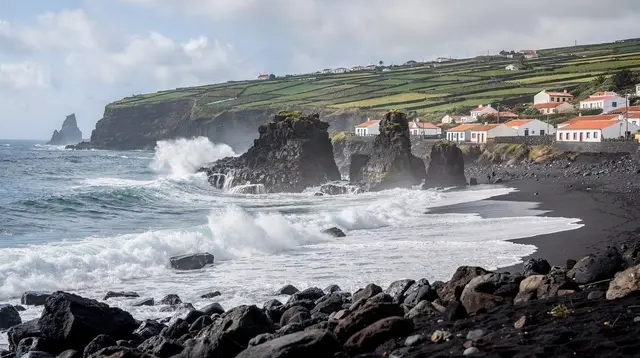
None of this makes Vila Franca do Campo a ruin, a memorial, or a place defined only by what it lost. Rebuilt over the following centuries, it is a functioning south-coast town with a genuine centre, a working harbour used by local fishing boats and the seasonal launches out to the islet, and a rhythm of daily life that has nothing performative about it. It sits roughly midway along the south coast, within easy reach of Ponta Delgada to the west and Água de Pau and Lagoa between them, and within striking distance of Caloura and its small harbour further along the coast.
Above the town, reached by a short climb or drive, the whitewashed chapel of Nossa Senhora da Paz looks straight down over the rooftops and out to the crater islet in the bay — the best vantage point for understanding how the town sits in its landscape, and for seeing, without needing to visit it directly on this page’s terms, the shape of the islet that the disaster’s aftermath left offshore rather than part of the mainland town.
Walking the centre today means a compact grid of streets, a parish church, a waterfront promenade, and a harbour that still earns its keep rather than existing for visitors. It is a smaller, quieter counterpart to Ponta Delgada’s old town — worth comparing directly if you want to see how differently the island’s past and present capital present themselves; the Ponta Delgada old town walking guide covers the town that took over the role Vila Franca once held.
Visiting Without the Islet
Because the crater islet just offshore is Vila Franca do Campo’s best-known attraction, it is worth being explicit about what this page does and does not cover. The Ilhéu de Vila Franca is a nature reserve with a daily visitor cap, reached by a short seasonal boat from the town’s marina, and it has real logistics of its own — booking ahead, sea conditions, and a limited season. None of that belongs here; it is handled in full in the dedicated Ilhéu de Vila Franca boat trip guide, and the coastal walking route that takes in both the town and the shoreline opposite the islet is covered separately in the Vila Franca islet and coast walk.
What this page is about is the town on its own terms: a former capital, standing on the site of a documented disaster, still doing the work of an ordinary south-coast community six centuries later. A short guided walk through the settlement puts that history in context on the ground — pointing out where the town’s civic core once stood, how the 1522 landslide reshaped its footprint, and how the rebuilt centre relates to the hillside above it.
a guided walk through Vila Franca do Campo’s settlers-era town centreSeveral operators also run a broader half-day loop that takes in Vila Franca do Campo alongside other south-coast stops, useful if you are combining the former capital with the rest of the coast rather than treating it as a stand-alone stop.
a half-day tour covering Vila Franca do Campo and the surrounding south coastBeyond the Town: The South Coast and the Interior
Vila Franca do Campo makes sense as one stop on a wider south-coast day rather than a destination visited in isolation. Westward along the coast, Caloura offers a smaller harbour and a more low-key stretch of shoreline; the Caloura harbour and south coast boat trips guide covers that side of the coast in more detail, and travellers wanting to get onto the water without heading out to the islet can look at south-coast sea kayaking between Vila Franca and Caloura as an alternative.
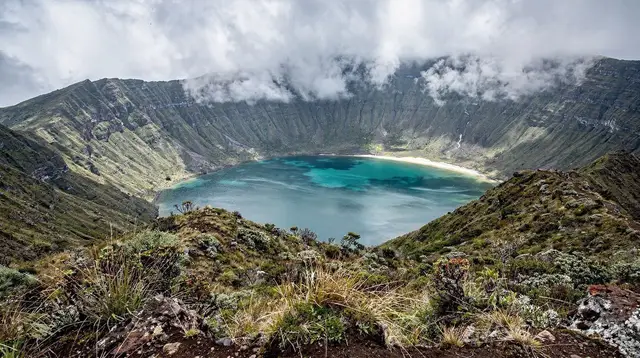
Inland and uphill, the crater lake of Lagoa do Fogo sits roughly between the south coast and the island’s centre, with no facilities of any kind and a habit of disappearing into cloud — a genuinely different kind of landscape from the settled coastline below, and a common pairing on tours that start from Vila Franca do Campo.
a half-day trip up to the Lagoa do Fogo crater lakeFor visitors building out a longer stay, Vila Franca do Campo fits naturally into a south-coast day within a three-day São Miguel itinerary, and the town’s role in island history is worth reading alongside the how many days do you need on São Miguel guide when deciding how much time to give the south coast versus the west and east of the island.
Getting There and Getting Around
Vila Franca do Campo sits on the EN1-1A, the road that rings the island, a manageable drive from Ponta Delgada along the coast or via the via rápida dual carriageway that links the capital with Ribeira Grande and Lagoa before the road narrows again toward the south coast. There is no train on São Miguel, and while buses run through the town, they operate on school and work timetables rather than sightseeing schedules — a rental car remains the practical way to combine Vila Franca do Campo with the rest of the south coast in a single day.
The town itself is walkable once you arrive: the centre, harbour, and the path up to Nossa Senhora da Paz are all within a short distance of each other, and parking near the waterfront is generally straightforward outside the busiest summer weeks. Coach and small-group tours based in Ponta Delgada typically stop in Vila Franca do Campo for an hour or two as part of a longer south-coast or full-island loop, which suits travellers who would rather not drive but still want to stand where the island’s first capital once stood.
Vila Franca do Campo in the Story of São Miguel
It is worth stepping back from the town itself to note what this history says about the island more broadly. São Miguel’s landscape is not a passive backdrop — it is volcanic ground that has shaped where people could settle, how towns grew, and in Vila Franca do Campo’s case, which town ended up running the island at all. The 1522 landslide is not an isolated footnote; it belongs alongside the island’s other geological facts — the caldera at Furnas, the crater lake at Sete Cidades, the crater lake at Lagoa do Fogo — as a reminder that São Miguel’s towns and landscapes exist in the same active system.
Understanding that history changes how a visit to Vila Franca do Campo reads. It is not simply a pretty stop on the way to the islet boat, or a smaller version of Ponta Delgada. It is the place the island’s capital used to be, standing exactly where a documented disaster once ended that role, rebuilt and still occupied, still working, more than five centuries later.
Questions About Vila Franca do Campo’s History
Why is Vila Franca do Campo no longer the capital of São Miguel?
A landslide triggered by an earthquake in 1522 buried much of the town, killing many residents and destroying its administrative buildings. Ponta Delgada, which was already a growing port, absorbed the island’s government in the aftermath. The change was never formally deliberated — it happened because Vila Franca was no longer functional as a seat of power.
Is the 1522 disaster a historical fact or a local legend?
It is a documented historical event, recorded in contemporary Portuguese accounts and confirmed by later geological study of the slope above the town. The date, the cause and the consequence — Ponta Delgada becoming capital — are treated as established fact by Azorean historians, not folklore.
How many people died in the 1522 landslide?
Historical estimates vary widely depending on the source and how the town’s population is counted, and no single figure is treated as definitive. What is consistent across accounts is that the loss was severe enough to end Vila Franca’s role as the island’s administrative centre outright.
What caused the landslide?
An earthquake shook loose the unstable volcanic slope above the town, sending debris down onto the built-up area near the shore. São Miguel sits on active volcanic ground, and steep, saturated slopes above coastal settlements were and remain a recognised hazard across the island.
Can you still see any trace of the old town that was destroyed?
The rebuilt town sits over and around the site of the original, so there is no exposed ruin to visit. What survives is the historical record and the town’s continued role as a working south-coast community rather than a preserved disaster site.
Is Vila Franca do Campo worth visiting today if it’s no longer the capital?
Yes — it is a working south-coast town with a genuine centre, a working harbour, and the hilltop chapel of Nossa Senhora da Paz above it, without the traffic and cruise crowds of Ponta Delgada. It reads as an island town going about its business rather than a monument to what it used to be.
Does this guide cover the islet across from Vila Franca do Campo?
No. The Ilhéu de Vila Franca, the crater islet reached by seasonal boat from the marina, is covered in its own dedicated guide. This page is about the town itself and the history of its lost status as capital.
City Sightseeing on GetYourGuide
Verified deep-linked GetYourGuide tours. Book through these links and we earn a small commission at no cost to you.
GetYourGuide does not provide a product photo for this activity — the image shows the meeting point, photographed by us.