Vila Franca do Campo Day Trip
How do you spend a day in Vila Franca do Campo?
Walk the harbour and old streets of the former island capital, climb or drive up to the Nossa Senhora da Paz chapel for the view over the bay, and, if the sea is calm and it's the right season, take the short boat out to the Ilhéu de Vila Franca. Add a seafood lunch by the marina and you have an easy, unhurried day.
Most visitors drive straight past Vila Franca do Campo on their way somewhere louder — Furnas’ caldeiras, the Sete Cidades viewpoints, the whale-watching boats out of Ponta Delgada. That’s a mistake, because this small south-coast town spent the better part of a century as the actual capital of São Miguel, and it still carries that history in its layout: a proper harbour, a grid of old streets, a parish church with weight to it, and a chapel on the hill above that was built to be seen from the sea.
Add the one genuinely unusual thing on this stretch of coast — a nature reserve inside a sunken volcanic crater, reachable by a short boat ride when the weather cooperates — and a single day here earns its place on an island itinerary.
This guide covers the town itself, its port, the climb to the Nossa Senhora da Paz chapel, and what to know about the seasonal boat to the islet. It doesn’t walk you step by step along the coastal path to the islet viewpoint — that’s covered separately in the islet and coast walk guide — and it doesn’t cover Caloura, the small harbour a little further west, which has its own guide and its own destination page.
Why Vila Franca do Campo matters
Before Ponta Delgada was anything more than a fishing settlement, Vila Franca do Campo was the seat of power on São Miguel. Portuguese settlers established the town early in the island’s colonisation, and by the early 1500s it was the largest and most important place on São Miguel — the capital in every practical sense. Then, in 1522, an earthquake triggered a landslide off the slopes above the town that buried a large part of it, killing an unknown but substantial number of residents. The town never fully recovered its former standing, and administrative power shifted north to Ponta Delgada, which has been the island’s capital ever since.
You can read the full story, with more on what the landslide destroyed and what survived, in the former capital guide and in the shorter blog piece on the same event. For a day trip, the practical point is this: the streets you’re walking through today, the church, the old core around the harbour — all of it sits on and around a town that was once the most important place on the island, rebuilt in the centuries since. It’s worth knowing before you arrive, because otherwise Vila Franca do Campo can read as a pleasant but minor stop. It isn’t. It’s the island’s original capital, quietly demoted.
Getting there and getting oriented
Vila Franca do Campo sits on the south coast, a short drive east of Ponta Delgada — close enough that many visitors base themselves in the capital and treat this as a half-day out, and easily combined with a wider loop along the south coast toward Furnas. A rental car is the practical way to get here, as it is for most of São Miguel; the things-to-do page for the town and the Ponta Delgada destination page both cover the wider logistics of basing yourself in the capital and day-tripping out.
Once you arrive, the town is compact and walkable. Park near the marina or the main square and everything worth seeing on foot — the harbour front, the old streets, the parish church — is within a few minutes on foot. The road up to the chapel is separate and covered below.
a half-day tour of Vila Franca do Campo is a straightforward way to see the town’s highlights with a guide if you’d rather not plan the sequence yourself, and it usually folds in some of the surrounding coastline as well.
The port and the old town
Vila Franca do Campo’s harbour is still a working one, with fishing boats alongside the pleasure craft and the small tour boats that run out to the islet in season. It’s the natural anchor for a visit: walk the marina front, watch the boats, and use it as your starting and finishing point for the rest of the day.
Behind the harbour, the old town has a denser, older feel than many of São Miguel’s smaller settlements — a legacy of having been the island’s centre for so long. The parish church anchors the main square, and the streets around it are worth wandering without a fixed plan for twenty or thirty minutes. This isn’t a town built for tourism — it’s a working town that happens to have a striking history and a good waterfront, which is part of its appeal.
If you’d rather have someone connect the dots for you, a guided walk through the old settlers’ town covers the history in more depth than a self-guided wander will, including the parts of the 1522 story that aren’t obvious just from looking at the buildings.
For food, the streets around the marina and the main square hold the town’s restaurants and cafés, mostly geared toward fresh seafood given the setting. This isn’t Furnas, so you won’t find a cozido pit here — for that, see the dedicated guide on how cozido das Furnas is cooked underground — but grilled fish and limpets (lapas) are a reasonable bet in season, and the broader guide to Azorean seafood is useful background before you sit down.
The chapel above the village
Above the town, on a hill that dominates the view from the harbour, sits the whitewashed chapel of Nossa Senhora da Paz. It’s reachable by road — there’s a car park near the top — or on foot, via a long staircase that climbs directly from the lower town for those who want the exercise and the changing view as they go.
The chapel itself is modest, but the point of coming up here is the view: the town laid out below, the harbour and its boats, the curve of the coastline, and, on a clear day, the islet sitting just offshore. It’s one of the better short viewpoint stops on the south coast, and it takes little more than the time it takes to drive or climb up, look, and come back down. Photographers will want to time it for softer light — late afternoon works better than the flat light of midday, when the coast tends to wash out.
There’s no fixed opening schedule to worry about for the outdoor terrace and the view — you can turn up more or less any time during daylight — though the chapel building itself follows its own, more limited hours if you want to see the interior.
The islet: when the sea allows
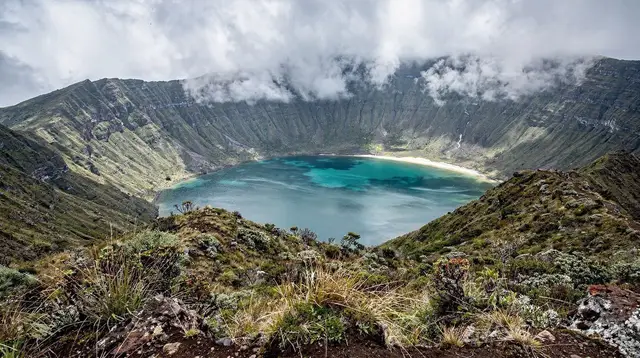
The single most distinctive thing to do from Vila Franca do Campo is the short boat trip out to the Ilhéu de Vila Franca — a small islet just offshore that is, geologically, a drowned volcanic crater. Erosion has opened one side of the crater rim to the sea, so in calm conditions you can swim inside a flooded caldera, with the crater walls rising around you and the open Atlantic just outside the gap.
This is a genuinely unusual spot on an island that isn’t short of unusual spots, and it’s the reason many people build a whole day trip around Vila Franca do Campo rather than just passing through. But it comes with real constraints that are worth understanding before you plan around it.
The islet is a protected nature reserve, and access is capped. Only a limited number of visitors are allowed on and around the islet at any time, which keeps the crossing manageable and the site from being overrun. The shuttle boat runs in season only — broadly the warmer months, roughly matching the period covered in the best-time-to-visit guide — and it does not run year-round. Outside that window, or outside the boat’s operating hours, the islet simply isn’t reachable.
The point that trips people up most often: the shuttle does not go out in rough seas, whatever the season. This is a small open crossing on the open Atlantic, and the operators cancel it when conditions call for it — swell, wind, poor visibility. A calm summer forecast is not a guarantee; conditions on this coast can change within a day, and the boat’s own judgement on the morning is what decides, not the calendar.
If the islet is the reason you’ve built your day around Vila Franca do Campo, build in flexibility — an alternative activity in town or nearby, and ideally a day or two of buffer if the trip matters to you. The general pattern of weather-driven cancellations on São Miguel’s boat trips is covered in more depth in the guide to boat tours and weather cancellations, and it applies here as much as anywhere on the island.
When the crossing does run, it’s short — a matter of minutes from the marina — and once on or around the islet, the appeal is straightforward: clear water inside the crater, a genuinely different feel from the open coastline, and (season and operator depending) the chance to get in the water yourself. the islet boat tour out to the Ilhéu de Vila Franca is the most direct way to book the crossing rather than trying to arrange it on the spot at the marina, which isn’t always possible on short notice in peak weeks.
For those who want to be in the water rather than just looking at it, snorkelling trips run from the same starting point when conditions allow, taking in both the crater interior and some of the surrounding coastline — see the separate guide on snorkelling inside the islet crater for what that actually involves.
Kayaking is another way to explore the water around the town at a slower pace and on your own schedule: renting a kayak in Vila Franca do Campo lets you paddle the harbour area and coastline without committing to the islet crossing itself, which is a reasonable option if the shuttle isn’t running that day.
If you want the fuller story on the islet — its formation, the visitor cap, and the coastal path that runs along the shore opposite it — the dedicated islet boat trip guide and the islet and coast walk guide both go further than this page does; this one keeps to what you need to plan a single day around the town and the crossing, not a full exploration of the shoreline.
A simple day plan
There’s no single right order, but a workable structure looks like this:
| Time | What | Notes |
|---|---|---|
| Morning | Arrive, walk the harbour and old town | Park near the marina; church and old streets nearby |
| Late morning | Drive or climb to Nossa Senhora da Paz | Short stop; best light isn’t midday |
| Midday | Lunch near the marina | Seafood is the local strength |
| Early afternoon | Islet crossing, if running | Book ahead in peak season; check with the operator that morning |
| Late afternoon | Return, or continue along the coast | Caloura or Água de Pau lie further west if you want to extend the day |
If the islet isn’t an option that day — wrong season, or the sea’s up — the town, port and chapel alone still make for a satisfying half-day, and you can fold the extra time into a wider south-coast loop, or a visit to Ponta Delgada or Furnas depending on where the rest of your itinerary is heading. For a longer stay that fits Vila Franca do Campo into a broader plan, the classic three-day itinerary and the general how many days you need on São Miguel guide are useful starting points.
Combining it with the rest of the coast
Vila Franca do Campo works well as a stand-alone half-day, but it also slots naturally into a longer south-coast route. Heading west, Caloura’s small harbour and swimming spots make a reasonable next stop, though — as noted above — that town has its own dedicated coverage rather than being folded into this page. Heading east, the road continues toward Água de Pau and on to Furnas, which is a different kind of day entirely: the caldera, the underground-cooked cozido, and the thermal parks, none of which this guide tries to cover.
For anyone weighing up boat-based activities more broadly around the town — beyond the islet crossing itself — the boat-tours category page collects the wider set of options along this stretch of coast, and the things-to-do page for Vila Franca do Campo rounds up everything bookable from the town in one place.
What to bring
Nothing about a Vila Franca do Campo day trip calls for special gear. Comfortable walking shoes cover the old town and the chapel staircase if you climb rather than drive. If there’s any chance the islet crossing runs, bring a swimsuit and a towel on the off-chance conditions hold, but don’t build the day around a guarantee — the sea decides, not the schedule. A light layer is worth having regardless of season; the south coast is generally milder and drier than the north, but the weather on São Miguel changes by the hour, and what’s calm at the marina in the morning can turn by early afternoon.
Vila Franca do Campo day trip: questions answered
How long do you need in Vila Franca do Campo?
Half a day covers the town, port and chapel viewpoint comfortably. Add another hour or two if the islet boat is running and you want to go out to the reserve.
Can you visit the Ilhéu de Vila Franca islet any day of the year?
No. The shuttle out to the islet runs in season only, and only when the sea allows — it does not go out in rough or windy conditions, whatever the calendar says.
Why was Vila Franca do Campo the capital of São Miguel?
It was the island’s first major settlement and its administrative centre until 1522, when an earthquake-triggered landslide destroyed much of the town. Ponta Delgada took over as capital afterwards.
What is the chapel above Vila Franca do Campo?
Nossa Senhora da Paz, a whitewashed hilltop chapel reached by road or by a long staircase, with a wide view over the town, the harbour and the islet offshore.
Is the Ilhéu de Vila Franca islet free to visit?
The islet itself is a nature reserve with a daily cap on visitor numbers. Getting there means a short paid boat crossing from the marina, run only in season and only in calm sea.
Is Vila Franca do Campo worth visiting if you’re staying in Ponta Delgada?
Yes — it’s a short drive along the south coast and works well as a half-day out, either alone or combined with Caloura or the Água de Pau area on the way back.
Can you swim at Vila Franca do Campo?
There’s no sand beach in the town itself; the main swimming draw is inside the flooded crater of the islet in season. Along the coast, Caloura’s harbour area is the nearest swimmable spot.
Day Trips on GetYourGuide
Verified deep-linked GetYourGuide tours. Book through these links and we earn a small commission at no cost to you.
GetYourGuide does not provide a product photo for this activity — the image shows the meeting point, photographed by us.