Vila Franca do Campo: São Miguel's Forgotten Capital
A Town I Kept Underestimating
The first two or three times I stopped in Vila Franca do Campo, I treated it the way most guidebooks do: a pleasant stop on the way to Furnas, worth an hour for the harbour and a look at the crater islet sitting just offshore. Nice church, nice waterfront, nice light in the late afternoon. I filed it next to Caloura in my head — a quiet fishing corner of the south coast, agreeable but minor, permanently in the shadow of Ponta Delgada.
It took a local guide, halfway through a walk around the old streets, to correct me. Vila Franca do Campo was not always minor. It was the capital of São Miguel. Not briefly, not informally — for decades it was the seat of government for the whole island, until the night in 1522 when the hillside above it let go and buried the town under an earthquake-triggered landslide. Ponta Delgada became the capital afterward not because someone in Lisbon decided the island needed a fresher administrative centre, but because the old one had just been destroyed.
That single fact rearranges how I now walk through Vila Franca do Campo. It is not a town that has always lived quietly in someone else’s shadow. It is a town that lost its status in one catastrophic night, and has spent five centuries since being something smaller than it once was.
What Actually Happened in 1522
The details, as far as they are known, are stark. An earthquake struck the area and shook loose the slopes above the settlement. What came down was not lava or ash but earth and rock, a landslide moving fast enough to overwhelm a town built on the flat ground below. Contemporary accounts describe heavy loss of life and a town effectively wiped from the map in a matter of hours. This was not erosion, not a slow decline in trade, not a rival port simply outcompeting it. It was sudden, violent, and geological — the same restless ground that gives São Miguel its lava tubes, its craters and its hot springs also took away the island’s original capital in a single event.
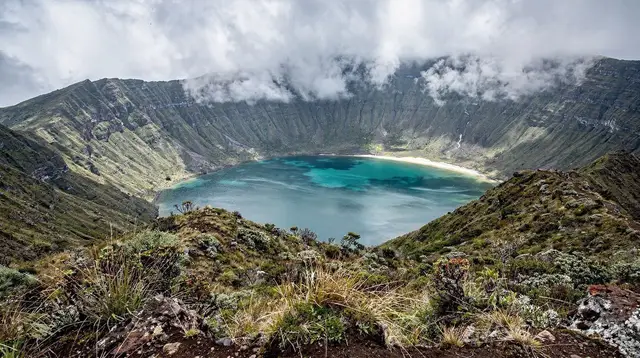
I find that connection more interesting than the disaster itself. São Miguel’s volcanic character is usually framed as scenery: the caldera at Sete Cidades, the steaming ground at Furnas, the crater lake at Lagoa do Fogo. Rarely is it framed as a force that directly rewrote the island’s political map. But that is exactly what happened here. The same underlying processes that make this the Ilha Verde, green and fertile from volcanic soil, also made its first capital uninhabitable almost overnight.
Why Ponta Delgada, and Not Somewhere Else
Once Vila Franca do Campo could no longer function as the administrative centre, the island needed a new one, and Ponta Delgada was the obvious candidate. It already had a working port, flatter and more stable ground, and a merchant community that had been growing steadily. The shift was not really a competition between two towns so much as a redirection of function toward the place best placed to absorb it. Within a relatively short span, Ponta Delgada consolidated the role Vila Franca do Campo had held, and it never gave it back. Everything that followed — the growth of the harbour, the churches and forts of the old town, the airport that now sits two or three kilometres from its centre — sits on top of that 1522 hinge point.
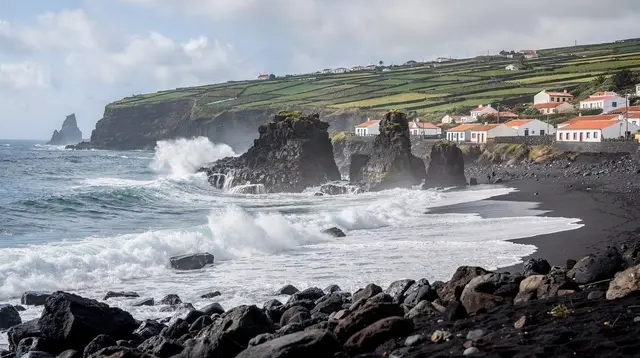
It is worth being precise about what this does and does not mean for the town today. Vila Franca do Campo rebuilt. It is not a ruin, and it is not a museum piece frozen in 1522. Walking its streets now, past the church of São Miguel Arcanjo and along the small harbour, you are mostly looking at a later town built over and around the older one, shaped by the same disaster but not preserved as its monument. There is no single plaque-and-ruin experience waiting for you the way there might be elsewhere. The history lives in the shape of the place and in what did not happen next — no second rise to prominence, no return of the capital.
The Islet That Now Defines the Town
Ask most visitors what Vila Franca do Campo is known for today and they will say the islet — the sunken crater a short boat ride from the marina, its ring of rock enclosing a natural pool where you can swim in season. It is a genuinely striking feature, an older volcanic structure entirely separate from the 1522 landslide, and it has become the town’s signature image on every postcard and every feed. I understand why. It photographs beautifully and it is, quite literally, unlike anywhere else on the island.
But I think the islet’s fame has quietly finished the job the landslide started: it has replaced Vila Franca do Campo’s political memory with a scenic one. People now come for a swim inside a crater and leave without knowing they walked through what was once the administrative heart of São Miguel. Both things can be true and worth knowing at once. You can book a boat out to the islet, snorkel inside the crater, and still spend twenty minutes beforehand walking the old streets with the 1522 story in mind, which changes how the church, the waterfront and the quiet backstreets read.
If you want that history filled in properly, with the sites that anchor it, I’d point you to a walk through the town itself before or after the water. A short guided walk through the historic centre spends its time on exactly this — the streets, the church, and the story of a town that once ran the island.
For the boat side of things, an islet crossing to the crater at Ilhéu de Vila Franca covers the natural history the landslide has nothing to do with, while a biologist-guided boat trip around the islet goes further into the geology and wildlife if that is more your interest.
A Town Worth a Slower Look
I no longer treat Vila Franca do Campo as a stop on the way to somewhere else. It is a place whose current modesty is the direct result of a specific, dated catastrophe — not a sleepy default it has always occupied. That reframing does not require much extra time on the ground: an hour in the old streets, a stop at the church, a look at the harbour with the knowledge that this was once where São Miguel’s decisions were made, before it becomes, thirty minutes later, the south coast day trip most people expect.
If you are building out a longer loop of the island, it slots naturally into a south coast day trip alongside Caloura’s harbour and boat trips, or into a broader two-day itinerary that also takes in Ponta Delgada.
What I keep coming back to is how directly this piece of administrative history is written into the landscape. São Miguel’s volcanic ground is not backdrop here; it is cause and effect. For more on how that volcanic character shaped the island more broadly, it is worth reading how São Miguel’s volcanic history unfolded alongside this one, and if the wider point about the Azores not being one interchangeable postcard interests you, this island is not the whole story of the Azores either.
Vila Franca do Campo’s Lost Capital, Answered
When did Vila Franca do Campo stop being the capital of São Miguel?
In 1522. An earthquake set off a landslide from the hills above the town that buried a large part of it in a single night, ending its decades as the island’s capital.
What caused the 1522 disaster in Vila Franca do Campo?
A strong earthquake shook the slopes above the town and triggered a landslide that came down onto the settlement. It was a geological event, not a storm or a fire, and it is remembered as one of the deadliest disasters in Azorean history.
Why did Ponta Delgada become the new capital instead of somewhere else?
Ponta Delgada was already a growing port on more stable, flatter ground, with a natural anchorage and expanding trade. After 1522 it absorbed the administrative role Vila Franca do Campo could no longer safely hold.
Is there anything left of the old capital to see today?
The rebuilt town sits partly over the older one, so there is no single ruin to visit. What remains is the street pattern, the church of São Miguel Arcanjo, and the shape of a town that was laid out to govern an island, not just serve one corner of it.
Is Vila Franca do Campo still at risk from earthquakes and landslides?
São Miguel remains volcanically and seismically active, and the whole island lives with that reality, not just Vila Franca do Campo. Modern building codes and monitoring exist precisely because the 1522 event is part of the historical record, not forgotten.
What is the Ilhéu de Vila Franca, and is it related to the 1522 event?
The islet is a separate, older volcanic crater just offshore, not a product of the 1522 landslide. It has become the town’s best-known feature today, which is part of why its political past gets overlooked.
tours.History
Verified deep-linked GetYourGuide tours. Book through these links and we earn a small commission at no cost to you.
GetYourGuide does not provide a product photo for this activity — the image shows the meeting point, photographed by us.