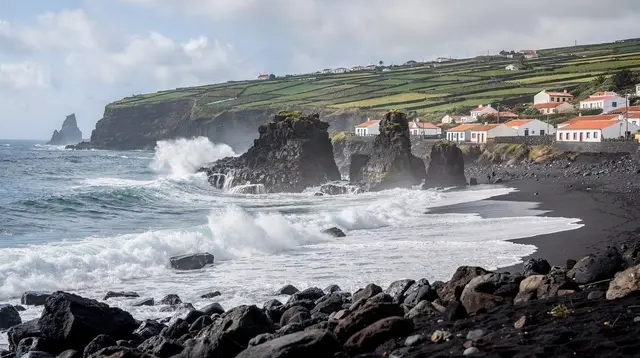
South of the airport road, past Lagoa’s rooftops, the coast drops down to a small harbour where a handful of fishing boats sit on flat water below a wall of dark rock. This is Caloura. There is no beach, no promenade lined with restaurants, no cluster of hotels — just a working anchorage, a couple of places to swim off the rocks, and a view south across open Atlantic that on a clear day runs all the way to the horizon with nothing in between.
A harbour, not a resort
It helps to be clear from the start about what Caloura is not. This is not a beach resort in the way that phrase gets used elsewhere in the Atlantic or the Mediterranean — there is no strip of imported sand, no row of sunbeds, no beach bars playing music into the evening. Caloura is a small, functioning fishing harbour on the south coast of São Miguel, the kind of place where a handful of boats tie up between outings and a few houses climb the slope behind the water. What draws people here is exactly that lack of production: a quiet corner of coastline where the programme for the day is set by the sea, not by a schedule of poolside activities.
That distinction matters because São Miguel’s south coast, unlike the postcard lakes of Sete Cidades or the steaming ground of Furnas, does its best work in a lower key. Caloura sits in the stretch between Ponta Delgada and Vila Franca do Campo, close to the town of Lagoa and the district of Água de Pau, both of which have their own character and their own pages — Caloura’s is narrower and simpler: a harbour, some rock pools, a stretch of open water, and the rhythm of a village that has always looked seaward rather than inland.
Getting there and getting oriented
Caloura is roughly 20-25 minutes by rental car from Ponta Delgada, following the coast road east through Água de Pau and down into Lagoa before dropping to the harbour. It is a similarly short hop onward to Vila Franca do Campo, which makes Caloura a natural stop on a south coast loop rather than a destination that justifies its own dedicated day. As with almost everywhere on this island, a rental car is the practical way to see it; bus routes on São Miguel are built around school and work timetables, not sightseeing, and there is no train on the island at all.
Once you arrive, there is not much to navigate. The harbour itself is small enough to take in on foot in a few minutes: a stone quay, a scatter of moored boats, a slipway, and steps and platforms cut into the rock where people ease themselves into the water. A short walk along the shoreline in either direction turns up quieter corners for swimming away from the boat traffic. This is not a place that rewards a long, structured itinerary — it rewards slowing down.
Swimming off the rocks
There is no sand at Caloura, and there never has been — this whole coast is built from lava rather than dunes, and swimming here means stepping down from stone into clear water rather than walking in across a beach. Locals and visitors alike use a couple of small natural pools and platforms cut into the rock close to the harbour, which offer a sheltered, relatively calm entry point compared with swimming directly off open coastline.
The water is at its most inviting from June to September, when the sea along this stretch of coast typically sits around 22-24 degrees Celsius and the swell is, on average, at its gentlest. Outside that window — particularly from November to March — the Atlantic here turns colder and considerably rougher, and swimming becomes a fair-weather activity rather than a daily one. Even in summer, though, conditions can change within a single afternoon: a flat, glassy harbour at mid-morning can have a noticeable swell running by early evening. Anyone planning to swim should look at the sea in front of them on the day, not at a seasonal average.
If Caloura’s own pools feel too small or too busy, the nearby islet at Vila Franca do Campo offers a different, more contained kind of sea swimming — inside a flooded crater rather than open water — though it operates on its own seasonal schedule and visitor limits, covered separately.
For a longer look at that alternative, the Ilhéu de Vila Franca has its own page covering the sunken crater islet in full, along with a dedicated guide to swimming inside the crater and another to boat trips out to the islet.
Caloura has its own narrower version of the same idea, set out in a guide to snorkelling and swimming at Caloura itself; for visitors who would rather explore this stretch of coast by kayak than from a rock ledge, a separate guide to sea kayaking between Vila Franca do Campo and Caloura covers that option too.
Boats, and why the harbour comes with no promises
Caloura’s harbour is a working one, and its small scale is part of the point: this was never built for cruise-size traffic, and it shows. Fishing boats go out from here, and on the right day a boat trip can be arranged along this stretch of coast, whether that means a short excursion out of Caloura itself or picking up a wider south coast or whale-watching trip that departs from a larger harbour nearby.
What has to be said plainly, though, is that no boat trip on this coast comes with a guarantee. Caloura’s anchorage sits open to the Atlantic, and the same swell that can flatten a morning’s swimming can just as easily cancel an afternoon’s boat trip — in July as readily as in January, even if it happens less often in summer. Boat operators here make that call on the day, sometimes on short notice, based on sea state rather than a promise made in a brochure. If a marine excursion is part of your plan, it pays to build in a spare day rather than pin everything on one booking, and to treat any trip that does go ahead as a bonus rather than a certainty.
For travelers who want the water experience without leaving quite so much to the sea’s mood, a short excursion built around Vila Franca do Campo and its coastline can be a more structured way to get out on the water from this part of the island: a half-day trip along the Vila Franca do Campo coastline covers some of the same stretch of south coast that Caloura looks out on, with the logistics of transport and timing handled for you.
Whales offshore, seen or not
The open water beyond Caloura’s harbour is part of the same Atlantic that carries whales and dolphins past São Miguel’s coastline through much of the year — sperm whales and dolphins are resident here year-round, while blue, fin and sei whales pass through on a spring migration roughly between March and June, and whale watching more broadly runs at its strongest from April to October.
None of that is specific to Caloura, and no page on this site will promise a sighting from here or anywhere else: boats are guided out to likely areas by shore-based spotters, a role with roots going back to the whaling lookouts of an industry that ended in the Azores in the 1980s, and what the sea offers on a given day is still down to the animals, not the operator.
The practice of watching for whales from shore has deep roots on this island: a guide to the whaling heritage and vigia lookouts explains how an industry that ended in the 1980s turned into today’s spotter network, and the old whaling station at Capelas, further along the north coast, is one place that history is still visible on the ground. For anyone timing a visit around the animals rather than the harbour, a separate guide to the best time of year for whale watching on São Miguel covers the migration patterns in more depth than fits on this page.
A trip that combines the wider whale-watching experience with time in the water is one way to fold that uncertainty into a single outing rather than a separate booking: a whale watching trip that pairs lookout time with lunch and water activities which, like everything that leaves a harbour on this coast, runs on the sea’s terms rather than a fixed script.
The village behind the water
Behind the harbour, Caloura climbs gently into a small settlement of houses, a church, and the kind of unhurried village life that exists along most of this coastline outside the main towns. There is no strip of shops built for visitors, and no expectation that there should be — this is a place people live and fish, not a stage set. A short walk up from the water gives a view back down over the harbour and out to sea that, on a still day, is worth the few minutes it takes.
The surrounding land, like much of the south coast around Água de Pau and Lagoa, carries the mix of pasture, hedgerow and small-scale cultivation that defines São Miguel away from its volcanic centrepieces — this is farmed, inhabited countryside, not wilderness, and Caloura’s setting reflects that as much as its harbour does.
Where Caloura fits on the south coast
Caloura works best not as a stop in isolation but as one point on a short stretch of coastline that rewards unhurried driving. To the west, the town of Lagoa and the district of Água de Pau carry their own sights and their own pace, each covered on its own page rather than folded into Caloura’s. To the east, Vila Franca do Campo is a genuinely different scale of place — the island’s capital until an earthquake-triggered landslide buried the original town in 1522 — with its harbour, its town centre, and its offshore islet reachable by boat in season.
Strung together, Caloura, Lagoa, Água de Pau and Vila Franca do Campo make a coherent half-day or full-day loop along the south coast, easily combined with a wider circuit of the island over several days. Anyone building a longer itinerary around São Miguel’s south coast, rather than trying to see it in a single rushed pass, will find Caloura sits comfortably as a short, unforced stop between two more built-up towns — a place to slow the car down rather than a place to plan an entire afternoon around.
a private jeep tour that can be routed along the south coast at its own pace is one way to link Caloura with its neighbours without being tied to a fixed bus timetable that, on this island, does not really exist for sightseeing in the first place.
Travelers building a longer route around the island, rather than a single afternoon on the south coast, can find this stretch worked into a fuller island plan in a guide to four days covering the whole of São Miguel. For a land-based alternative to the jeep tour above, a quad and buggy adventure along the Vila Franca do Campo coastline covers some of the same ground on two or four wheels rather than on foot or by boat.
Practical notes for a stop in Caloura
There is little to prepare for a visit to Caloura beyond what applies to the rest of São Miguel. A rental car remains the practical way to reach and leave the village, since it sits off any tourist-oriented bus route. Fuel is not an issue this close to Ponta Delgada, unlike the more remote Nordeste circuit further east, but it is still worth arriving with a reasonable tank if Caloura is one stop among several.
For swimming, an old pair of water shoes helps on the rocky entry points, and there are no lifeguards or organised facilities to rely on — this is informal sea swimming, and conditions should be judged on sight rather than assumed safe because the harbour looks calm at a distance. Sockets across the island are the European type C/F standard at 230V, tap water is drinkable everywhere including here, and the emergency number is 112 if anything goes wrong on the water or the rocks. Portuguese is the everyday language of the village; English is spoken in tourism-facing businesses elsewhere on the island but should not be assumed in a small fishing harbour like this one.
Prices for anything bought locally already include Portugal’s Azorean VAT rate, lower than the mainland’s, and a tip of a round-up figure — roughly 5-10 percent — is the local norm rather than anything larger. None of that changes much at Caloura specifically, since there is little commercial activity to speak of beyond the harbour itself, but it is worth carrying over from the rest of the island rather than assuming otherwise.
None of this is unique to Caloura — a fuller guide to driving on São Miguel and a separate one to the island’s bus network both cover what applies here as much as anywhere else, and a guide to tipping, VAT and restaurant etiquette in the Azores covers the norms mentioned above in more detail.
Caloura questions people actually ask
What is Caloura and is it worth visiting?
Caloura is a small fishing harbour on São Miguel’s south coast, between Ponta Delgada and Vila Franca do Campo. It is worth a stop for a quiet swim off the rocks or a short boat trip, not for beaches, resorts or nightlife, none of which exist here.
Is there a beach at Caloura?
No. Caloura has no sand beach. People swim from the rocks around the harbour and from a couple of small natural pools cut into the lava, the way most of São Miguel’s south coast works.
How do you get to Caloura?
By car, in about 20-25 minutes from Ponta Delgada, via the road that runs along the south coast through Água de Pau and Lagoa. There is no bus service built around visitors, and no train anywhere on the island.
Can you swim at Caloura all year?
The sea is swimmable from the rocks whenever conditions allow, but it is coolest and roughest from November to March. June to September brings the calmest, warmest water, around 22-24 degrees Celsius at the height of summer.
Are boat trips from Caloura reliable?
No boat trip anywhere on this coast is guaranteed. Caloura’s small harbour is exposed to the open Atlantic, and outings can be shortened, rerouted or cancelled for swell at any time of year, including in high summer.
Is Caloura a resort town?
No. Caloura is a working fishing harbour with a scatter of houses, not a resort. There are no large hotels, water parks or organised beach facilities here; the appeal is the quiet and the sea, not infrastructure.
What is near Caloura?
Caloura sits between the town of Lagoa and the district of Água de Pau, on the way to Vila Franca do Campo and its islet, all within a 10-20 minute drive along the same stretch of south coast.
Do you need a car to visit Caloura?
Effectively yes. Caloura is not set up as a public transport destination, and a rental car remains the practical way to combine it with the rest of the south coast in a single trip.