Caloura: A Swimming and Snorkeling Spot on the South Coast
Is Caloura a good place to swim or snorkel on São Miguel?
Caloura is a small, sheltered harbour hamlet on the south coast with a modest natural swimming area rather than a purpose-built beach or dive centre. It works well as an easy, low-key entry point into the sea when conditions are calm, but it is not a big infrastructure stop — there is no rental kiosk or dive shop on site.
What Caloura Actually Is
Caloura is a small fishing hamlet on São Miguel’s south coast, tucked into a natural inlet a short drive from Lagoa and Água de Pau. It has a working harbour, a handful of houses climbing the slope above it, a vineyard-and-wine estate nearby, and a small sheltered area where locals and visitors go into the water.
That’s the whole of it. There is no promenade, no row of beach bars, no dive centre with a compressor running in the background, and no rack of rental fins by the water. If you’re picturing a resort cove, recalibrate: Caloura is modest, low-key, and entirely unglamorous in a way that is part of its appeal for some visitors and a disappointment for others expecting more.
The honest question worth asking before you drive out here is not “how good is Caloura” in the abstract, but whether a small, simple, sheltered patch of south coast sea is what you actually want on a given day. For some itineraries, yes. For others, Vila Franca do Campo a few minutes further along the coast, or the Ilhéu de Vila Franca just offshore from it, will suit better.
The Swimming Spot Itself
The water access at Caloura is around the harbour and the small cove beside it — a mix of rock platforms, a short concrete or stone entry point in places, and calm, semi-enclosed water when the wider Atlantic isn’t throwing swell at the coast. It is not a sand beach; don’t come expecting one. What the setting does offer is shelter. The inlet takes some of the edge off open ocean swell, which is exactly why fishermen based a harbour here in the first place, and it’s the same logic that makes it more approachable for casual swimming than an exposed stretch of open coastline.
That shelter is relative, not absolute. On a day with heavy south swell, Caloura’s cove will still show white water and surge, and getting in over rock is a different proposition when waves are breaking against it than when the sea is glassy. Locals read the sea before deciding to go in, and visitors should do the same rather than assume “sheltered” means “always calm.”
Water Temperature, Season by Season
The Atlantic around São Miguel is never tropical, and Caloura’s water is no exception to the island’s general pattern. Expect roughly:
| Season | Approx. sea temperature | What that means in the water |
|---|---|---|
| Late winter (Feb–Mar) | ~17°C | Cold enough that most people want a wetsuit for more than a quick dip |
| Spring (Apr–May) | ~18–20°C | Bearable for a short swim without a suit; still brisk |
| Summer (Jun–Sep) | ~21–24°C | The comfortable window; many swim without a wetsuit |
| Autumn (Oct–Nov) | ~19–21°C | Cooling but still swimmable for shorter sessions |
These figures are island-wide approximations, not a Caloura-specific forecast — the sheltered cove doesn’t run noticeably warmer than the open coast nearby. For a fuller picture of how sea temperature and diving conditions change across the year on São Miguel, see sea temperature and diving conditions.
Snorkeling: What to Expect
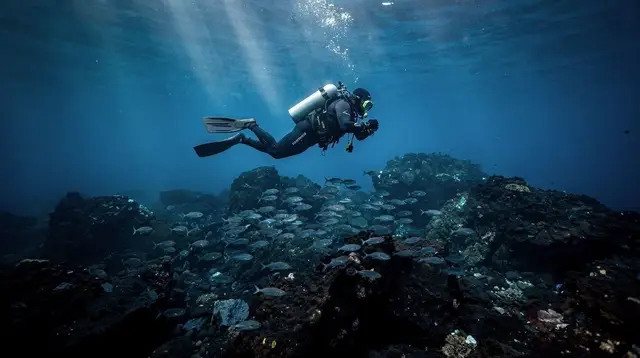
Snorkeling at Caloura means volcanic rock, some patches of sand between boulders, and the marine life typical of a temperate Atlantic inshore environment — small fish, sea urchins, the occasional octopus if you’re patient and lucky, and clear-enough visibility on a calm day without swell stirring up sediment. It is not a coral reef and nobody should come expecting one; the appeal here is a quiet, unstructured look at an ordinary stretch of Azorean coastline rather than a curated marine park experience.
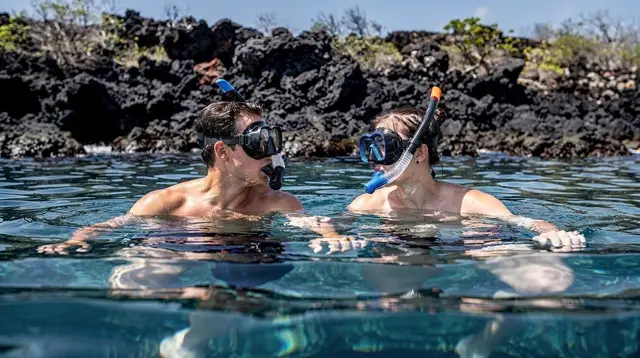
Because there’s no on-site rental, anyone planning to snorkel needs to bring a mask, snorkel and fins from Ponta Delgada or wherever they’re staying. There’s also no lifeguard station and no staffed entry point, so snorkeling here is a self-directed activity: check conditions, go in with a companion if possible, and stay close to the sheltered part of the cove rather than pushing out toward open water.
If a more organized, guided introduction to snorkeling on this coast appeals more than a self-guided dip, operators run trips from nearby Vila Franca do Campo that include guidance and gear — worth considering for anyone less confident going it alone. A snorkeling tour departing from Vila Franca do Campo covers a similar stretch of south coast water with equipment and a guide included, which removes the “did I bring the right kit” problem entirely.
Caloura vs Other South Coast Water Access
It helps to place Caloura against its neighbours rather than judge it in isolation:
| Spot | Type | Facilities | Best for |
|---|---|---|---|
| Caloura | Sheltered harbour cove | None on site | A quiet, casual dip; no booking needed |
| Ilhéu de Vila Franca | Crater islet, boat access only | Seasonal boat, visitor cap | A dramatic, enclosed swim inside a sunken crater |
| Vila Franca do Campo harbourfront | Town harbour | Cafés, shops nearby in town | Combining a swim with a proper meal and a look around |
| Mosteiros | Black-sand coast, sea stacks | Café/village nearby | Snorkeling around volcanic sea stacks on the west coast |
Caloura’s edge is convenience: no boat to catch, no ticket, no schedule. Its limit is scale — it’s a hamlet cove, not a destination beach. The Ilhéu de Vila Franca is worth the extra planning if a more memorable, enclosed swim is the goal and the season and sea state allow the crossing; see also the general guide to snorkeling inside the crater for how that works.
This page deliberately doesn’t cover boat trips departing Caloura’s own harbour — those are a separate activity with their own planning questions, covered in boat trips from Caloura harbour.
What to Bring
Because Caloura has no rental point and no shop selling beach gear at the water’s edge, come prepared:
- Your own mask, snorkel and fins if snorkeling is the plan.
- Reef-safe sunscreen, applied before you arrive rather than at the rocky entry point.
- Water shoes or old trainers — entry is over rock and stone, not sand, and bare feet are a poor idea.
- A towel and a change of clothes; there are no changing facilities at the cove.
- A wetsuit or rash guard outside the June–September window, or for anyone who runs cold in general.
None of this is exotic, but it’s worth spelling out precisely because there is nothing to buy or borrow on site. Assume you arrive self-sufficient.
Reading the Sea Before You Go In
The single most important habit for swimming safely anywhere on São Miguil’s coast, Caloura included, is looking at the actual sea on the actual day rather than trusting a general impression that “it’s sheltered.” Signs to hold off:
- Visible white water breaking across the mouth of the cove.
- A recent spell of strong wind or storm activity in the days before, even if the wind has since dropped — swell often lags behind the weather that caused it.
- Cloudy, churned-up water where normally it would be clear — a sign the sea has been more active recently than it looks that moment.
There’s no lifeguard at Caloura to make that call for you, so it’s a personal judgment every time. If in doubt, the coast road toward Vila Franca do Campo offers other options, and the town itself has a proper harbourfront and services if the plan needs a fallback.
An Alternative: Coasteering Instead of a Quiet Swim
For visitors who want more structure and more coastline covered than a static swim at Caloura offers, several operators run coasteering trips along this stretch of the south coast — a mix of scrambling over volcanic rock, cliff jumps at manageable heights, and swims between coves, done with a guide and safety gear.
A coasteering trip around Caloura’s volcanic coastline turns the same stretch of sea into a more active half-day out, with equipment and supervision that a solo swim at the harbour doesn’t offer. It’s a genuinely different experience from a quiet dip — worth choosing deliberately rather than by accident. For background on how that activity works on this coastline generally, see coasteering safety on São Miguel’s volcanic coast.
Another way to see this stretch of coast from the water without relying on a single cove is a half-day sailing trip that combines a look at the coastline with a stop to snorkel and paddle. A half-day sailing trip with snorkeling and stand-up paddle stops covers more ground than staying at one harbour and adds a snorkel break in open water rather than a fixed cove.
Getting to Caloura
Caloura sits just off the main coast road between Lagoa and Vila Franca do Campo, roughly a 15–20 minute drive from central Ponta Delgada. A rental car is the practical way to reach it, as with most of the south coast — there is no dedicated tourist shuttle to a hamlet this size, and bus timetables here run on local schedules rather than sightseeing ones. Parking is informal and limited near the harbour, so arriving outside peak midday hours in summer makes finding a spot easier.
Combine the stop with a look at Vila Franca do Campo, the island’s capital until 1522, or continue on toward Água de Pau and Lagoa if the day includes more of the south coast. Caloura works best as one stop on a longer south coast loop rather than a sole destination for a full day — there simply isn’t enough infrastructure here to fill one on its own.
When to Plan a Caloura Stop
Summer (June–September) gives the warmest, most comfortable water and the calmest average conditions, which is when a casual swim at the harbour makes the most sense without a wetsuit. Spring and autumn are workable for shorter, cooler dips and come with fewer other visitors around. Winter swimming here is for the committed only — the water is at its coldest and Atlantic weather systems bring more days of swell that rule out a calm entry altogether. For the island’s weather patterns more broadly across the year, see the São Miguel weather guide and best time to visit São Miguel.
Whatever the season, check the sea on the day rather than planning around an assumption. A hamlet cove like Caloura rewards flexibility far more than a fixed plan.
FAQ: Swimming and Snorkeling at Caloura
Is there a beach at Caloura?
Not a sand beach. Caloura’s swimming area is a small, rocky, sheltered cove around the harbour, with natural entry points rather than a stretch of sand. It suits a short dip more than a day spent lying out.
Do I need a wetsuit to swim at Caloura?
It depends on the season and your own tolerance. Sea temperature around São Miguel runs from about 17°C in late winter to around 24°C in late summer, so many visitors are comfortable without one from June to September and prefer one outside that window.
Is there snorkeling gear to rent at Caloura?
There is no rental kiosk at the harbour itself. Bring your own mask, snorkel and fins from Ponta Delgada or your accommodation if you plan to snorkel, since Caloura is a hamlet, not a resort front.
Can you dive at Caloura?
Caloura is a swimming and snorkeling spot rather than a dive site with an on-site operator. Anyone wanting a guided dive on São Miguel should arrange it through an operator based in Ponta Delgada rather than expecting facilities in Caloura itself.
Is Caloura safer than other south coast swimming spots?
The harbour gives some shelter from open Atlantic swell, which makes entry easier on calm days, but it is still open ocean, not a pool. Conditions should always be checked on the day, and swimming should be avoided when there is visible swell or after recent bad weather.
How does Caloura compare to the Ilhéu de Vila Franca for swimming?
The Ilhéu de Vila Franca is a sunken crater islet reached by a short seasonal boat trip, with swimming inside the crater walls and a daily visitor cap. Caloura needs no boat and no booking, but it is a much smaller, simpler spot with none of the islet’s enclosed, dramatic setting.
What is near Caloura if the sea isn’t calm enough to swim?
Lagoa and Água de Pau are a short drive away, and Vila Franca do Campo, with its harbourfront and views of the Ilhéu, is a few minutes further along the coast road. Both make an easy plan B on a rough day.
Diving & Snorkelling on GetYourGuide
Verified deep-linked GetYourGuide tours. Book through these links and we earn a small commission at no cost to you.
GetYourGuide does not provide a product photo for this activity — the image shows the meeting point, photographed by us.