Best Time to Visit São Miguel
When is the best time to visit São Miguel?
June to September is the driest, warmest stretch, with the sea around 22-24°C and the Ilhéu de Vila Franca boat running. April to June and September to October give the best overall balance, since whale watching peaks between April and October and the island is quieter and cheaper than midsummer.
Matching the Season to What You Actually Want
There isn’t one correct answer to when to visit São Miguel — there’s an answer for what you’re after. Someone chasing warm swimming water and long dry days wants a different month than someone who cares most about a whale sighting or a quiet, affordable trip. The island doesn’t have an off switch: thermal pools, Sete Cidades, Furnas and the tea plantations of Gorreana are open and worth seeing in any month. What changes is the weather, the sea, the crowds, the prices, and which boats are running.
This guide works through the three practical windows — peak summer, the two shoulder periods, and the trade-offs between them — so you can weigh what matters to your own trip. It doesn’t go month by month in detail (see the month-by-month guide for that), and it doesn’t focus specifically on the quieter winter stretch (covered on its own in the winter low-season guide).
June to September: the driest, warmest stretch
June through September is São Miguel’s summer proper, and it’s the most predictable window for warm, dry weather. The sea climbs to its yearly high of roughly 22-24°C, hydrangeas come into flower from June with a peak in July, and the Ilhéu de Vila Franca boat trip — a short seasonal crossing to a sunken crater islet you can swim inside — runs on a regular schedule rather than depending on a calm-sea window.
It’s also the island’s busiest and most expensive period, particularly the last two weeks of July and all of August, when both Azorean and mainland Portuguese families travel. Car rental availability tightens first, followed by tables at the handful of restaurants around Furnas that serve cozido, the meal cooked underground in the caldera’s hot ground. If you’re set on a midsummer trip, book the car and the Furnas meal well before you land — everything else on the island can be arranged with a few days’ notice, but those two fill up first.
Table showing what to expect at the summer peak:
| Aspect | June-September |
|---|---|
| Sea temperature | 22-24°C |
| Typical daytime highs | Warm, driest months of the year |
| Hydrangeas | June onward, peak in July |
| Vila Franca islet boat | Running on schedule |
| Crowds and prices | Highest of the year, especially late July-August |
| What to book ahead | Rental car, Furnas restaurant tables |
Warm and dry doesn’t mean rain-proof. Weather on São Miguel changes from one side of the island to the other and from one hour to the next — see the island’s weather patterns — so even a July trip should leave room for a plan B.
Whale watching’s two overlapping seasons
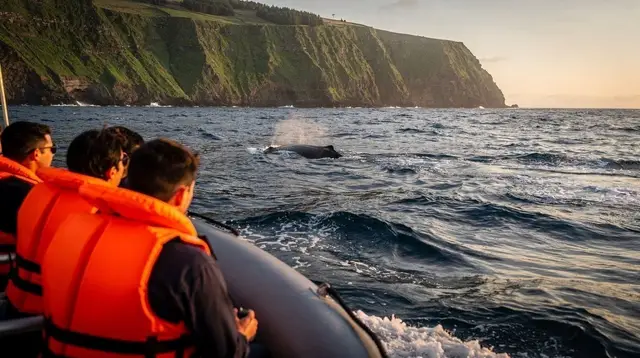
If seeing whales or dolphins matters to your trip, the calendar runs on its own logic, separate from beach weather. Whale and dolphin watching is strongest from April to October, which means the best whale-watching months don’t line up exactly with the driest, warmest ones.
Two different populations are behind that stretch. Blue, fin and sei whales pass São Miguel on their spring migration, roughly between March and June — some of the largest animals in the ocean, visible for a window measured in weeks rather than months. Separately, sperm whales and several dolphin species are resident around the island all year, which is why sightings are possible even outside the peak window, just less consistent.
Boats are guided from shore by vigias, lookouts descended from the whaling-era spotting posts (whaling itself ended in the Azores in the 1980s), and that guidance is a large part of why sightings are as reliable as they are here. Still, this is wild-animal watching, not a show with a schedule — no operator or guide can promise an encounter on a given day, and rough seas cancel trips more often outside the calmer summer months. If a whale sighting is the centrepiece of your trip, April to June gives you both the migration and generally settled seas, while July through September trades the migrating giants for calmer, more dependable boat conditions and resident sperm whales and dolphins.
a full loop of the Sete Cidades caldera and Lagoa do Fogo with a guide, useful whichever season you land in pairs well with a whale-watching morning, since both depend on settled weather rather than a specific month.
The shoulder seasons: April-June and September-October
For a lot of travellers, the shoulder months either side of summer are the best overall trade-off on São Miguel. April to June and September to October combine the strongest whale-watching window with a quieter, greener island and lower prices than the July-August peak. Rental cars are easier to find, restaurants take walk-ins more readily, and the island’s pastureland and hedgerows are at their greenest, especially before the summer dry-out sets in.
This isn’t a compromise season so much as the version of São Miguel many repeat visitors deliberately choose. You lose a couple of degrees of sea temperature compared with midsummer and the Vila Franca islet boat may run a shorter season depending on conditions, but you gain space — at Sete Cidades, at the Nordeste viewpoints, and at the thermal pools that get crowded in August.
Table comparing the two main options:
| June-September | April-June / September-October | |
|---|---|---|
| Sea temperature | Warmest, 22-24°C | Cooler, transitional |
| Whale watching | Good, resident species | Strongest window, incl. spring migration |
| Vila Franca islet boat | Full season | Season varies with conditions |
| Crowds | Highest | Noticeably lower |
| Prices | Highest, especially Aug | Lower than peak summer |
| Island scenery | Dry-season green fading | Greenest, hydrangeas building or fading |
Either a half-day around the Furnas caldera, its fumaroles and thermal pools or a combined day covering Sete Cidades, Lagoa do Fogo and a pineapple plantation works in any of these months, since none of it depends on swimming-warm sea temperatures.
Matching the season to your activities
Sea temperature, crowds and whale migration cover the big three, but a few other activities have their own seasonal logic worth weighing before you settle on a window.
Hikers generally do best in the drier months. Trails hold up better underfoot when the ground hasn’t had weeks of sustained rain, which matters most on routes with exposed rim sections or loose volcanic soil — see the comparison of São Miguel’s best hikes for how conditions vary trail by trail across the year. Canyoning works the other way around: the sport needs enough water moving through the ravines to be worth doing, so operators judge conditions against rainfall day by day rather than ruling out any particular month outright, and a season that’s too dry can leave a canyon with too little flow to run.
Thermal pools barely register the calendar at all. Caldeira Velha, Terra Nostra’s iron-rich pool and Poça da Dona Beija hold their heat regardless of the air temperature outside, and plenty of visitors find the contrast between cool air and hot mineral water more satisfying in the shoulder months and winter than in the heat of August — the full comparison of São Miguel’s thermal pools breaks down which sites suit which kind of visit.
Photographers and stargazers lean toward the same drier, calmer stretches that suit hikers, since low cloud and haze do more to spoil a sunset viewpoint or a night sky than the month printed on the calendar. Hydrangea season is the one clear exception, building through June to a July peak regardless of how dry or wet the summer turns out to be.
Cyclists tend to prefer the shoulder seasons to full summer. Cooler air makes the island’s climbs — and there are a lot of them, given how quickly the terrain rises from any coastal village toward the calderas — noticeably more manageable without giving up much daylight; see cycling on São Miguel for route ideas that suit the in-between months particularly well.
What this page deliberately leaves out
Two related questions get their own dedicated treatment rather than a section here. If you want the island broken down month by month — rainfall, typical temperatures, what’s blooming, what’s running — that detail lives in the month-by-month guide. And if you’re specifically weighing a winter trip (November to March), including what stays open, what gets cancelled more often, and why it’s a genuinely viable off-season rather than a dead one, that’s covered on its own in the winter low-season guide. Both are worth reading once you’ve settled on a rough window using this page.
Weather here is local, not seasonal
Whichever months you land in, treat any single forecast for São Miguel with some suspicion. The island is only around 65 km long, but its terrain — a chain of calderas, ridges and coastline — means conditions vary from one side to the other and change through the day. It’s entirely normal for Furnas to be under cloud and drizzle while Ponta Delgada, twenty minutes away, is dry and sunny, or for the road up to Lagoa do Fogo to be closed in fog while the coast below is clear.
This matters for planning more than the calendar month does. A flexible, multi-day itinerary that can shuffle an outdoor day for an indoor one — a museum, a tea plantation, a thermal pool — handles São Miguel’s weather far better than a tight single-day plan built around one forecast. It’s also why boat-based activities, from the Vila Franca islet crossing to whale watching, build in cancellation and rescheduling as a normal part of doing business here, not an exception.
Booking priorities by season
Whatever window you choose, a few things are worth locking in ahead of time rather than left to arrival:
- Rental car — the practical way to see the island in any season, and the first thing to sell out in July-August.
- Furnas restaurant tables, particularly for cozido — busiest around midsummer and around any long weekend.
- Whale-watching boats on good-weather days, especially during the April-June migration window.
- Popular jeep or full-day tours covering Sete Cidades, Lagoa do Fogo and Furnas together, which fill fastest on the best-forecast days of any season.
- Canyoning and other guided outdoor activities with limited daily group sizes, which book out faster in the shoulder months when demand and good conditions often overlap.
None of this changes much by season on its own — it’s really about how many other travellers are competing for the same limited pool of cars, tables and boat seats at any given time, which is highest in midsummer and lowest in the depths of winter.
For a broader sense of how many days to budget once you’ve picked a season, see how many days you need on São Miguel and the island’s realistic travel budget. And once a season and a day count feel settled, a ready-made itinerary — like the five-day in-depth route — is a faster way to see how the pieces fit together than planning from scratch.
Choosing Your São Miguel Season: Common Questions
What is the best overall time to visit São Miguel?
For most travellers, late spring (April to June) or early autumn (September to October) works best. Whale watching is at its strongest, the island is green, prices and crowds are both lower than in July and August, and the weather is still reasonably settled.
Is June to September the best time to go?
It’s the best time for heat and dry weather. The sea reaches its warmest, around 22-24°C, hydrangeas are in flower from June with a July peak, and the Ilhéu de Vila Franca boat trip runs on schedule. It is also the busiest and most expensive stretch, especially late July and August.
When is whale watching best on São Miguel?
Whale watching runs strongest from April to October. Blue, fin and sei whales pass on their spring migration roughly between March and June, while sperm whales and dolphins are resident year-round. No operator can guarantee a sighting on any given day.
What is the best time to visit for fewer crowds and lower prices?
The shoulder months of April to June and September to October offer the best trade-off: lower prices and car rental availability than peak summer, without losing the reliable whale-watching window or most outdoor activities.
Do I need to worry about a rainy day ruining my trip?
Plan for changeable weather rather than a single forecast. It can rain in Furnas while Ponta Delgada stays dry, and conditions shift from hour to hour. Thermal pools, caldeiras, tea plantations and museums stay open regardless; only boat trips get cancelled more often in unsettled weather.
How warm is the sea around São Miguel?
The Atlantic here runs from about 17-18°C in winter to 22-24°C at its summer peak. It’s noticeably cooler than Caribbean or Mediterranean waters year-round, which matters for anyone planning to swim at the Ilhéu de Vila Franca or Ponta da Ferraria.
How far ahead should I book for peak summer?
For July and August, book rental cars and Furnas restaurant tables well ahead, since availability tightens fastest in those two months. Shoulder-season travel (April-June, September-October) needs less lead time, but whale-watching boats and popular jeep tours still fill up on good-weather days.
Seasonal Guide on GetYourGuide
Verified deep-linked GetYourGuide tours. Book through these links and we earn a small commission at no cost to you.
GetYourGuide does not provide a product photo for this activity — the image shows the meeting point, photographed by us.