São Miguel Month by Month: What to Expect
What does each month look like on São Miguel?
Roughly: spring (March-May) brings the peak of whale migration and a greening island; summer (June-September) brings hydrangeas, the warmest sea and the busiest weeks, especially late July and August; autumn (September-October) keeps good weather with fewer crowds; winter (November-March) is mild but wet and windy, with boat trips cancelled more often. There is no single 'best' month, only trade-offs between weather, wildlife, flowers and price.
Ask ten people on São Miguel what month to visit and you will get ten different answers, because they are each answering a different question. Someone chasing whales wants a different window than someone chasing hydrangeas in bloom, and both want something different from a family trying to dodge school-holiday prices. This guide walks through the island’s year in loose seasonal blocks, month by month in feel rather than in exact dates, so you can weigh the trade-offs against what actually matters to your trip. For the single-line verdict on timing, see our best time to visit São Miguel guide; this page is the longer version.
One thing worth saying up front: this is a small, volcanic, Atlantic island, and its weather changes by the hour and by the coastline, not just by the season. It can be raining in Furnas while Ponta Delgada sits under sun. Every range below should be read as a tendency, not a promise, and our full weather guide goes deeper on how the island’s microclimates work.
The year at a glance
| Period | Feel | Whales | Hydrangeas | Crowds & prices |
|---|---|---|---|---|
| March-May | Greening up, showers between sun | Peak migration window | Not yet in bloom | Low to moderate |
| June | Early summer, warming | Migration tailing off, residents active | Starting to bud and open | Moderate, rising |
| July-August | Warmest, driest, busiest | Resident sperm whales and dolphins | Full bloom, peak in July | Highest of the year |
| September-October | Still warm, calmer | Occasional late migrants, residents | Bloom continuing, fading late | Moderate, easing |
| November-March | Mild but wet and windy | Residents only, boats cancelled more often | None | Lowest of the year |
Spring: March to May
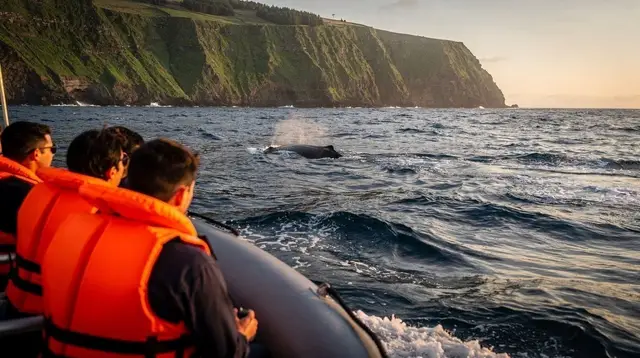
Spring is when the island turns from winter brown to the deep green that gives it the nickname Ilha Verde. It is also the strongest stretch for whale variety: blue, fin and sei whales pass on their spring migration roughly from March into June, layered on top of the sperm whales and dolphins that live off the coast year-round. If wildlife is the reason for your trip, this is the block of months to build around — our dedicated whale watching season guide covers the timing in detail, and the whale and dolphin watching overview explains how the boats and the shore-based vigias actually find them.
Sightings are never guaranteed in any month — that is true of wild-animal watching everywhere — but spring is when the odds and the variety of species are both at their best. Sea temperatures are still on the cool side this early in the year, and the crater lakes at Sete Cidades can be misty in the mornings before clearing by midday. Trails are quieter than in summer, which suits hikers heading toward Lagoa do Fogo or the laurel forest trails around the Serra da Tronqueira, where the rare priolo survives.
For a well-paced spring day, a guided outing takes the guesswork out of timing and access — a guided day covering both Sete Cidades and Lagoa do Fogo pairs the island’s two best-known craters into one trip without you having to plan the access roads yourself.
Early summer: June
June is the hinge month. The spring whale migration is winding down even as the resident sperm whales and dolphins keep the coast active, and the first hydrangea buds start opening along the roadsides and around the Sete Cidades caldera rim. Full colour is not guaranteed yet — bloom timing shifts from year to year — but by late June the hedgerows are noticeably filling in. Our hydrangea season guide covers the flowering window in more depth, and the hydrangeas and Sete Cidades viewpoints photo guide is useful if photography is the point of the trip.
Days are lengthening, the sea is warming without yet reaching its summer peak, and prices and crowds are still moderate compared to what is coming in July and August. It is often the quiet sweet spot for people who want green landscape and warm — not hot — weather without the peak-season booking scramble. A guided e-bike route is a pleasant way to cover ground around the caldera at this time of year: a guided e-bike ride around the Sete Cidades caldera takes in the viewpoints without the climbs being a barrier.
High summer: July and August
This is peak São Miguel. Hydrangeas are usually at their fullest, sea temperatures reach their warmest point of the year, and the island sees its busiest weeks — late July and August in particular. It is also the block where the Ilhéu de Vila Franca boat trips run most reliably, sea conditions allowing, and where restaurants around Furnas fill up fastest for cozido das Furnas bookings.
The trade-off is straightforward: the best flowers and the warmest water come with the highest prices, the fullest car-rental fleets, and the longest waits for a Furnas table if you have not booked ahead. If you are set on visiting in these months, book your car, your Furnas restaurant and any boat trips well before you land. For a coastal alternative to the crater-lake circuit, a guided run along the north coast pairs surf-town scenery with a swim stop: a guided tour to Ribeira Grande and Santa Bárbara beach covers that side of the island in a day.
Whale watching does not stop in summer — resident sperm whales and dolphins are around all year — but the wider variety of the spring migrants has largely moved on by this point. If diving in cooler water is on your list, our surf season and water temperature guide has the realistic range rather than a single number.
Autumn: September and October
Autumn often gets overlooked, which is part of its appeal. The sea is still warm from summer, hydrangeas can linger into September in a good year, and the crowds and prices of July and August have eased noticeably by October. It is a strong window for hiking the trails around Nordeste or the coastal paths near Faial da Terra without the summer heat or the summer queues.
Whale activity in autumn is quieter than the spring peak but not absent — the resident sperm whales and dolphins are still there, and occasional late migrants can still turn up. For travellers weighing wildlife against comfort and cost, autumn is often the most efficient trade of the whole year. A full-day guided loop through the eastern side of the island suits this season well: a full-day guided tour through Furnas and Nordeste covers caldera villages, viewpoints and thermal stops in one outing while the weather still holds.
Winter: November to March
Winter on São Miguel is honestly the low season, not a dead one. Days are mild rather than cold, but rain and wind are more frequent, and boat trips — whale watching included — are cancelled more often when the Atlantic kicks up. Our São Miguel in winter guide and the low season is not a dead season piece both go into what actually stays open.
And plenty does. The thermal pools at Terra Nostra Park and the Furnas area are heated by the ground, not the calendar, so they work exactly the same in January as in July — see our Terra Nostra thermal pool guide for what to expect. Tea plantations, museums, the caldeiras of Furnas and most restaurants stay open too. What you lose is reliable boat access and consistently dry hiking days; what you gain is the emptiest island of the year and its lowest prices for cars and rooms. Sperm whales and dolphins are still resident offshore through winter, though sea conditions mean fewer trips actually go out.
Matching the month to your priority
If you are choosing a month around one specific goal rather than the calendar in general, it helps to rank by what you actually care about:
| Priority | Best window | Trade-off |
|---|---|---|
| Widest whale variety | March-June | Sea still cool, hydrangeas not yet out |
| Hydrangeas at their fullest | Late June-September, peaking around July | Warmest weeks are also the busiest and priciest |
| Lower prices, fewer crowds | November-March, or September-October as a milder version | Winter boats cancel more often |
| Balanced weather and wildlife | April-June or September-October | Rarely the single “best” for any one thing, but rarely the worst for anything either |
| Warmest sea for swimming | July-September | Peak-season booking pressure |
None of these windows are exclusive of each other — the point of laying them out separately is that “best time to visit” depends on which row you are optimising for. A first-time guide to São Miguel and a sense of how many days you need on the island are worth reading alongside this page before you lock in dates, since the right month also depends on how long you are staying and how much ground you plan to cover.
Whichever month you land in, build in flexibility for weather. A hiking day around Sete Cidades or a boat trip out of Vila Franca do Campo can move by a day without much trouble if you leave slack in the itinerary — the island rewards travellers who treat the forecast as a rough guide, not a fixed script.
If you want a structured guide to hiking that works across seasons, private hiking with a local guide is worth booking directly rather than planning solo: a private hiking day with a local guide can adjust the route on the day if the weather turns.
Frequently asked questions about São Miguel’s seasons
What is the best month to visit São Miguel?
There is no single best month, but late spring and early autumn tend to balance well: whale activity is still strong, the island is green, and prices and crowds are lower than in high summer. If hydrangeas in full bloom matter most to you, aim for a window that leans later into summer instead.
Is there a truly bad month to visit São Miguel?
No month closes the island down. Winter is wetter and windier, and boat trips are cancelled more often, but thermal pools, caldeiras, tea plantations and museums all stay open, and fares and rooms are at their cheapest.
When do the hydrangeas bloom on São Miguel?
Hydrangeas flower roughly from June to September, with the fullest colour usually landing around July. Exact timing shifts year to year with the weather, so treat any date as a rough guide rather than a guarantee.
When is whale watching best on São Miguel?
Blue, fin and sei whales pass on their spring migration roughly between March and June, while sperm whales and dolphins are resident on the coast all year. That makes spring the richest stretch for variety, though a trip in any season can still turn up sightings.
Is São Miguel warm enough to swim in winter?
The sea stays cool rather than cold, but it is a fresh Atlantic swim, not a tropical one, even in the warmer months. The thermal pools at Furnas and Ponta da Ferraria stay usable year-round regardless of sea temperature, since their heat comes from the ground, not the season.
Does it rain every day in the wet season?
No. Even in the wetter months rain tends to arrive in bands rather than as constant drizzle, and the island’s microclimates mean one side can be dry while another is under cloud. Pack for changeable weather in any month rather than expecting either a washout or a guaranteed dry week.
Should I avoid São Miguel in August?
Not necessarily, but plan ahead: late July and August are the busiest weeks, with hydrangeas at their most photogenic and cars, Furnas restaurants and popular boat trips booking up well in advance. It rewards early planning more than any other month, rather than being a month to skip.
Seasonal Guide on GetYourGuide
Verified deep-linked GetYourGuide tours. Book through these links and we earn a small commission at no cost to you.
GetYourGuide does not provide a product photo for this activity — the image shows the meeting point, photographed by us.