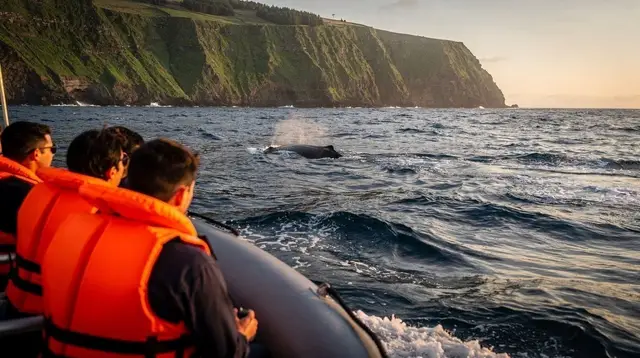
Whale and Dolphin Watching on São Miguel
When is the best time to see whales and dolphins on São Miguel?
Sperm whales and dolphins live off São Miguel year-round, so trips run in every season. Blue, fin and sei whales pass on their spring migration, roughly March to June, which is why April to October is the strongest overall window - but sightings are wildlife, never a scheduled guarantee.
Two Kinds of Whale Watching, Every Day of the Year
Ask an operator in Ponta Delgada when to book a whale watching trip and the honest answer is: depends what you want to see. São Miguel sits above a stretch of deep Atlantic water close to shore, which is why boats can reach open sea from the marina in under half an hour and still be over depths that whales use. That geography supports two very different populations, and confusing them is the single most common way visitors end up disappointed.
The first group lives here permanently. Sperm whales hold territory in these waters year-round, diving for squid at depth and surfacing to breathe in predictable, if not guaranteed, patterns. Common dolphins, bottlenose dolphins, and at times Risso’s dolphins and Atlantic spotted dolphins move around the island in pods that can number in the dozens. None of these animals migrate away for winter. A trip in January can, and does, see them.
The second group is only passing through. Blue whales, fin whales and sei whales - three of the largest animals on the planet - use the waters around the Azores as a corridor on their spring migration, moving north from tropical breeding grounds toward Arctic and subarctic feeding grounds. They are not residents of São Miguel; they are commuters, visible for a window of a few months and largely absent the rest of the year. Seeing one is a different proposition from seeing a dolphin pod, and the timing matters far more.
Both groups are covered on the same boats, usually the same trip, which is part of why “best time to visit” and “best time to see a blue whale” are not the same question. A full breakdown of species by season is in our best time to go for whale watching guide; this page focuses on the mechanics behind the timing, and on why even the best-timed trip is still a roll of the dice.
Who Is Actually Out There: Residents vs Spring Migrants
The clearest way to plan around this is to separate what is always here from what only shows up for part of the year. The resident species are covered in more depth in our guide to sperm whales and dolphins resident all year; the migratory pattern is unpacked further in blue, fin and sei whales’ spring migration. Here is the short version.
| Species | Status off São Miguel | Typical window |
|---|---|---|
| Sperm whale | Resident | All year |
| Common dolphin | Resident | All year |
| Bottlenose dolphin | Resident | All year |
| Risso’s dolphin | Frequent visitor | All year, more often in warmer months |
| Blue whale | Spring migrant | Roughly March to May |
| Fin whale | Spring migrant | Roughly March to June |
| Sei whale | Spring migrant | Roughly April to June |
| Humpback whale | Occasional passage migrant | Sporadic, mostly spring |
Sperm whales are the animal most associated with the Azores, partly because of the whaling history and partly because their diving behaviour - a long surface interval followed by the distinctive raised fluke as they sound - makes them easier for a boat crew to track and predict than a fast-moving pod of dolphins. Because they hold territory rather than migrating, an operator working out of São Miguel builds real local knowledge of where individuals tend to surface, which is one reason sightings are as consistent as they are, month to month.
The migratory rorquals are a different story. Blue whales are the largest animal that has ever lived, and seeing one from a small boat is memorable in a way little else on the island matches - but they are only funnelling past São Miguel for a matter of weeks each spring, following food rather than any fixed schedule, and a late or early season shifts the window by weeks in either direction. Fin whales, the second-largest species, tend to have a slightly longer presence than blues; sei whales usually arrive last and leave last, stretching a little further into early summer. None of this is exact, because it is migration, not a ferry timetable.
When the Odds Are Best: A Month-by-Month Look
Stacking the two patterns together gives a rough shape to the year rather than a guarantee for any given week.
March to June is peak migration season. This is when a trip has the best chance of combining resident dolphins and sperm whales with a passing blue, fin or sei whale, and it is the only realistic window for the big rorquals at all. Sea conditions in early spring can still be rougher than midsummer, so morning departures and flexible dates help.
April through October is the period every local operator points to as the strongest overall stretch, and it is the range most guides on the island use as shorthand for “whale watching season.” It captures the tail of the spring migration, the calmer, more settled seas of summer that make spotting easier, and the months when boats run daily rather than opportunistically.
July to September brings the calmest seas and the longest daylight, ideal for visibility, but the migratory whales have largely moved on by midsummer. Trips in this window are almost entirely about resident sperm whales and dolphins, plus the general improvement in comfort and reliability that calm water brings.
November to March is the low season for boat trips generally - not because the animals leave, since sperm whales and dolphins do not - but because rougher Atlantic weather cancels a higher share of departures. Trips that do run can be just as rewarding, with far fewer other passengers aboard, but flexibility with dates matters more here than in any other season. Our month-by-month breakdown of when whale watching is best goes further into this trade-off between species range and sea comfort.
None of these windows are hard borders. A blue whale has been reported in early July; a flat, glassy February morning has produced excellent dolphin encounters. Treat the ranges above as where probability shifts, not as a promise attached to a calendar date.
What a Trip Actually Looks Like
Almost every whale watching trip on São Miguel follows the same basic structure, whether it departs from the marina at Ponta Delgada or the smaller harbour at Caloura on the south coast. Boats leave in the morning, when the sea is typically calmer and animal activity tends to be higher, though some operators also run afternoon or sunset departures. A standard trip runs three to four hours; full-day versions exist, often pairing the search with a swim stop or extra time along the coastline.
Before leaving harbour, most crews are already in contact with land-based spotters scanning the water from elevated points along the coast - a lookout system with direct roots in the island’s whaling past, when the same vantage points were used to signal boats toward sperm whales rather than away from them. That history, and how the modern spotting network actually works, is covered in full in our guide to vigias and the island’s whaling heritage; this page only needs the practical point, which is that a trip is being actively guided, not just puttering around hoping to get lucky.
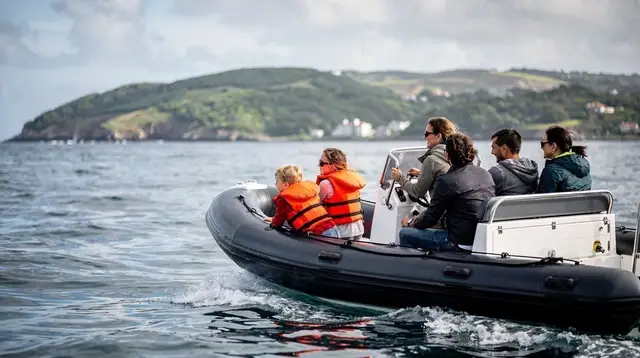
Once on the water, crews narrate what you are seeing, note behaviour, and generally keep a respectful distance mandated by local wildlife regulations - boats do not chase or corner animals, and slow down or hold back if a pod changes direction toward the coast. What you should actually expect once aboard, including realistic odds and how crews handle a quiet day, is set out in detail in what a whale watching boat trip is really like. For families weighing whether the boats work for younger children, see our separate note on whale watching with children, since the answer depends more on hull type and sea state than on age alone.
Why No Boat Can Promise a Sighting
This is worth stating plainly because it gets glossed over in marketing more often than it should: whale and dolphin watching on São Miguel is wildlife watching, not a scheduled attraction. Sperm whales dive for up to an hour at a time and can surface anywhere within a wide radius; dolphin pods move fast and unpredictably; the migratory whales are, by definition, only in these waters for a limited season and are not obliged to appear on any single afternoon. Spotters and experienced skippers shift the odds considerably in your favour, but they do not control the ocean.
Operators generally quote a high success rate across a season - most report the large majority of trips see something - but that figure is an average, not a guarantee for your specific outing. Weather adds another layer: swell, wind and poor visibility can force a trip to be shortened, rerouted, or cancelled outright, independent of whether animals were present. What that means for cancellations, rebooking and refunds is covered separately in weather cancellations on whale watching trips explained. The fair way to plan is to treat a sighting as the likely outcome of a well-guided search in good conditions - not as something purchased along with the ticket.
Booking a Trip: What to Choose
For a first outing, a standard three-hour trip covers the essentials without a long commitment on the water, and works well paired with another activity the same day. The three-hour whale and dolphin watching trip from São Miguel is built around exactly this format: a focused search with an experienced crew and spotter contact, back at the harbour in time for lunch.
Travellers who want more time on the water, or who like the idea of a swim stop worked into the day, tend to prefer the full-day whale watching and wild dolphin swimming trip, which trades a longer commitment for a wider search area and the chance to get in the water where conditions allow.
Not every good marine day has to centre on whales. If the forecast favours light and calm water more than active wildlife, the sunset boat tour along the cliffs and sea caves is a good lower-pressure alternative, still very much on the water and often turning up dolphins along the way without being built around a sighting. For a visit that mixes the coastline with the island’s interior in a single booking, the private island highlights tour by boat and car combines a marine outing with sites further inland, useful for a shorter stay that cannot spare a separate day for each.
Whichever trip you pick, build in slack. Departures shift with weather more than with anything else on this island, and a whale watching morning sits well at the start of a longer visit rather than on the last possible day, when there is no room left to rebook. Our best time to visit São Miguel guide and dedicated whales and sea itinerary both build that flexibility in from the start, and the whale watching category page lists every operator and trip style running from the island if you want to compare beyond the four above.
For the broader context on why guarantees do not belong anywhere near this activity, our short reads on why sightings are never guaranteed and on the whaling that ended in the Azores in the 1980s are worth a few minutes each. Boats also run from Capelas on the north coast, a former whaling station that puts today’s watching trips in useful perspective.
FAQ: Whale and Dolphin Watching on São Miguel
Are whale watching sightings on São Miguel guaranteed?
No, and no honest operator will say so. These are wild animals in open ocean, not a show on a timetable. Most trips do see something, but a small share come back having spotted only birds or nothing at all.
What is the best month to see blue whales off São Miguel?
Blue, fin and sei whales pass São Miguel on their northbound spring migration, mostly between March and June, with numbers usually peaking in April and May. Outside that window they are rarely reported.
Can you see whales and dolphins on São Miguel all year?
Dolphins and sperm whales are resident year-round, so trips run in every month including winter. The wider mix of species, and generally calmer seas for spotting, favour April to October.
How long does a whale watching trip last?
Most boats out of São Miguel run three to four hours, long enough to reach open water and search a wide area. Full-day trips exist too, combining watching with swimming stops or extra coastline.
Do whale watching boats on São Miguel still use vigias?
Yes, most operators keep contact with shore-based spotters known as vigias, a role that survives from the whaling era. Their history and how the lookout system works is covered separately in our vigias guide.
Is whale watching suitable for children on São Miguel?
Generally yes, on the shorter three-hour trips in calm conditions, though open-Atlantic swell can be tiring or uncomfortable for younger kids. Families should check hull type, seating and age minimums before booking.
What happens if a whale watching trip on São Miguel is cancelled?
Operators cancel or postpone for sea state, wind or fog rather than run an unsafe or pointless trip. Most rebook you for another slot or refund; ask about the policy before paying.
Do I need to book a whale watching trip on São Miguel in advance?
In the busiest months, from June to September, popular morning departures can sell out days ahead, so booking in advance is worth it. Outside peak season same-week booking is usually fine, weather allowing.
Whale Watching on GetYourGuide
Verified deep-linked GetYourGuide tours. Book through these links and we earn a small commission at no cost to you.
GetYourGuide does not provide a product photo for this activity — the image shows the meeting point, photographed by us.