Whales and Sea: A 2-Day São Miguel Itinerary
Two Days Built Around the Atlantic
This itinerary keeps the car in second gear. Instead of circling the island, it stays on the south coast for two days and puts the sea at the centre of both of them: a morning on the water looking for whales and dolphins, an afternoon at a working harbour, and a second day that ends with a boat trip inside a sunken crater. It works well tacked onto a longer full island itinerary or as a short, focused break in its own right, and it pairs naturally with a stay based in Ponta Delgada rather than out east.
Two honest caveats before you book anything. First, this plan does not hold up well between November and March, when boat trips out of Ponta Delgada and Vila Franca do Campo are cancelled far more often for sea conditions — swap it for a winter escape instead. Second, nothing here is a promise: sightings are usual, not guaranteed, and the islet crossing runs in season and calm weather only.
This itinerary sits at the short end of what’s possible on São Miguel. If two days feels tight, the same sea-and-south-coast idea stretches further inside the five-day in-depth itinerary, and if you’d rather not rent a car at all, a version of the whale-watching morning also works inside the multi-day itinerary built around buses and tours, since the Ponta Delgada departure point doesn’t require driving anywhere.
Day 1: Whale Watching from Ponta Delgada, Afternoon in Caloura
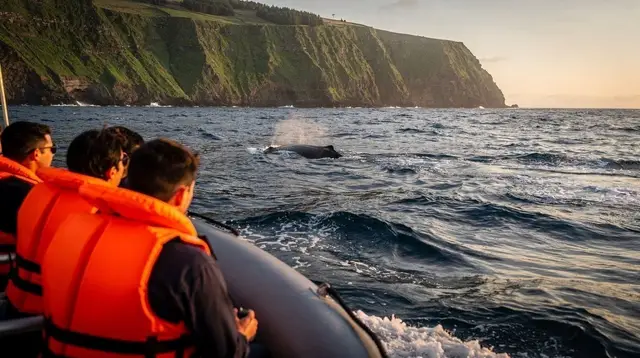
Base yourself in Ponta Delgada and start the morning at the marina near Portas do Mar, where most whale-watching boats leave from. April to October gives the strongest odds of a sighting: sperm whales and dolphins are resident around the island all year, while blue, fin and sei whales pass through on their spring migration, roughly March to June. Outside that window sightings still happen, but less predictably.
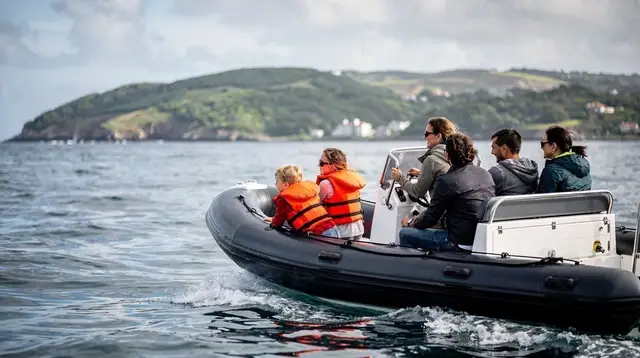
The boats themselves are guided by vigias, shore-based spotters who once worked for the whaling stations that operated here until whaling ended in the Azores in the 1980s — the same skill, redirected. Crews watch the horizon and radio each other, and even so, a trip can come back having seen dolphins but no whales, or nothing at all. No operator can promise otherwise, and neither can this page. Expect a briefing on safety and etiquette before you leave the harbour, roughly two to three hours on the water, and a good chance of spray and swell even on a calm day — dress for wind, not for the temperature on land. If mornings are booked out, some operators run afternoon departures too; check before assuming a slot is free.
Back on shore by early afternoon, drive roughly twenty minutes south-east to Caloura, a small fishing harbour tucked into the cliffs below Água de Pau. There is little to do here in the organised-activity sense, which is the point after a morning of engine noise and horizon-scanning: a natural sea pool cut into the rock, boats pulled up on the slipway, and a couple of places to eat with the water a few metres from the table. It is also one of the quieter spots to watch the coastline for dolphins on your own, with no schedule attached.
Caloura rewards a slower look than most itineraries give it. Beyond the harbour and the sea pool, small boats run short trips along this stretch of coast, and the sheltered water below the cliffs is one of the few spots on the south shore where snorkelling straight off the rocks is a realistic option rather than a beach-only activity. A separate guide covers Caloura’s harbour and the boat trips that leave from it in more detail, for anyone tempted to turn the afternoon stop into more than a coffee break.
If the morning boat is cancelled — it happens, and no refund makes up for a missed island day — a land-based alternative near Ponta Delgada is a walk through the old town with a guided historic tour of Ponta Delgada, which covers the Portas da Cidade, the Forte de São Brás and the market streets on foot, weather permitting regardless of sea state.
Some operators also run whale-watching departures from further along the north coast near Ribeira Grande; if your accommodation sits closer to the north shore, it’s worth checking that option before defaulting to Ponta Delgada.
For a fuller sense of what a whale-watching trip actually involves once you’re on the boat — the briefing, the radio contact with the vigias, the realistic odds hour by hour — a dedicated guide walks through what to expect on a whale-watching boat trip. It’s worth reading before you book, especially if this is a first attempt and expectations need calibrating against the sea rather than a brochure. Anyone basing themselves on the north coast rather than in Ponta Delgada can also look at watersports options around Ribeira Grande to fill the rest of the day around a morning boat trip.
Day 2: Vila Franca do Campo and the Islet Crossing
Drive south-east along the coast to Vila Franca do Campo, about twenty minutes from Ponta Delgada. It’s a town worth more attention than a passing glance: it was the island’s capital until 1522, when an earthquake-triggered landslide buried the original settlement and forced the move to Ponta Delgada. Little of that history is dramatic to look at today — a harbour, a hillside chapel, low white houses — but the fact reframes the town from “stop on the way” to the place São Miguel actually started from.
The main event, sea and season allowing, is the crossing to the Ilhéu de Vila Franca, the crescent-shaped islet just offshore that is the drowned rim of an old crater. It’s a protected nature reserve with a daily visitor cap, reached by a short boat from the town marina, and it only runs in season and in calm seas — never in heavy swell, and never guaranteed on any given day even in July. Inside the ring, the water is sheltered enough for swimming and snorkelling when conditions allow, which is the closest São Miguel gets to a lagoon. Build in slack time: if the crossing is cancelled, there is no fixed alternative that replaces it, only the town itself and the coast road.
Inside the ring, snorkelling the flooded crater is the main draw once the boat has crossed over — sheltered enough that the water is usually calmer than the open sea you crossed to get there, though a life jacket and basic swimming ability are assumed rather than checked. For visitors who’d rather build the whole day around Vila Franca do Campo itself, without tying it to the islet’s uncertain schedule, a separate Vila Franca do Campo day-trip guide lays out the town on its own terms.
For a broader look at the south coast without depending on the islet crossing, a half-day tour through Vila Franca do Campo and its surroundings covers the town, the coastline and the viewpoint above it at a fixed pace, which is a reasonable fallback if the boat is off.
Two land-based options go further inland and uphill rather than out to sea: a 4x4 route above Vila Franca with views over Furnas lake, and a quad-buggy route on back roads around the town — both keep the day going if the sea has other plans.
If you have energy left in the late afternoon, a short detour back toward Ponta Delgada includes the option of a guided visit to a working apiary near Ponta Delgada, a low-key, land-based way to close a sea-heavy two days with something unrelated to boats entirely.
Where to Stay for This Itinerary
Because both days run along the south coast between Ponta Delgada and Vila Franca do Campo, basing yourself in Ponta Delgada makes the most sense here — it’s where most whale-watching boats leave from, and Caloura and Vila Franca do Campo are both a short drive away rather than a detour. A broader comparison of Ponta Delgada against Furnas as a base is worth reading if you’re combining this itinerary with a longer stay, and the general guide to where to stay on São Miguel covers the trade-offs island-wide for anyone still deciding.
Planning This Whale-and-Sea Itinerary
| Element | Detail |
|---|---|
| Best months | April to October, for both whale sightings and calmer seas |
| Weak months | November to March — boat trips cancel far more often |
| Departure points | Ponta Delgada marina (whale watching), Vila Franca do Campo marina (islet) |
| What can fall through | Either boat trip, on short notice, for sea conditions |
| Car needed | Yes, for the Ponta Delgada–Caloura–Vila Franca do Campo road |
| Booking window | A few days ahead in July–August; more flexible outside peak season |
A few practical notes worth holding onto. Book the whale-watching trip and the islet crossing separately — they’re run by different operators on different schedules, and neither guarantees the other’s availability. Confirm both the evening before if you can, since cancellations for sea state are usually called that morning, not days out. And keep a backup half-day in mind: the thermal pools compared across the island or a walk around old-town Ponta Delgada both work as dry-land substitutes if the Atlantic doesn’t cooperate.
Extending or Shortening This Itinerary
Two days is enough to try both boat trips once each, but it leaves the rest of the island untouched. Anyone with more time can fold this plan into the seven-day complete itinerary, which already includes a whale-watching morning as one stop among several. Going the other way, a single day built around just the whale-watching trip fits inside the classic two-day itinerary if the islet crossing isn’t a priority, or the budget getaway itinerary if cost matters more than covering every boat trip on the island.
FAQ About Whale Watching and the Vila Franca Islet on São Miguel
Is whale watching guaranteed on this itinerary?
No. Sightings are usual between April and October but never promised — operators guide boats using vigias, shore spotters, and can still come back without a whale on a given day.
When are whales most likely to be seen near São Miguel?
Sperm whales and dolphins are resident around the island all year, while blue, fin and sei whales pass through on a spring migration roughly between March and June, which is why April to October is given as the strongest overall window.
Can I do the Vila Franca islet crossing in winter?
Not reliably. The crossing runs in season and only in calm seas, and both the season and the sea conditions narrow sharply from November to March.
What if the boat trip is cancelled for weather?
Cancellations are usually confirmed the morning of departure. Build a land-based backup into the day — a historic walk in Ponta Delgada, a half-day tour around Vila Franca do Campo, or a nearby thermal pool — rather than counting on a same-day reschedule.
Do I need a car for this itinerary?
Yes. Ponta Delgada, Caloura and Vila Franca do Campo sit along the same stretch of south coast road, and there’s no fixed sightseeing bus timetable that links them conveniently for a two-day trip.
Is the water inside the Vila Franca islet safe for swimming?
When the crossing is running at all, conditions are considered safe enough for swimming and snorkelling inside the sheltered ring — but the boat itself only operates in calm seas, so if it’s running, the water inside is generally settled too.
Why does whale watching mention whaling history?
The vigias who guide today’s whale-watching boats descend from the shore-based spotters used during the whaling era, which ended in the Azores in the 1980s — the same watching skill, now used to find whales rather than hunt them.
What happens during a typical whale-watching trip on São Miguel?
Expect a safety briefing at the harbour, roughly two to three hours at sea, and spotting guided by vigias on shore who radio the boats. A full walkthrough of what to expect is covered in this guide to whale-watching boat trips.
How often do boat trips get cancelled for weather on this itinerary?
Often enough that it’s worth planning around, especially outside April to October. A dedicated guide to weather-related cancellations on São Miguel’s boat tours explains how operators decide and how last-minute the call usually is.
Whale Watching on GetYourGuide
Verified deep-linked GetYourGuide tours. Book through these links and we earn a small commission at no cost to you.
GetYourGuide does not provide a product photo for this activity — the image shows the meeting point, photographed by us.