Where to Stay on São Miguel
Where should I stay on São Miguel?
There is no single right base. Ponta Delgada is the capital, with the airport and the most restaurants and services; the north coast, Furnas and Sete Cidades are all quieter alternatives, and the EN1-1A ring road means every region can reach the rest of the island in loops rather than one-way drives.
Four Regions, One Ring Road
São Miguel is about 65 km long and 8-15 km wide, and the EN1-1A road runs the length of it in a loop, with a faster via rápida connecting Ponta Delgada to Ribeira Grande and Lagoa. That geography changes the usual question of “where should I stay” into something less binding than it is on most trips. Because you can drive most of the island and back in a day from nearly any point on the ring, choosing a base here is less about locking yourself into one region and more about deciding which mornings and evenings you want to spend close to home.
This guide walks through the island’s main regions — the capital and south coast, the north coast, Furnas, and Sete Cidades — as places to base yourself, not as a ranking. Each has a genuinely different character, and each puts you within a workable drive of the rest of the island. If you want a direct answer on splitting your nights between two specific bases, that trade-off is covered separately in Ponta Delgada or Furnas as your base; if you want a day-by-day plan once you’ve picked, see how to plan a São Miguel itinerary. Here, the goal is simply to lay out what each area is actually like to stay in.
Ponta Delgada and the South Coast
Ponta Delgada is the island’s capital and by far its largest town, with around 68,000 people in the municipality. It is also the most practical arrival point: João Paulo II airport (PDL) sits only 2-3 km from the centre, which matters on the first and last nights of a trip when you’d rather not add a long drive to a jet-lagged evening. The marina and cruise front at Portas do Mar sits right in town, along with the historic Portas da Cidade arches, the Mercado da Graça food market, and the widest concentration of restaurants, cafés and shops on the island.
Staying in or near Ponta Delgada means the shortest possible drive from the airport, the most choice for eating out on nights you don’t want to cook or drive, and easy access to boat trips leaving from the marina. It also puts you within reach of the south coast towns — Vila Franca do Campo, the island’s capital until an earthquake-triggered landslide buried it in 1522, and Caloura with its small harbour — both a short drive east along the coast road.
The trade-off is that Ponta Delgada is the busiest part of the island, with town traffic, cruise-ship days and the least sense of rural quiet. If your priority is proximity to the airport, restaurants, and boat departures, the south coast around the capital is the most convenient single choice. If you want mornings that start in caldera stillness rather than town noise, one of the other regions may suit you better — this is a genuine trade-off, not a wrong turn either way.
The North Coast
North of the central ridge, Ribeira Grande is the island’s second town, smaller and quieter than the capital but still equipped with its own shops, cafés and services. The north coast is defined by water in more than one sense: the surf beach at Praia de Santa Bárbara, the thermal waterfall and pools at Caldeira Velha on the slope of the Água de Pau massif, and the tea plantations of Gorreana, founded in 1883 and the oldest working tea estate in Europe.
A north-coast base sits close to the via rápida into Ponta Delgada, which keeps the capital within easy reach for evenings out, while placing you nearer to the drive up toward Lagoa do Fogo and along toward Nordeste on the island’s quieter eastern arm. It also suits anyone drawn to surfing, since Santa Bárbara is the island’s main surf beach and the water and swells here are treated more seriously than on the sheltered south coast.
What the north coast doesn’t offer is the density of dining and nightlife found in the capital, or the concentration of thermal sights found in Furnas. It reads as a working coastline of fishing towns, like Rabo de Peixe, and tea fields rather than a resort strip, which is exactly its appeal for travellers who want to slow down without going fully rural.
Furnas
Furnas sits inland, inside its own active caldera in the east of the island, and staying here feels distinctly different from staying on the coast. Steaming caldeiras vent through the village itself, the Terra Nostra garden holds its iron-rich, orange thermal pool, and Poça da Dona Beija offers another set of mineral pools a short walk from the centre. At the Lagoa das Furnas, restaurants still cook cozido in pots lowered into the hot ground — a process that takes 5 to 7 hours and needs booking ahead, since the hole belongs to the kitchens, not to visitors.
A base in Furnas puts the geothermal side of the island at your doorstep and removes the drive that day-trippers make from the coast. It’s a genuinely quiet place in the evening, with the sulphur smell of the caldeiras part of the experience rather than a novelty. Furnas has no beach of its own — the nearest one, Ribeira Quente, is on the far side of the ridge — and its restaurant and shop options are more limited than the capital’s, which matters if you want variety over several nights.
The drive from Furnas back to Ponta Delgada or the north coast takes roughly 40 minutes to an hour depending on the route chosen, which is comfortable for day trips but worth factoring in if you’re arriving late or catching an early flight.
Sete Cidades
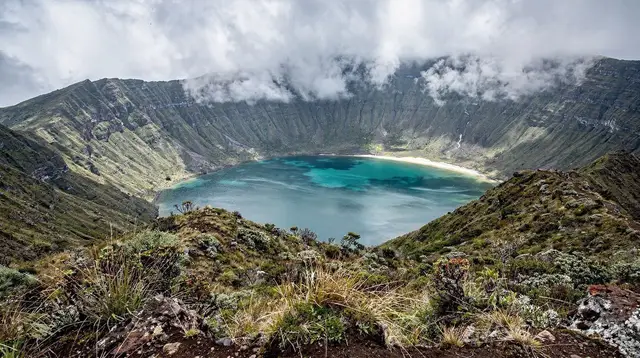
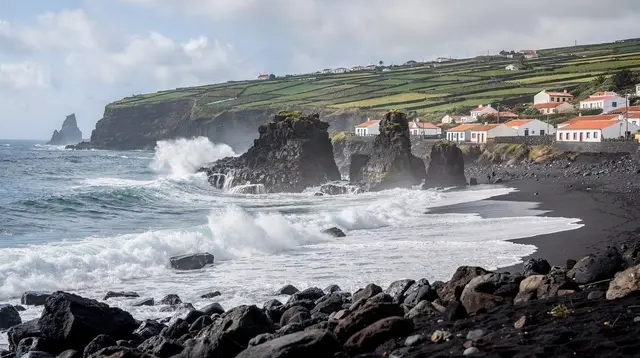
In the far west, Sete Cidades is a small village sitting inside a caldera, wrapped around the twin lakes Lagoa Azul and Lagoa Verde. It’s one of the most photographed spots on the island, especially from the Vista do Rei viewpoint above the rim, and the drive out here alone — past Mosteiros and its black-sand beach, or via Ponta da Ferraria where a hot spring meets the sea — is part of the appeal.
Staying inside or near the caldera puts you close to sunrise and evening light over the lakes without the drive that day visitors make from the coast, and near the western viewpoints and walking trails without needing an early start. It is the most rural and remote of the four regions covered here: services are minimal, the village itself is small, and the pass in and out can be closed or fogbound, since the weather here changes quickly and the caldera often sits under cloud even when the coast is clear.
This makes Sete Cidades a strong choice for travellers prioritising quiet, photography, and proximity to the western walking trails, and a less practical one for anyone who wants a wide choice of restaurants or a short drive to the airport.
Comparing the Regions
| Region | Distance to PDL airport | Character | Best suited to |
|---|---|---|---|
| Ponta Delgada / south coast | 2-3 km | Town, marina, most restaurants and shops | Short airport transfers, dining variety, boat departures |
| North coast (Ribeira Grande) | Roughly 20-25 minutes | Working coastal towns, surf beach, tea fields | Surfing, quieter pace, access to Nordeste and Lagoa do Fogo |
| Furnas | Roughly 40-60 minutes | Inland caldera, thermal pools and cozido | Geothermal sights, quiet evenings, unhurried mornings |
| Sete Cidades | Roughly 45 minutes | Remote caldera village, lake views | Photography, western viewpoints, quiet and scenery over services |
These drive times are approximate and depend on the route and weather — the passes to Lagoa do Fogo and Sete Cidades in particular can add time or close outright in poor conditions.
Getting Around Whichever Base You Choose
Whichever region you settle on, the practicalities of moving around the island stay the same. A rental car is the practical default: buses run through operators like Auto Viação Micaelense, Varela and Caetano, but on school and work schedules rather than tourist ones, and there is no train anywhere on the island. The EN1-1A rings São Miguel and the via rápida speeds up the stretch between Ponta Delgada, Ribeira Grande and Lagoa, but roads elsewhere are narrow and mountain passes can close with fog or wind.
This is really the point of thinking about the island as a ring rather than a fixed base: a traveller staying in Ponta Delgada can still spend a full day exploring Furnas or Sete Cidades and drive home in the evening, and the reverse is just as true. What changes with your choice of base isn’t what you can reach — it’s what your mornings and evenings feel like, and how far the day’s driving stretches before you’re back at your accommodation.
Booking Activities From Any Base
Most guided activities on the island are built to collect and return visitors regardless of where they’re staying, which is another reason the choice of base matters less than it might elsewhere. A full loop of the western caldera and coastline, such as the guided tour taking in Sete Cidades and the western coast, typically picks up from Ponta Delgada and several other points. Travellers who want to cover more ground in a single day, including the crater villages and viewpoints, often choose an island-wide jeep tour for exactly that reason — it’s built around collecting guests rather than requiring a specific base.
For those staying away from Furnas but still wanting the geothermal side of the island without driving themselves, a half-day tour of Furnas’ caldeiras and thermal park covers the cozido lunch, the fumaroles and Terra Nostra in one outing. None of these require staying near their starting point, which is worth remembering if a region appeals to you for its accommodation but not for its logistics.
Choosing a Base on São Miguel: FAQ
Is it better to stay in Ponta Delgada or in the countryside?
Both work. Ponta Delgada puts you closest to the airport, the widest choice of restaurants, and the marina at Portas do Mar, while a base in Furnas, the north coast or Sete Cidades trades some convenience for quieter evenings and shorter drives to specific sights.
Do I need to stay in more than one place on São Miguel?
No. Because the EN1-1A rings the island and a dual-carriageway via rápida links Ponta Delgada with Ribeira Grande and Lagoa, most regions are reachable on a day loop from a single base. Splitting your stay can shorten some drives, but it is a preference, not a requirement.
How far is each region from Ponta Delgada’s airport?
Ponta Delgada itself sits 2-3 km from PDL airport. The north coast around Ribeira Grande is a short drive further, Furnas is roughly 40 minutes to an hour depending on the route, and Sete Cidades is around 45 minutes on the western road.
Which region is best for whale watching and boat trips?
Boat trips leave from several harbours, including Ponta Delgada’s marina, Vila Franca do Campo and Caloura on the south coast. A south-coast or Ponta Delgada base keeps you close to a launch point, but boats also run day tours that collect visitors from other parts of the island.
Is a car necessary wherever I stay?
A rental car is the practical default across the whole island. Buses exist on the main routes but run on school and work timetables rather than sightseeing ones, and there is no train, so most regions are more comfortable with a car regardless of where you base yourself.
Is Furnas too far from the coast to be a good base?
Furnas sits inland, in its own caldera, so it has no beach of its own — its coastal side is Ribeira Quente, over the ridge. It works well as a base for the geothermal and eastern sights, but expect a drive of 30-45 minutes to reach the coast or Ponta Delgada.
Does the weather differ much between these regions?
Yes, and it can differ by the hour. It is common for Furnas to sit under cloud while Ponta Delgada is dry, or for the Sete Cidades caldera to be fogged in while the north coast is clear, so no single base guarantees sun.
Planning on GetYourGuide
Verified deep-linked GetYourGuide tours. Book through these links and we earn a small commission at no cost to you.
GetYourGuide does not provide a product photo for this activity — the image shows the meeting point, photographed by us.