East Coast or West Coast: Which Side of São Miguel First?
Should I visit São Miguel's east coast or west coast if I'm short on time?
If you can spare only one full day outside Ponta Delgada, most first-time visitors get more from the west, where Sete Cidades' twin crater lakes are the island's single most photographed sight and sit under an hour from the capital. The east side, built around Furnas' active caldera and the high forest of the Serra da Tronqueira, rewards a full day of its own and is worth the extra driving time on a second day rather than a rushed detour on the same one.
Two ends of one island, not one easy loop
São Miguel is roughly 65 km long, and its two best-known landscapes sit at opposite ends of that length. The west is built around Sete Cidades, a caldera holding twin lakes joined at the middle, seen from the rim at Vista do Rei. The east is built around Furnas, a caldera that is still active, its ground venting steam into a village where lunch is cooked underground. Between them lies Lagoa do Fogo and roughly ninety minutes of driving on the EN1-1A, more if the mountain pass is closed in cloud.
That distance is the reason this question comes up constantly, and the reason the honest answer is a choice rather than a shortcut. This guide compares what the west and the east actually offer, not how to string together a full island itinerary — for that, see how to plan a São Miguel itinerary — and it does not attempt to rank hiking trails between the two sides, which is covered separately in the comparison of São Miguel’s best hikes. What follows is narrower and more practical: if a trip has one spare day, or two, which coast earns it.
The west coast: Sete Cidades and the double crater lake
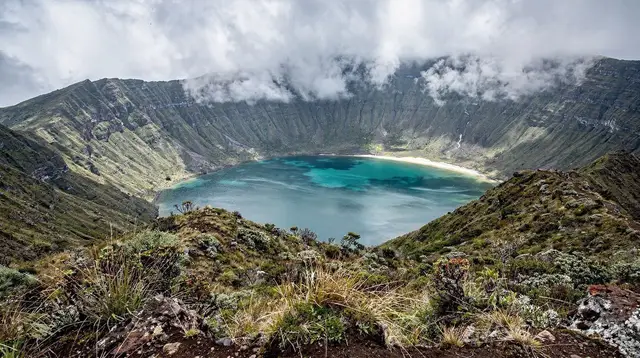
Sete Cidades is the image most people have of São Miguel before they arrive. A village sits inside a caldera roughly 5 km across, and inside that caldera are two lakes that share the same body of water but read as different colours: Lagoa Azul, which appears blue, and Lagoa Verde, which appears green. They are joined, not separate — the colour difference comes from light and depth over the shallower, algae-lined Verde side, not from two different waters. Seen from above, at the viewpoint of Vista do Rei, the effect is still striking enough that it is the single most photographed scene on the island.
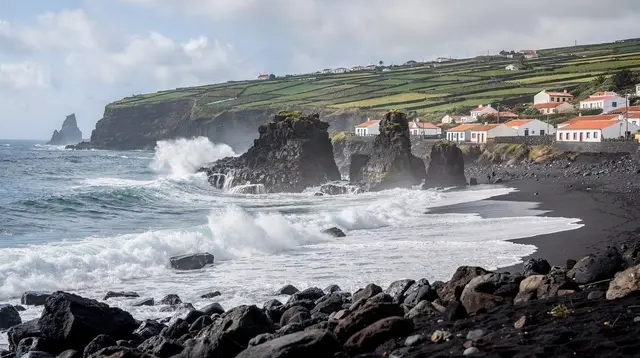
Beyond the classic viewpoint, the west rewards a full day rather than a drive-by. The Boca do Inferno viewpoint looks down over the smaller Lagoa do Canário and the green flank of Grota do Inferno. On the caldera’s outer slope, Mosteiros has a black-sand beach and sea stacks facing the open Atlantic — a different, wilder coastline than the sheltered lake inside the crater. A few kilometres further, Ponta da Ferraria is where a hot spring meets the sea at the foot of a lava flow: swimmable, but only around low tide, and dangerous in swell or at high water. The nearby villages of Ginetes and the wider west form the drive between these points, on narrow but manageable roads.
Ponta da Ferraria’s pools are usable mainly on the falling tide and near low water; a rising sea or any swell closes them to safe swimming, a timing detail the Ponta da Ferraria tide times guide covers before you plan around it. Mosteiros’ black-sand shoreline works the same way — a coastal stop with sea stacks and snorkeling rather than a groomed beach day — and the Mosteiros black-sand snorkeling guide sets expectations for the water and the walk down before arrival.
For visitors planning a single outing from the capital, a half-day west-coast route from Ponta Delgada is realistic, and a full day allows for Mosteiros and Ponta da Ferraria as well; the half-day Sete Cidades route from Ponta Delgada and the broader Mosteiros and Ponta da Ferraria day trip cover the driving in detail. Guided options exist for travellers who would rather not navigate the caldera roads themselves — one covers the full west coast in a day, and another pairs the caldera with lunch:
a full-day guided tour of the west coast, from Sete Cidades to the coastal villages or a Sete Cidades and west coast tour with lunch included.
The east coast: Furnas’ active caldera and the priolo’s last forest
Furnas is a different kind of caldera. It is not dormant scenery to admire from a rim; the ground itself is active, venting sulphurous steam through fumaroles that sit metres from the village’s houses and gardens. By the shore of Lagoa das Furnas, pots of cozido are lowered into holes in the hot ground each morning and hauled out five to seven hours later, cooked entirely by volcanic heat with no fire involved — a detail explained fully in how cozido das Furnas is cooked underground. Above the village, the Terra Nostra garden holds an iron-rich, orange thermal pool around 35-40°C that permanently stains swimwear, and dozens of smaller mineral springs dot the caldera floor.
The east coast extends past Furnas into Nordeste, the island’s remotest corner, where the viewpoints of Ponta do Sossego and Ponta da Madrugada look out over green, terraced coastline with none of Sete Cidades’ geometry but considerably more scale. Inland from Nordeste rises the Serra da Tronqueira, a laurel forest that is the only place on Earth the priolo survives — the Azores bullfinch, one of Europe’s rarest birds, found nowhere else on the island and not something spotted casually from a passing car. Reaching its trails is a deliberate outing, covered in the Serra da Tronqueira priolo trail guide.
East of Furnas and past Ribeira Quente’s stretch of coast, the caldera side of the island continues into Povoação, the island’s oldest settlement, and Ribeira Quente itself — Furnas’ own beach town on the far side of the ridge that separates the two, reachable without retracing the caldera roads.
The pairing is covered together in the Povoação and Ribeira Quente day trip, useful for travellers who have already given Furnas its half-day and want the coastline rather than a second pass through the fumaroles. It is a quieter extension than Nordeste, with less driving and no equivalent to the Serra da Tronqueira’s forest trails, but it fills an afternoon that would otherwise mean backtracking toward Ponta Delgada early.
Because Furnas alone easily fills half a day between the caldeiras, the thermal pools and lunch, and Nordeste’s viewpoints add another hour or more of driving beyond that, the east coast asks for more time than the west per stop, even though the sights themselves are fewer. A dedicated Furnas day trip covering cozido and the thermal park is the realistic version of this side of the island. Guided alternatives combine the caldera with the drive over Lagoa do Fogo, or with the harbour town of Caloura on the south coast, useful if self-driving the mountain roads is not appealing:
a guided tour taking in Lagoa do Fogo and north coast food traditions on the way toward Furnas or, for a slower look at the south coast near Furnas’ side of the island, a private boat tour along the Vila Franca do Campo islet coast.
Can you do both in one day from Ponta Delgada?
No, not without compromising both. This is worth stating plainly, because the map makes it look tempting: Ponta Delgada sits roughly in between, and both calderas appear as single dots not far from the capital. In practice, the west and east routes each take the better part of a day to see properly, and the drive between them adds ninety minutes or more each way on the EN1-1A, longer if the Lagoa do Fogo pass is closed by fog, which happens often enough not to be an edge case.
A same-day attempt at both usually means a rushed hour at Vista do Rei in the morning, a long drive with no stops, and an afternoon in Furnas too short for cozido, the thermal pool and the fumarole walk together. Something gets cut, and it is rarely obvious in advance which part will have to go. Travellers who try this most often report skipping Terra Nostra, or seeing Sete Cidades only from the road rather than walking down into the caldera. Two separate days, each built around one coast, consistently produces a better trip than one long day trying to cover both.
If you only have one day outside Ponta Delgada
Give it to the west, for three practical reasons. Sete Cidades is closer to the capital, so less of the day is spent driving. The classic viewpoint at Vista do Rei is a short stop rather than a long one, leaving time to also add Mosteiros or Ponta da Ferraria if the day allows. And the west’s sights are visual and immediate — a viewpoint, a lake, a coastline — which suits travellers who want one strong day rather than a slower, more layered one. This is also the practical choice for a cruise ship stopover or any visit measured in hours rather than days, since the west coast route can be trimmed to a half-day without losing its main point.
If you have two days
Split them by coast rather than trying to blend them. A Sete Cidades day trip on one day and a Furnas day trip on the next covers both properly, with nothing rushed. This is close to what a four-day full-island itinerary already builds in, dedicating separate days to west and east rather than one combined push — evidence, from people who plan the whole island rather than a single choice, that splitting the two sides is the workable pattern rather than a compromise.
For travellers deciding not just which coast but where to sleep, choosing between Ponta Delgada and Furnas as a base affects how each day starts: based in the capital, both coasts are a drive away; based in Furnas, the east becomes walkable and the west becomes the longer excursion.
Getting between the two coasts
However the days are split, renting a car is the practical way to see either side properly, since the bus network runs on work and school timetables rather than sightseeing ones and does not serve the smaller viewpoints at all. The EN1-1A rings the island and connects both routes, while the dual-carriageway via rápida speeds the stretch between Ponta Delgada, Ribeira Grande and Lagoa.
Roads on both sides are narrow in places, and the pass by Lagoa do Fogo between them can close in fog or heavy rain, so building in a little slack rather than a tight back-to-back schedule matters regardless of which coast comes first. Cloud cover does not fall evenly across the island either: the pass by Lagoa do Fogo and the high ground toward the Serra da Tronqueira catch cloud more often than the lower west-coast roads around Sete Cidades, which is one more reason a fogged-in morning is worth waiting out rather than pushing through — the São Miguel weather guide explains the pattern in more detail.
Hikers weighing the two sides against trail options specifically, rather than sightseeing stops, will find that comparison handled on its own in the best hikes on São Miguel compared guide; the hiking trails category lists options on both coasts side by side.
A third option: the south coast in between
Neither purely west nor east, Vila Franca do Campo and Caloura sit on the south coast roughly between the two, closer to Ponta Delgada than either Sete Cidades’ far viewpoints or Furnas’ caldera.
Vila Franca do Campo was the island’s capital until 1522, and its Ilhéu de Vila Franca — a sunken crater islet reachable by boat and, in season, swimmable inside — is a sight neither the west nor the east coast has an equivalent for; the Vila Franca do Campo former capital guide covers the town and the islet together. Caloura’s small harbour, a few kilometres along the same coast, works as a slower add-on rather than a destination of its own.
For travellers who have already committed a day each to the west and the east, the south coast is the natural third half-day rather than a competing choice between the two headline sides — near enough to the capital to fit around a flight, and different enough in character (islet, harbour, former capital) not to repeat either Sete Cidades or Furnas.
East coast vs west coast: your questions answered
Can I visit Sete Cidades and Furnas on the same day from Ponta Delgada?
Not without cutting both short. The two sit on opposite ends of São Miguel, and a same-day loop leaves barely an hour at each caldera once driving, parking and the mountain passes are accounted for. Most itineraries give each side its own day.
Which side of São Miguel has better views: east or west?
They are different kinds of view, not a better and a worse one. The west has the single postcard shot, the crater lakes of Sete Cidades seen from Vista do Rei. The east has wider, greener panoramas from Ponta do Sossego and Ponta da Madrugada, plus the smoking ground of Furnas itself.
Is Furnas worth it if I’ve already seen Sete Cidades?
Yes, because they show different things. Sete Cidades is a dormant caldera holding two lakes; Furnas is an active one, with fumaroles, hot springs and a cozido meal cooked by its heat. Seeing one does not substitute for the other.
Where can I see the priolo, the Azores bullfinch?
Only in the laurel forest of the Serra da Tronqueira, above Nordeste on the east coast. It is one of Europe’s rarest birds, does not range onto the west side of the island, and is not something to expect from a car window.
How long does it take to drive from Sete Cidades to Furnas?
Around an hour and a half each way on the EN1-1A, longer if the Lagoa do Fogo pass is fogged in and you detour via the via rápida. That drive alone rules out combining both calderas properly in one day.
Which coast is better for a cruise ship stopover?
The west, almost always. Sete Cidades is close enough to Ponta Delgada’s cruise berths at Portas do Mar to fit a half-day return; Furnas and Nordeste need more hours than most calls in port allow.
Do I need a car to visit both coasts?
You need one to visit either coast properly. Buses run on school and work timetables rather than sightseeing ones, and neither Sete Cidades nor Furnas is realistic as a bus day trip if you also want time at the viewpoints and pools.
Comparison on GetYourGuide
Verified deep-linked GetYourGuide tours. Book through these links and we earn a small commission at no cost to you.
GetYourGuide does not provide a product photo for this activity — the image shows the meeting point, photographed by us.