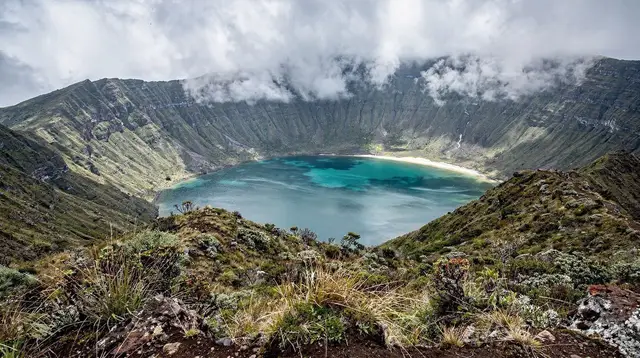
Most visitors reach the east of São Miguel through Furnas, and most of them never see the sea from there — because Furnas sits inside an active caldera, walled in on every side by the crater’s own rim. Ribeira Quente is what’s on the other side of that wall: a small fishing village and beach, over the ridge, facing open Atlantic water. It’s a different place with a different character, not a second name for the same one.
The village on the far side of the ridge
Furnas and Ribeira Quente belong to the same stretch of eastern São Miguel and even, historically, the same parish, but geography keeps them apart. Furnas fills the floor of a volcanic caldera — steaming ground, mineral springs, a lake, hills on every horizon. Ribeira Quente sits outside that caldera, on the coast, where a river valley runs down through a gap in the crater wall to meet the sea. The drive between the two climbs and drops over that ridge, roughly 15 to 20 minutes each way, and the difference at the far end is total: no fumaroles, no thermal smell, no lake — just a small harbour, a line of houses along the shore, and open ocean.
It’s worth being blunt about this because the confusion runs the other way just as often: nobody standing in the middle of Furnas can see the coast, and nobody standing on Ribeira Quente’s beach can see the caldera. The hills between them aren’t a detail — they’re the reason these are two stops on an itinerary, not one.
That split also shows in what each place is built around. Furnas grew up around its geothermal ground — the springs, the cooking pits, the garden that needs mineral water to justify its own existence. Ribeira Quente grew up around its harbour and whatever the boats brought in, the way most of the island’s smaller coastal settlements did long before tourism became a second economy here.
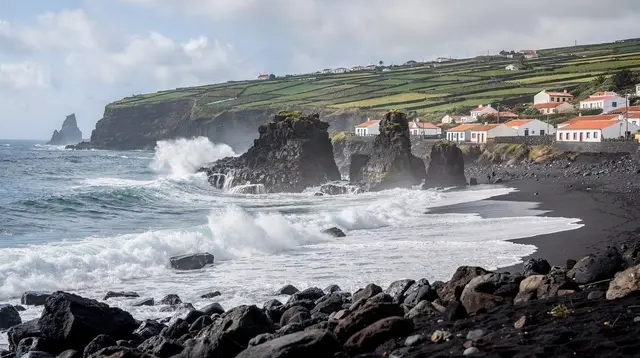
Walking the length of the village doesn’t take long: a row of houses along the water, a modest church, a short promenade running beside the beach, and the fishing boats themselves pulled up on the sand or tied off in the harbour. Nothing here has been built for visitors, which is exactly the appeal for travelers who’ve spent the morning among Furnas’ organized sights and want somewhere quieter for the afternoon.
Getting there
From Ponta Delgada, Ribeira Quente is roughly 45 to 55 minutes by car, either via Furnas and over the ridge, or via Povoação along the coast road, which is the quicker and flatter of the two options if the beach itself is the goal rather than Furnas’ thermal sights. Coming from Furnas village directly, budget 15 to 20 minutes for the ridge crossing.
There’s no train on São Miguel and no shortcut through the crater; a rental car is the practical way to link the two, and it’s the same story told across this whole coast — see the general guide to renting a car on São Miguel if this is your first Azorean drive. A limited bus service also runs the route on a working timetable rather than a sightseeing one, so it suits residents more than day-trippers on a schedule.
Whichever route you take, this is one-way driving for most of it — the ridge road connecting Furnas and Ribeira Quente doesn’t loop back on itself, so retracing the same stretch of road on the return leg is normal rather than a sign of a wrong turn. Travelers unsure how much of the island to fit around this detour can check the general guide to how many days you need on São Miguel, since a Furnas-and-coast day like this one is usually built into a longer east-side loop rather than treated as a standalone outing.
Combining the two stops into one day is the normal pattern, and there’s a ready-made version of it in the Povoação and Ribeira Quente day trip guide, which threads the coast road, the village, and the beach together without doubling back over the ridge twice.
What’s actually at Ribeira Quente
This is a working fishing village first and a beach stop second. A small harbour shelters a handful of local boats, a strip of black volcanic sand runs along the shore, and a modest promenade connects the two. It’s unpretentious rather than dramatic — there’s no equivalent here to the caldera views or thermal gardens that draw crowds a short drive inland. What it offers instead is the coastline itself: open Atlantic water, sea air after a morning of sulphur and steam, and a slower pace than the busier stops on the island’s day-trip circuit.
The beach is genuinely a beach, with the usual Azorean sea conditions — black sand, a water temperature that runs roughly 17 to 24°C depending on the month, and a swell that can be lively outside the calmest summer weeks. It is not, and should not be confused with, a thermal site: there is no warm mineral water here, no orange staining pool like Terra Nostra, no steaming ground like the caldeiras a short drive inland. Anyone arriving expecting Furnas’ hot springs on the coast will be disappointed; anyone arriving for an ordinary Atlantic swim and a walk along a working harbour will find exactly that.
For a broader sense of how this coast’s water compares to São Miguel’s other beaches and pools, the destination page for Sete Cidades and the island overview at São Miguel both cover the range from crater lakes to volcanic coastline, which puts Ribeira Quente’s plain seawater in context.
How Ribeira Quente compares to the island’s other beaches
Black sand alone doesn’t make a beach on São Miguel distinctive — most of the island’s shoreline is volcanic, and Ribeira Quente shares that dark sand with several other stops rather than standing out for it. Mosteiros, on the opposite side of the island, pairs its own black-sand shore with sea stacks and a more dramatic backdrop; see the Mosteiros black-sand snorkeling guide for how that stretch of coast differs from this one.
Praia de Santa Bárbara on the north coast is the island’s dedicated surf beach, with waves and a beach culture that Ribeira Quente’s sheltered harbour front doesn’t have — the Santa Bárbara surf beach guide covers that in full. What sets Ribeira Quente apart isn’t the sand or the surf, then, but its setting: a working harbour tucked at the base of the ridge that separates it from an active caldera, a combination none of the island’s other beaches can claim.
Swimming, fishing and small boat trips
Swimming conditions depend heavily on the swell, which is more exposed here than in a sheltered bay like Caloura further along the south coast. Summer months bring the calmest water and the most reliable swimming; from late autumn through winter, the Atlantic can make the beach unswimmable for stretches at a time, even while the drive over and the village itself remain perfectly pleasant. This is normal for the island’s north-facing and east-facing shores rather than a flaw specific to Ribeira Quente — the same pattern shows up across the north coast and around Nordeste.
Fishing is a real part of the village’s life, not a tourist add-on, and the harbour still services small local boats. Visitors curious about chartering a trip out of the area rather than just watching the boats come in should check the general guide to fishing charters on São Miguel before assuming Ribeira Quente itself runs a large charter operation — smaller ports like this one tend to work informally, and options change season to season.
Sea kayaking is a better-organized way to see this stretch of coast from the water, launching along the Furnas coastline rather than from a caldera lake — see the Ribeira Quente sea kayaking guide for how that differs from the calm inland paddling found on Sete Cidades’ lakes.
a coastal boat trip out of Povoação with water activities and drinks included is one way to see this shoreline from offshore, running along the same coast that Ribeira Quente sits on. For a longer day on the water covering more of the island’s south and east coastline, a private full-day boat tour around São Miguel is the fuller option, useful for travelers who want the sea as the main event of the day rather than a short stop.
Combining Ribeira Quente with Furnas
Almost nobody visits Ribeira Quente as a destination in isolation, and there’s no need to pretend otherwise — it earns its place on an itinerary as the coastal half of a Furnas day, adding sea air, a swim option, and a change of scenery to a morning spent among hot springs and steaming ground. A typical pairing looks like a morning in Furnas village, covering the caldeiras, the lake and the thermal garden, followed by the short drive over the ridge for lunch and a walk by the water in Ribeira Quente, or the reverse order for those who’d rather cool off with a swim before the warmer thermal pools.
a half-day tour covering Furnas’ caldera village is the standard way to see the inland side properly if you’re not driving yourself, though it typically focuses on the caldera rather than the coast — Ribeira Quente is better added as a self-drive extension afterward, or folded into a longer east-coast day.
Travelers building a longer loop sometimes extend the day further east toward Nordeste and its viewpoints, or take in the waterfall walk near Faial da Terra, which sits further along the same general coastline. a hike to the Salto do Prego waterfall with a picnic stop is a natural add-on for anyone continuing past Ribeira Quente rather than turning back toward Furnas.
Those who prefer a faster, motorized way to link the caldera villages and coastal viewpoints in one go can look at canyoning in the Ribeira dos Caldeirões waterfall park as a more active alternative for the same general area, though it’s a distinct activity from a beach stop and requires a wetsuit and a guided group.
For a ready-made structure rather than assembling the day piece by piece, the Furnas day trip guide and the itinerary for a Furnas day both cover the caldera side in full; Ribeira Quente is best treated as the coastal extension to either one, not a replacement for them.
Practical tips for visiting
Bring swimwear and a towel if the sea is the plan, comfortable shoes for the promenade and harbour front either way, and cash or a card for the handful of small cafés rather than expecting a wide choice of places to eat. Because the village is small and unhurried, there’s little reason to arrive at a specific time beyond avoiding the middle of the day if a Furnas visit is stacked on the same itinerary — see the general São Miguel packing list for what else belongs in the bag for a day that mixes a caldera village with a coastal stop.
When to go
June through September brings the warmest, calmest sea and the best conditions for actually swimming at Ribeira Quente, matching the island-wide pattern described in the São Miguel month-by-month guide.
Outside those months the village, harbour and coast road remain fully open and worth the detour on a clear day — the drive over the ridge and the view down to the water don’t depend on sea temperature — but the beach itself can go from calm to unswimmable with a change in the swell, and does so more often from November through March. Anyone timing a visit around a swim specifically should treat the sea forecast, not the calendar month alone, as the deciding factor, since conditions on this coast can shift within the same day the way they do across the rest of the island.
Ribeira Quente FAQ
Is Ribeira Quente the same place as Furnas?
No — Furnas is an inland caldera village with hot springs and no view of the sea; Ribeira Quente is its coastal beach, on the far side of the ridge, roughly a 15-20 minute drive away. They share a parish history but are two separate places joined by a mountain road.
Can you swim at Ribeira Quente?
Yes, in the sea. The water is ordinary Azorean Atlantic temperature, roughly 17-24°C depending on the season, not the warm thermal pools found in Furnas village. The beach is black volcanic sand and can have a noticeable swell, especially outside summer.
How do you get from Furnas to Ribeira Quente?
By car or bus over the ridge road that separates the caldera from the coast, about 15-20 minutes each way. There’s no shortcut through the crater itself — the hills are what put the beach out of sight of the village.
Is there anywhere to eat in Ribeira Quente?
Yes, a handful of small cafés and fish restaurants along the harbour front serve the fishing village’s own catch; it’s a simpler, quieter choice than the busier restaurants of Furnas village.
Is Ribeira Quente worth visiting on its own, or only as part of a Furnas trip?
Most visitors combine it with Furnas or Povoação as part of a longer east-coast loop; on its own it’s a modest fishing beach rather than a headline sight, but it makes a good stop to add sea air and a swim to an otherwise inland, thermal-focused day.
Does Ribeira Quente have thermal pools like Furnas?
No. Ribeira Quente is a regular coastal beach with normal seawater; the hot mineral pools, fumaroles and cozido cooking pits are all inland, in and around Furnas’ caldera, not on this stretch of coast.
What’s the best time of year to visit Ribeira Quente?
June to September for the calmest, warmest sea and most comfortable swimming; the village and coast road are open and worth the detour year-round, though winter storms can make the beach unswimmable and occasionally close the access road temporarily.
How does Ribeira Quente’s beach compare to Mosteiros or Santa Bárbara?
All three are black-sand, volcanic beaches, but they’re set up differently: Mosteiros pairs its shore with sea stacks and a dramatic coastline, Santa Bárbara is the island’s dedicated surf beach with real waves, and Ribeira Quente is the calmest and most sheltered of the three, tucked into a working harbour rather than facing the open swell.
What should I pack for a stop at Ribeira Quente?
Swimwear and a towel if you plan to get in the sea, comfortable shoes for the promenade and harbour front, and cash or a card for the village’s small cafés — there’s no wide choice of shops or restaurants, so it’s worth not relying on finding one at the last minute.