Renting a Car on São Miguel
Do you need to rent a car on São Miguel?
Yes, for most visitors a rental car is close to essential. There is no train on the island, and buses run on school and work timetables rather than tourist routes, so many viewpoints and villages sit well outside easy bus reach. The EN1-1A ring road links the main towns, though the passes near Lagoa do Fogo and Sete Cidades can close in fog.
Why a car is the practical default on São Miguel
São Miguel looks small on a map, roughly 65 km end to end, and that scale fools people into assuming a bus, a bike, or a few taxis will cover it. On the ground it doesn’t work that way. There is no train anywhere in the Azores, and the island’s bus network exists first for residents getting to school and to work, not for visitors chasing a viewpoint at sunset. Services cluster around commuting hours on weekdays, thin out sharply on weekends, and simply don’t run to a lot of the places this guide’s readers actually want to see: crater rims, coastal trailheads, thermal pools tucked into valleys, the far end of Nordeste.
That’s the honest case for a rental car here. It isn’t about comfort or independence for its own sake, it’s that the alternative — public transport built for a working island rather than a touring one — genuinely limits what you can reach and when. For a short, single-base stay in Ponta Delgada, you can get by without one.
For anyone planning to see Sete Cidades, Furnas, the Lagoa do Fogo crater, and the villages of Nordeste in the same trip, a car is close to the only practical way to do it on your own schedule. If you’re still weighing how many days that itinerary needs, see how many days you need on São Miguel before deciding.
This guide covers how car rental works on São Miguel as a system — the roads, the timetable problem it solves, and the weather it has to work around. It does not cover the mechanics of driving once you have the keys, which is its own guide at driving on São Miguel: what to expect, and it does not cover finding a space in the capital, which lives at parking in Ponta Delgada. It also deliberately stays away from naming specific rental companies, quoting rates, or recommending vehicle types — those change by season and by booking channel, and a guide that pins them down goes stale within a year.
Buses, taxis and the gap a car fills
The island’s operators — Auto Viação Micaelense chief among them, alongside smaller regional companies — run real, usable routes between Ponta Delgada and the other main towns: Ribeira Grande, Lagoa, Vila Franca do Campo, Povoação, and further out to Furnas and Nordeste. The catch is the timetable logic behind them. Routes are frequent early in the morning and around the end of the school and working day, and sparse in between — which is exactly when a visitor wants to be out exploring, not waiting at a stop. Weekend and holiday schedules cut back further. For a full comparison of what the network can and can’t do, see the dedicated São Miguel bus guide.
Taxis fill some of the gap for point-to-point trips within and around Ponta Delgada, but they aren’t built for a day spent moving between four or five stops in the caldera villages or along the north coast; costs and waiting times add up quickly once you’re outside the main towns. A car removes that friction entirely: no schedule to plan around, no return trip to negotiate, and the ability to stop at a viewpoint on a whim rather than commit to it in advance.
None of this means public transport is pointless. It’s a reasonable way to get into and around Ponta Delgada itself, where distances are short and parking is its own small headache (see parking in Ponta Delgada), and it works for visitors who plan to spend most of a short trip based in the capital and add one or two organised day tours rather than self-drive days. If that’s closer to your plan, guided tours versus self-drive on São Miguel lays out the trade-offs directly.
| Option | Reaches Nordeste, Sete Cidades rim, remote viewpoints | Runs on a sightseeing schedule | Best fit |
|---|---|---|---|
| Rental car | Yes | Yes, entirely your own | Multi-day, whole-island itineraries |
| Bus | Rarely to the remote spots | No — school and work hours | Ponta Delgada and short in-town hops |
| Taxi | Costly beyond short hops | Yes, but priced per trip | Single transfers, not full-day touring |
| Organised day tour | Yes, on that day’s route | Fixed to the tour’s own plan | Visitors without a car, or one extra day |
If flying in without a car booked, an airport transfer such as a pre-arranged transfer between João Paulo II airport and your accommodation or a scheduled airport bus into central Ponta Delgada covers the first and last legs of the trip without needing a rental at either end.
Roads, road numbers, and what the EN1-1A actually gives you
The island’s main artery is the EN1-1A, which loosely rings São Miguel and threads through or near most of the towns covered on this site: Ponta Delgada, Ribeira Grande, Povoação, and on toward Nordeste and back along the south coast through Vila Franca do Campo and Lagoa. Between Ponta Delgada, Ribeira Grande and Lagoa there’s a short stretch of dual-carriageway, the via rápida, which is the fastest driving on the island — a rarity here, and not representative of the rest of the network.
Everywhere else, expect two-lane roads that narrow further as they climb into farmland and forest, often bounded by stone walls or hedgerow with little verge to spare. This isn’t a flaw in the road system, it’s the shape of a small volcanic island that’s been farmed and settled for five centuries: distances that look short on a map take longer in practice, and a 40 km drive across the interior can easily take an hour or more once you account for the terrain. Planning realistic driving times, not straight-line distances, matters most when comparing the west and east of the island — see east coast versus west coast São Miguel if you’re deciding how to split your days.
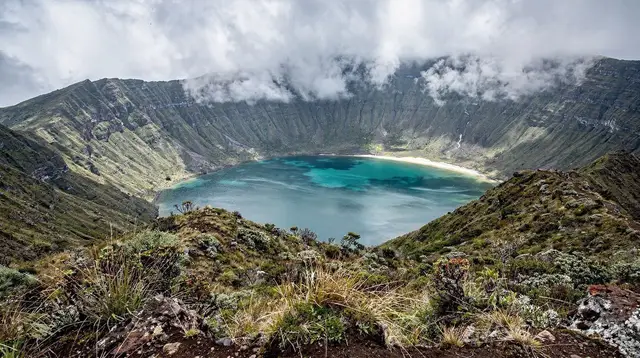
Two routes deserve specific mention because they’re not always straightforward: the road up to Lagoa do Fogo, and the road into the Sete Cidades caldera. Both climb quickly from sea level into higher, cloud-prone terrain, and both can close to traffic when conditions turn — covered in full in the next section. Away from those two, the rest of the EN1-1A network is open and manageable in typical weather, if slower than a first look at the map suggests.
Booking a car: what to actually expect
Car rental on São Miguel works broadly like anywhere else — you book online or at the counter, present a licence and a card, and collect the vehicle, most often near the airport in Ponta Delgada. What’s worth knowing is less about the process and more about the constraints specific to a small island: the total fleet available at any one time is genuinely limited, not artificially scarce for marketing effect, and it tightens noticeably during the peak June-to-September season and around any local holiday weekend. Booking with real advance notice, rather than expecting to walk up and choose from a full lot, is the safer approach for anyone travelling in summer or tying a rental to a specific onward flight.
Licence requirements depend on where it was issued — some nationalities need an international driving permit alongside their home licence, others don’t — so this is worth confirming for your specific situation before travelling rather than assuming. Whichever company you book through will be able to confirm what’s required at pickup.
This guide deliberately doesn’t name particular rental companies, quote daily rates, or recommend a vehicle category, since all three shift by season, by booking window, and by promotional pricing in ways that would make any figure printed here wrong within months. What stays constant is the underlying logic: book ahead for summer, check licence requirements for your nationality, and expect a smaller, more traditional car to suit the island’s narrow roads better than a large one. The day-to-day experience of actually driving that car — junctions, cattle on the road, single-track stretches — is covered separately in driving on São Miguel: what to expect.
For visitors who’d rather not deal with any of the above, guided alternatives cover much of the same ground. A guided tour through the western caldera villages and viewpoints reaches Sete Cidades and the surrounding coast without a rental car, and a full-island jeep tour or a half-day tour through the Furnas caldera can substitute for a self-drive day on the itinerary’s harder-to-navigate stretches.
Weather, fog and the passes that can close
The two mountain routes worth planning around are the road to Lagoa do Fogo and the descent into the Sete Cidades caldera by Vista do Rei. Both climb into terrain that sits inside cloud on a regular basis — not occasionally, but as a normal feature of island weather, since São Miguel’s interior generates its own microclimate that can differ completely from the coast on the same afternoon. Lagoa do Fogo in particular has no facilities of any kind at the top: no café, no ticket office, no shelter, so a closure there isn’t an inconvenience layered on top of amenities, it’s simply a road that isn’t passable that day.
Closures aren’t announced with much lead time and aren’t predictable from a standard weather forecast checked the night before. The practical response isn’t to chase a guaranteed clear window, since one can’t be promised, but to build slack into a longer stay so a fogged-out morning at Lagoa do Fogo or Sete Cidades isn’t the only chance you get. If your itinerary depends on a specific viewpoint being clear, Lagoa do Fogo’s viewpoint and when the clouds actually clear covers the timing patterns in more detail, and the wider São Miguel weather guide explains why conditions can differ so sharply between the coast and the interior on the same day.
This is also a reason a rental car earns its cost even on a trip with a few flexible days built in: a fogged-out morning simply means switching the day’s plan to the coast instead, something that’s far harder to improvise around a fixed bus timetable or a booked tour slot.
Planning around a rental car
Working a rental car into the wider trip comes down to a few practical calls: how many days you need, where to base yourself, and how much ground you’re realistically covering per day. A car changes all three. It makes a single-base stay in Ponta Delgada workable even for itineraries reaching Nordeste and Furnas, since the return drive is the same either way, though basing partway across the island is worth weighing too — see Ponta Delgada or Furnas as your base for that comparison.
For the shape of a multi-day plan built around self-drive days, the four-day full-island itinerary gives a sense of realistic daily distances, and how to plan a São Miguel itinerary covers the wider logic of sequencing days around weather and opening hours. Budgeting for a rental, fuel and the odd toll-free but slow mountain crossing is one line among several — the full picture, including accommodation and food, sits in the São Miguel travel budget guide.
None of this requires deciding on day one. Plenty of visitors land without a booking, spend a car-free day or two around Ponta Delgada using things to do organised around transport and a tour or two, and pick up a rental only once they’re ready to head further out. What matters is knowing before you land that the choice exists, and that it’s the single decision most likely to determine how much of the island you actually get to see.
Renting a car on São Miguel: frequently asked questions
Do I really need a rental car on São Miguel?
For most visitors, yes. The island has no train, and while buses connect the main towns, they follow school and work schedules rather than a sightseeing timetable, which makes it hard to reach places like Nordeste’s viewpoints or the Sete Cidades caldera rim on your own schedule without a car.
Can I see São Miguel by public bus alone?
It is possible for the main towns along the coast, but slow going for anywhere off that spine. Services thin out on weekends and school holidays, and many of the island’s best stops, from crater viewpoints to trailheads, are not on any bus route at all.
Which road links the main towns, and is it fast?
The EN1-1A circles most of the island and is the closest thing São Miguel has to a main road, supplemented by a short dual-carriageway via rápida between Ponta Delgada, Ribeira Grande and Lagoa. Away from that stretch, roads are narrow and wind through farmland, so journeys take longer than the map distance suggests.
Do the passes to Lagoa do Fogo and Sete Cidades ever close?
Yes. Both routes climb into cloud-prone terrain, and fog, heavy rain or wind can close them, sometimes with little notice. Building a spare day or two into a longer stay, rather than a single fixed date, is the practical way around this.
What happens if I don’t want to drive at all?
A short stay based in Ponta Delgada, using organised day tours and transfers instead of a car, is workable, and pairing a hire car with the odd guided day is common too. It simply narrows how much of the island, particularly Nordeste and the more remote viewpoints, is realistic to reach.
Is a car necessary for a short stopover, like a cruise call?
Not necessarily. On a single day in port, an organised shore excursion or a transfer-based plan usually covers more ground with less logistics than arranging and returning a rental car within a few hours.
How far in advance should I book a car?
Booking ahead is worth doing for peak summer weeks and any date tied to a specific flight, since availability on an island this size is genuinely limited rather than a booking-engine trick. Outside July and August, arranging a car with more notice than a walk-up still tends to give more choice.
Do I need an international driving permit?
Requirements depend on where your licence was issued, so check the rules for your nationality before travelling rather than assuming your home licence is automatically sufficient. This is worth confirming with whichever company you book through, since it affects pickup at the counter.
Transport on GetYourGuide
Verified deep-linked GetYourGuide tours. Book through these links and we earn a small commission at no cost to you.
GetYourGuide does not provide a product photo for this activity — the image shows the meeting point, photographed by us.