A Surf Beach, Not a Swimming Beach
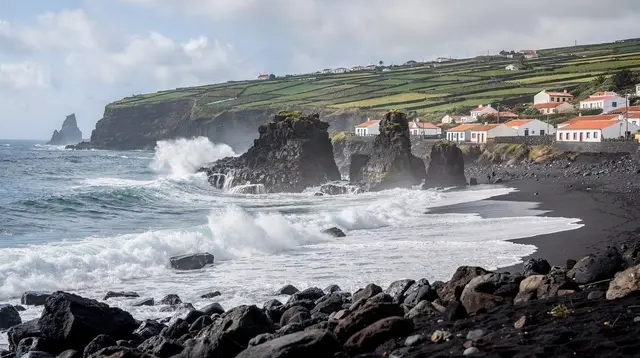
Praia de Santa Bárbara sits on the open north coast of São Miguel, a short drive west of Ribeira Grande, the island’s second town. It is the closest thing São Miguel has to a dedicated surf beach: a long, gently curving bay of dark volcanic sand facing the full fetch of the North Atlantic, with a beach break that produces rideable waves through most of the year. Locals surf it before work.
Visiting surfers build entire island stays around it. And every so often a first-timer arrives expecting a warm, calm swimming beach and gets a useful lesson in what “Atlantic” actually means. For a deeper dive into how the swell behaves across the seasons, see the dedicated surf guide to Praia de Santa Bárbara and the wider surf season and water temperature guide.
Set expectations here before anything else, because they shape everything that follows. This is not a Caribbean-style beach. The sand is black, of volcanic origin, and can be genuinely hot underfoot at midday in summer. The sea is not warm; it runs roughly from 17°C in the depths of winter to about 24°C at the height of a good August, and even that summer number is cooler than most sun-and-sand travellers expect.
And the water is rarely flat — the swell that visiting surfers fly in for is the same swell that makes this a poor choice for a lazy afternoon float. None of that makes it a bad beach. It makes it a different kind of beach, and once that’s understood, Praia de Santa Bárbara is one of the more rewarding stops on the island’s north side.
The Setting
The beach stretches for close to a kilometre along a shallow bay backed by low cliffs and pasture, with the buildings of Ribeira Grande visible to the east and open coastline running west towards Capelas and Rabo de Peixe. There’s a promenade and car park behind the sand, a scatter of surf schools and board-rental huts, a couple of cafés, and, in the main season, a lifeguard tower on the central section. Outside the peak weeks it can feel almost empty even on a sunny weekend — most of the island’s holidaymakers are drawn to the thermal pools and craters further inland, which leaves the beach itself to surfers, dog walkers, and locals.
Because the beach faces essentially north, it catches North Atlantic swell directly, which is exactly what makes it a surf spot rather than a curiosity. The trade-off is exposure: onshore wind can make conditions choppy, and the same open aspect that builds good waves also means the sea state changes quickly.
Anyone planning a session, whether surfing or swimming, should check conditions on the day rather than assume yesterday’s forecast still holds. Further along the coast, Capelas keeps its own old whaling station worth a stop, and the wider north-coast watersports scene around Ribeira Grande extends well beyond this one beach.
Surf Conditions Through the Year
São Miguel’s surf season runs longer than most visitors expect, because the island sits directly in the path of North Atlantic winter storm swells. Broadly:
| Period | Swell | Water temperature | Who it suits |
|---|---|---|---|
| November-February | Largest, most consistent groundswell | Around 17-19°C | Experienced surfers, thicker wetsuits needed |
| March-May | Moderate, still reliable | About 18-20°C | Intermediate surfers, some beginner windows |
| June-August | Smaller, more forgiving | 21-24°C | Beginners, families trying a first lesson |
| September-October | Building again as autumn storms arrive | About 20-22°C | Intermediate to advanced surfers |
The pattern is a useful rule of thumb rather than a guarantee. São Miguel’s weather can change within a single day, and a flat morning can build into a solid afternoon session, or the reverse. Surf schools and rental huts at the beach track live conditions and are the most reliable read on any given day; a forecast checked from home the week before is a starting point, not the final word.
Wind matters as much as swell size. Offshore or light wind grooms the waves into clean, surfable lines; a strong onshore wind — common on the exposed north coast — can turn the same swell into a choppy mess within an hour. If a session is the main goal of the day, building in flexibility to surf early morning, when the wind is typically lightest, pays off more often than not. For how these swell windows fit into the island’s broader climate, the month-by-month guide and general weather guide cover conditions across all seasons, not just at the beach.
Skill Levels and What to Expect
The beach’s biggest practical advantage is its width: several peaks break along its length, so instructors and experienced locals alike can usually find a section that suits the conditions and the surfer. That said, skill level still matters a great deal here.
- Complete beginners do best on the smaller summer swells, ideally with an instructor who knows which section of the beach is working that day. A first lesson on a big winter groundswell is neither fun nor safe.
- Improving surfers will find plenty to work with from spring through autumn, with enough swell to progress but not so much that every session turns into a battle.
- Experienced surfers tend to time visits for the November-to-February window, when the biggest and most consistent groundswells arrive, understanding that conditions can also turn heavy and demanding fast.
Board and wetsuit rental is available at the beach by the hour or half day, and several schools run lessons that include equipment. Outside the busiest weeks of summer, booking a day or two ahead is usually enough; in July and August, earlier is safer, particularly for a specific time slot. Families weighing a lesson against other activities can compare notes in the broader São Miguel with kids guide.
Not a Swimming Beach, and Why That Matters
It’s worth repeating plainly: Praia de Santa Bárbara is built around waves, not calm swimming. There is shore break at the water’s edge, rip current risk is real near the rocky sections at either end of the bay, and even in the flagged, lifeguarded central area in summer, conditions can be stronger than a beach of this size would suggest elsewhere. Anyone wanting a gentle swim, rather than a surf session, is generally better served on the calmer south coast around Ribeira Quente or the seasonal, sheltered swim inside the crater islet at Ilhéu de Vila Franca — both very different beaches with very different water.
If swimming here anyway, stay inside the lifeguarded and flagged area when one is operating, and treat an unflagged, out-of-season beach as unsupervised open water. Fog, wind and swell can all change within an hour on this coast, and the beach offers no facilities beyond the season to fall back on if conditions turn. This contrast between a wave-built north coast and calmer options elsewhere is a running theme on the island — see why São Miguel isn’t a Caribbean-style beach destination for more on what to expect from the sand and sea here generally.
Getting There and Practicalities
The beach lies just west of Ribeira Grande on the north coast road, roughly 25-30 minutes from Ponta Delgada via the dual-carriageway via rápida and the EN1-1A. There’s a car park immediately behind the beach, free outside of major events, and it fills up on the best summer weekend days by late morning.
A rental car remains the practical way to reach it — buses run to Ribeira Grande on Auto Viação Micaelense’s timetables, but the final stretch to the beach itself is a walk, and public transport is built around commuting hours rather than dawn surf checks. Travellers without a rental car can check the island bus guide for what public transport can and can’t do on this coast, while anyone still deciding on wheels can read renting a car on São Miguel first.
Facilities include a promenade with a couple of cafés and snack bars, public toilets and showers in season, and the surf schools’ own huts for rental and lessons. Outside the main summer season, some of these close or reduce their hours, so it’s worth checking ahead if visiting in the shoulder or low season purely for facilities rather than the surf itself, which runs regardless.
What to Combine It With
Because Praia de Santa Bárbara is a single, focused stop — a beach, not a village or a caldera — it pairs naturally with a wider loop of the north coast rather than standing as a full day on its own, unless a lesson or two fills the time. A logical day might take in the beach for a morning session, then continue west towards Mosteiros and Rabo de Peixe, or inland to the region’s other north-coast landmarks. For travellers who’d rather have someone else drive the loop, the Rabo de Peixe, Mosteiros and Capelas super expedition covers a good stretch of this same coastline in a single guided day.
On a flat or blown-out surf day, Ponta Delgada is close enough for a change of scene — the guided cultural walk through Ponta Delgada’s old town is an easy half-day alternative when the ocean isn’t cooperating. Travellers building a longer island itinerary around the north coast often add a day inland as well: the Sete Cidades jeep tour reaches the west-side caldera and its twin lakes, while the full-day hike to Lagoa do Fogo is a good match for anyone who wants a physical day out on land to balance a physical day out on water.
Heading east instead, Caldeira Velha and its thermal waterfall make a natural change of pace from salt water to hot spring water on the same stretch of coast, and the Ribeira Grande and Caldeira Velha day trip packages the two together.
Photographing the Beach
The north coast light suits Praia de Santa Bárbara well: dark sand throws waves into sharp relief, and the beach faces roughly north, so both sunrise glow along the water and a broad, open sky through the day give photographers plenty to work with. Late afternoon, when the wind often drops and surfers are still out, tends to be the most productive window for action shots from the sand.
As with anywhere on this coast, weather can shift a shoot quickly — a clear morning is not a guarantee of a clear afternoon, so it pays to have a fallback plan rather than a single scheduled window. São Miguel’s fast-changing weather is worth understanding before planning any shoot around this coast; see why the weather changes hour to hour.
When to Visit
There is no single “best” time at Praia de Santa Bárbara — the right season depends entirely on what a visitor wants from it.
| Goal | Best months | Why |
|---|---|---|
| Learning to surf | June-August | Smaller, more forgiving swell and warmer water |
| Experienced wave-riding | November-February | Largest, most consistent groundswell |
| A quiet look at the beach, no surfing | Shoulder months (April-May, September-October) | Fewer crowds, milder weather, sea still workable |
| Photography | Year-round, prioritise late afternoon | Light and swell both photogenic most of the year |
Whatever the season, this is a coast where plans should stay loose. A calm-looking morning can turn windy by noon, and a flat forecast can build into a session-worthy afternoon swell. Checking with a local surf school or rental hut on the day remains more reliable than any single forecast checked in advance. For a wider view of seasonal trade-offs across the whole island, the best time to visit São Miguel guide and the low-season guide both cover the quieter months in more depth.
Praia de Santa Bárbara: Common Questions
Is Praia de Santa Bárbara good for beginners?
Yes, in the right conditions. The beach is wide with several peaks, so instructors can usually find a gentler section for a first lesson, especially on smaller summer swells. In a big winter groundswell the beach is for experienced surfers only.
Can you swim at Praia de Santa Bárbara without surfing?
You can, but it is not a sheltered swimming beach. There is shore break, rip current risk near the rocks at either end, and the water is cool by warm-destination standards. Swim within the flagged and lifeguarded area in season and heed the flags.
What is the water temperature like?
It runs roughly from 17°C in late winter to around 24°C at the top of summer. Most visitors surf in at least a spring suit outside July and August, and many wear one year-round.
Do I need my own board and wetsuit?
No. Surf schools based at the beach rent boards and wetsuits by the hour or half day and run lessons for beginners and improvers. Booking a day or two ahead is sensible in peak summer weeks.
Is the sand really black?
Yes. Like most São Miguel beaches, the sand here is dark volcanic sand, not the pale coral sand of a tropical beach. It heats up more than pale sand in strong sun, so footwear helps at midday.
When is the surf biggest?
North Atlantic groundswells generated by winter storms produce the largest, most consistent waves roughly from November to February. Summer swells are smaller and more forgiving.
Is there a lifeguard?
A lifeguard service operates in the main summer season on the central section of the beach. Outside those months and outside the flagged area, you are on your own, so treat the ocean with respect.
How does this beach compare to Mosteiros or the south coast?
Praia de Santa Bárbara faces the open North Atlantic and is built around surf, with a genuine break most of the year. The south coast, around Caloura and Vila Franca do Campo, is calmer and better suited to swimming and boat trips than to waves. Those calmer waters, particularly around Caloura and Vila Franca do Campo, are covered in their own destination guides.