A working harbour, not a sight
Most stops on São Miguel’s north coast exist to be looked at: a thermal waterfall, a tea plantation, a viewpoint. Rabo de Peixe is different. It is the island’s largest fishing village, strung along a stretch of the north coast between Ribeira Grande and Capelas, and it earns its place on a map because it is still doing what it has always done — putting boats out and bringing a catch in — not because it has been arranged for visitors.
There is no beach here to swim from, no promenade of cafés, no ticketed attraction. What there is is a working community on the water, and for travellers willing to slow down for half an hour rather than tick off a sight, that is worth something in its own right.
This page treats Rabo de Peixe honestly: as a place to pass through and look at with some care, not as a resort town or a planned half-day out. If you are searching for a swimming spot on this part of the coast, you want Mosteiros and its black-sand beach, or Praia de Santa Bárbara further east — not here.
Where Rabo de Peixe sits
Rabo de Peixe occupies a stretch of the north coast a short drive west of Ribeira Grande and east of Capelas, on the same shoreline corridor that carries the EN1-1A around the island. It is close enough to Ponta Delgada to be a detour rather than a destination, and close enough to Ribeira Grande and Capelas that most visitors see it in passing, on the way to or from those two towns, rather than as a stop planned on its own.
| From | Approximate driving time |
|---|---|
| Ponta Delgada | 20-25 minutes |
| Ribeira Grande | 5-10 minutes |
| Capelas | 10-15 minutes |
| João Paulo II Airport (PDL) | About 25 minutes |
Distances on São Miguel are short in kilometres and longer in minutes than they look on a map, because the coast road curves with the shoreline and passes through village centres with lower speed limits. Rabo de Peixe is no exception: it sits directly on that road, so through-traffic runs along its edge rather than around it.
A fishing village, not a beach resort
It is worth saying plainly what Rabo de Peixe is not, because the name and the coastal setting can suggest otherwise to a visitor arriving without context. This is not a bathing beach, not a resort development, and not a site laid out with visitor facilities. The shoreline here is built around a harbour, a landing area and a slipway for the fishing fleet — infrastructure for taking a living from the sea, not for recreation in it. Swimming is not what this stretch of coast is for, and there is no lifeguard-watched sand or organised bathing area to speak of.
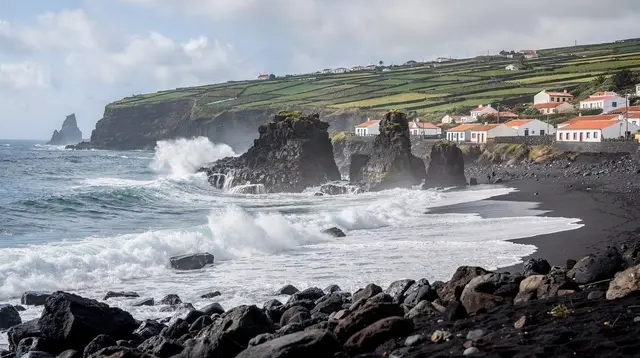
That distinction matters more here than at most stops on this coast, because São Miguel does have real black-sand beaches and sea pools nearby — Mosteiros is the obvious one, with sea stacks and a beach that is genuinely set up for a swim. Rabo de Peixe is a different kind of place altogether: a village whose relationship with the Atlantic is one of daily work, not leisure. Travellers who understand that going in tend to find it interesting on its own terms; travellers expecting a beach town are simply in the wrong village.
What you will actually see
Rabo de Peixe is the largest fishing village on São Miguel, and the harbour is its centre of gravity. Boats — working trawlers and smaller day boats — come and go with the tide and the weather, nets and gear are stored and mended along the waterfront, and the slipway is in regular use for hauling craft in and out of the water. Around the harbour, the village itself is a dense, workaday settlement: narrow streets, a parish church, small shops and cafés serving residents rather than tourists, and houses built close together in the pattern typical of the island’s older fishing settlements.
There is no single sight to head for and no signposted trail through the village. The interest here is in the whole of it — the boats, the harbour routines, the ordinary rhythm of a community whose income still comes substantially from the sea — rather than in any one building or view. That makes Rabo de Peixe a place to walk through slowly and look, not a place with a checklist of things to photograph.
Passing through the north coast corridor
Rabo de Peixe makes the most sense as one stop in a longer run along the north coast rather than a destination chosen on its own. To the east, Ribeira Grande is the island’s second town, with a historic centre, the surf beach at Praia de Santa Bárbara, and the thermal waterfall at Caldeira Velha on the slope above it — covered in full in the Ribeira Grande and Caldeira Velha day trip guide.
To the west, Capelas holds an old whaling station that speaks to a different chapter of the island’s relationship with the sea, detailed in the Capelas old whaling station guide and the wider whaling heritage and vigias guide; walkers can extend that stop with the Capelas coastal trail.
Further west again, the black-sand beach and sea stacks of Mosteiros and the tidal hot spring at Ponta da Ferraria round out a full north-and-west-coast day, covered together in the Mosteiros and Ponta da Ferraria day trip guide. Strung together, Ribeira Grande, Rabo de Peixe, Capelas and Mosteiros make a coherent stretch of coast that mixes a historic town, a working fishing village, a whaling-era site and a proper beach — each honest about what it is, none pretending to be the other.
Getting there and getting around
A rental car is the practical way to see Rabo de Peixe alongside its neighbours in one visit. The village sits directly on the coast road linking Ponta Delgada to Ribeira Grande and on towards Capelas and Mosteiros, so it adds only a few minutes to a north coast drive rather than requiring a detour. Parking in the village is informal — expect to find space along the harbour front or nearby streets rather than a dedicated visitor car park, because none is provided; this is not a place built to receive tour buses.
Public buses do run this stretch of coast, operated by Auto Viação Micaelense among others, and are covered in the São Miguel bus guide. As across the island, though, these follow school and work timetables rather than sightseeing ones, which makes a self-drive itinerary the more workable option for combining Rabo de Peixe with Ribeira Grande and Capelas in a single outing. There is no train on São Miguel and no realistic way to see this stretch of coast without either a car or considerable patience with bus schedules.
Seeing it as part of a guided day
Because Rabo de Peixe has no ticketed sight of its own, most visitors experience it either by driving through independently or as one stop within a wider guided itinerary of the north coast and the island’s interior. A small number of tours cover this corridor directly.
a guided day covering Rabo de Peixe, Mosteiros and Capelas along the north coast is the most direct way to see the village with some context rather than passing through unguided. For a broader look at the island’s volcanic interior on the same kind of full day out, a jeep tour to the Sete Cidades caldera and a full-day tour to the Furnas caldera cover the island’s better-known volcanic landscapes, useful for travellers building out days either side of a north coast drive.
| Tour | Focus | Typical length |
|---|---|---|
| Rabo de Peixe, Mosteiros and Capelas | North coast villages and coastline | Full day |
| Sete Cidades jeep tour | Twin-lake caldera, west of the island | Half day |
| Furnas full-day tour | Eastern caldera, cozido and thermal park | Full day |
None of these are built specifically around Rabo de Peixe as a headline stop — that would misrepresent what the village is. They are honest ways to see it as part of a wider day on the island, which is how most visitors will encounter it in practice.
A community, not a curiosity
The most useful thing a visitor can bring to Rabo de Peixe is a light footprint. This is a place people live and work, not a set arranged for onlookers, and the harbour, the boats and the gear laid out along the waterfront belong to the households that depend on them. A slow walk and a respectful distance from working boats and equipment is the right approach; treating the harbour as a photo backdrop, or photographing residents at close range without asking, is not.
The same courtesy applies here as anywhere on São Miguel where daily life and visitor interest overlap — everyday Azorean customs are worth a look before any village stop, and they apply with particular weight in a working fishing community like this one.
Seen this way — as a genuine, unpolished part of the island rather than an attraction that has fallen short of one — Rabo de Peixe fits naturally into a longer stay on São Miguel. For help deciding how much time the island as a whole deserves, and where a stop like this one fits into a wider plan, see how many days you need on São Miguel or a ready-made four-day full-island itinerary that has room for the quieter parts of the coast alongside the better-known sights of São Miguel as a whole.
Questions travellers ask about Rabo de Peixe
Is Rabo de Peixe a beach destination?
No. Rabo de Peixe is a working fishing village, and its shoreline is built around a harbour and a slipway for boats, not swimming. Travellers looking for a beach on this stretch of coast are better served by Mosteiros or Praia de Santa Bárbara, further along the north coast.
How far is Rabo de Peixe from Ponta Delgada?
It is roughly 20-25 minutes by car from Ponta Delgada, reached via the via rápida towards Ribeira Grande and then the coastal road. It sits between Ribeira Grande and Capelas, so it fits naturally into a drive along the north coast rather than a separate trip.
Is there anything to actually do in Rabo de Peixe?
The village itself offers a look at a working harbour, boats being landed or repaired, and everyday village life rather than a list of sights. It is a stop to slow down and look, best combined with Ribeira Grande and Capelas on the same drive.
Is Rabo de Peixe safe to visit?
Yes. Like the rest of São Miguel, the everyday hazards are the sea, cliff edges and weather rather than crime or wildlife — there are no dangerous land animals on the island. As anywhere, ordinary care around a working harbour with boat traffic and machinery is enough.
Can you eat in Rabo de Peixe?
There are small local cafés and eateries serving the village and its fishing community, in the everyday register typical of an Azorean working town rather than a curated dining scene. This is not a destination for a planned restaurant visit the way Furnas or Ponta Delgada are.
Can you get to Rabo de Peixe by bus?
Yes, in principle — the north coast is served by Auto Viação Micaelense routes linking Ponta Delgada, Ribeira Grande and the villages beyond, but timetables follow school and work hours rather than sightseeing schedules. A rental car remains the practical way to combine Rabo de Peixe with nearby stops in one visit.
How is Rabo de Peixe different from Ribeira Grande and Capelas?
Ribeira Grande is the island’s second town, with a historic centre and its own sights; Capelas has a former whaling station tied to that industry’s history. Rabo de Peixe, between the two, is a plainer, still-active fishing village without a comparable set of visitor sights — its interest is the working harbour itself.
What’s the best time of day to see the harbour?
Weekday mornings tend to show the most activity, when boats are out or returning and the harbour is in use. Evenings and Sundays are quieter, in keeping with a village whose rhythm follows fishing and church rather than tourism.