A working village, not a whaling show
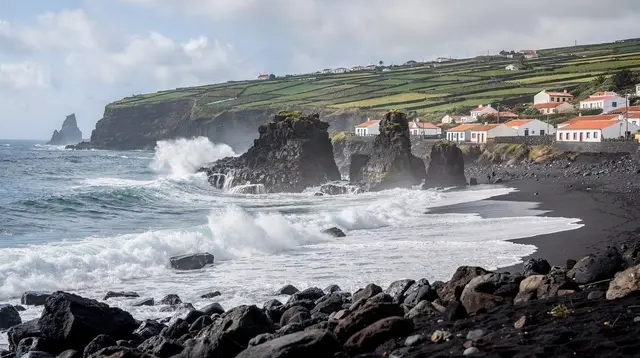
Capelas sits on the north coast of São Miguel, a short stretch past Ribeira Grande and before Rabo de Peixe, strung along a low black shoreline where the Atlantic meets basalt rather than sand. It has no headline attraction, no ticketed sight, no coach park. What it has is a real village going about its business, and, on its edge, the concrete shell of a whaling station that closed for good in the 1980s and has never reopened as anything else.
That distinction matters, because it is easy to get wrong. Whaling in the Azores is not a performance kept alive for visitors, not a re-enactment, not a seasonal attraction with a schedule. It is a closed chapter. What survives from it is a building, a handful of place names, and a way of reading the sea from land that has been repurposed for a gentler use. This page sets out what that means in Capelas specifically, and points elsewhere on the site for the fuller story of whale watching itself, which is covered island-wide rather than village by village.
Why Capelas looks the way it does
Like several villages on this coast, Capelas grew around fishing and, for part of the 20th century, around whaling. Sperm whales passed close to São Miguel’s north shore, and shore-based stations processed carcasses brought in by open boats rowed and later motored out from harbours like this one. The industry was hard, seasonal, and increasingly marginal against industrial whaling fleets elsewhere in the Atlantic.
It ended across the Azores in the 1980s, later than in most of Europe, and Capelas’ station is one of the physical traces left on São Miguel. For the building itself, opening times and what remains to see on site, the dedicated page on the old whaling station in Capelas goes further than this overview does.
What the station left behind is not only concrete. It left the vigia system: lookouts posted on high ground along the coast, scanning the water for the spout and dark back of a surfacing sperm whale, then signalling the boats below. Capelas was one of several villages with its own vigia posts. When whaling stopped, the skill did not simply disappear — the same reading of the sea, the same knowledge of where sperm whales are likely to surface, turned out to be exactly what whale-watching operators needed a decade or two later.
Today’s spotters, working from clifftop posts and radioing boat skippers, work on the same principle the whaling-era vigias used, aimed now at watching rather than hunting. The full story of that handover — how it happened, and how it shapes a modern boat trip — is told on the vigias page and in the wider whaling heritage guide; this page keeps to Capelas’ own part in it rather than repeating either in full.
It is worth being precise about what that does and does not mean for a visit to Capelas itself. Whale-watching boats do not depart from Capelas’ small harbour in any organised way — the island’s whale-watching fleets are based mainly out of Ponta Delgada and a few other ports, and are covered as an island-wide activity on the São Miguel page and in the dedicated whale and dolphin watching guide. Capelas’ role in that story is historical, not operational: it is where some of the spotting tradition comes from, not where you book a boat today.
What there is to see
Capelas rewards an unhurried half hour to an hour more than a checklist. The village church, the small working harbour, and the shoreline of dark rock and spray form most of the visit. The old whaling station stands apart from the village centre, its concrete slipway and processing sheds weathered rather than restored, more industrial ruin than museum piece — treat it as a place to look at from outside and read about rather than one with staffed exhibits or fixed hours; the whaling station guide sets out exactly what is and is not accessible.
Beyond the station, the appeal of Capelas is the coast itself: black lava shelves, spray coming up over low walls in any onshore wind, and small boats pulled up on slipways rather than a marina full of leisure craft. A short stretch of the Capelas coastal trail runs along this shoreline and is a reasonable way to spend the rest of an hour here without driving further. Photographers tend to linger longest, particularly late in the day when low light catches the black rock and the whitewashed village houses above it.
There is no beach to swim from in Capelas in the way there is at Praia de Santa Bárbara further along this coast — the shoreline here is rock and swell, not sand, and swimming is not the point of the stop.
Village life beyond the whaling story
Away from the old station, Capelas carries on as it always has: a parish church, a scattering of whitewashed houses stepping down toward the harbour, and small boats that still go out for fish rather than whales. The catch today is reef fish and shellfish landed for local tables, sold and eaten within the village rather than exported or marketed to visitors. There is no fish market built for tourists here, unlike the Mercado da Graça in Ponta Delgada — what happens on Capelas’ harbour is ordinary daily fishing, seen rather than sold.
The pace is domestic rather than touristic: cars slow for pedestrians, gardens spill onto the lane, and the loudest thing most afternoons is the sea against the rocks. It is this ordinariness, as much as the whaling station itself, that makes Capelas worth the five-minute stop — a reminder that most of São Miguel’s north coast is lived-in first and photographed second.
Capelas in the shape of a north coast day
Capelas is not usually the reason to drive the north coast — it is a stop along the way. The natural sequence, driving from Ponta Delgada, runs through Ribeira Grande, the island’s second town and a much fuller stop in its own right (its own page, the Ribeira Grande guide, covers what to see there), on towards Capelas, and then on again to Rabo de Peixe, still a working fishing town rather than a restored one. Some itineraries continue further west to the tea country around Gorreana, which sits on the same stretch of coast and can reasonably be folded into the same half-day.
None of these three villages — Ribeira Grande, Capelas, Rabo de Peixe — duplicates the others. Ribeira Grande has the town centre, churches and a proper high street; Rabo de Peixe is the island’s most visibly working fishing port; Capelas is the smallest and quietest of the three, defined by its whaling past rather than by anything happening there today. Visiting all three in one loop gives a more honest picture of the north coast than any single stop would.
a guided north-coast run that takes in Capelas alongside Rabo de Peixe and Mosteiros in a single day is the one tour on this site that names Capelas directly, and suits anyone who would rather not self-drive the coast road. Most visitors, though, see Capelas as a five-minute pull-off on their own route rather than as a booked stop.
Visitors basing themselves for longer in the west or centre of the island sometimes fold a stop like Capelas into a bigger day rather than a dedicated north-coast loop. A guided cultural walk that takes in villages and churches on this side of the island covers some of the same ground on foot rather than by car, at a slower pace than a self-drive loop allows.
For those who would rather spend the day inland among craters and lakes than along the coast, a highlands tour taking in Sete Cidades and Lagoa do Fogo or a full-day hike around Lagoa do Fogo make a reasonable alternative to a coastal day built around Capelas, Ribeira Grande and Rabo de Peixe — neither passes through the village itself, but both are booked from the same island and suit travellers choosing between a coast day and a crater day rather than trying to fit both into one visit.
Getting there and getting around
Capelas is reached by the coast road out of Ribeira Grande, roughly 20-25 minutes and about 15 km from Ponta Delgada by car. There is no dedicated visitor parking beyond roadside space near the village centre and the harbour — this is a village, not a tourist site, and it should be treated accordingly: park considerately, keep to public areas, and remember that the working harbour and the streets around it are not set up for coach traffic. Public buses run this stretch of coast on Auto Viação Micaelense’s north-coast routes, but on a work and school timetable rather than a sightseeing one, so a rental car remains the practical way to combine Capelas with the rest of the north coast in one visit.
There are no facilities built for visitors in Capelas itself — no ticket office, no visitor centre, no café aimed at tourists. Treat it as a stop to bring your own water and plan your next meal in Ribeira Grande or Rabo de Peixe rather than in the village.
Where to eat and stay near Capelas
Capelas itself has no restaurants or accommodation built for visitors — plan meals and a bed in one of the larger towns nearby rather than in the village. Ribeira Grande, a few minutes back along the coast road, has the wider choice of the two neighbouring towns; the Ribeira Grande guide covers what is there in more detail.
Rabo de Peixe, just beyond Capelas, is smaller again but has its own working-town character. Most visitors staying on this stretch of coast base themselves in Ribeira Grande or in Ponta Delgada itself and drive out for the day; the island-wide where to stay guide sets out how the different bases compare for a trip that includes the north coast.
What Capelas is not
Capelas is not a place to see whales from land in any reliable sense, and it is not a departure point for whale-watching boats. It is not a whaling museum with opening hours and a ticket desk. And it is not a beach stop — the coast here is rock, not sand, and the sea is for looking at rather than swimming in. Anyone arriving expecting a re-enactment, a working whaling boat, or a staffed exhibition will be disappointed; anyone arriving to see what an industry leaves behind once it has genuinely ended will find exactly that.
Capelas and its whaling history: FAQ
Is whale watching still done from Capelas?
No boats depart from Capelas for whale watching today. The island’s whale-watching fleet operates mainly from Ponta Delgada and other ports; Capelas’ connection to whale watching is historical, through the vigia lookout tradition, not a current departure point. See the whale and dolphin watching guide for where and how trips actually run.
What is a vigia?
A vigia was a shore-based lookout who scanned the sea from high ground for surfacing whales and signalled boats below — the core of how whaling crews found their quarry before radar and spotter planes. The same principle, spotter on land guiding a boat by radio, is now used by whale-watching operators to find sperm whales and dolphins respectfully rather than to hunt them. Full detail is on the vigias page.
Can you visit the old whaling station in Capelas?
You can see it from outside; it is a preserved industrial structure rather than a staffed museum with fixed opening hours. Details of what is accessible are on the whaling station guide.
When did whaling actually end in the Azores?
In the 1980s, later than in most of Europe. It is a closed industry, not a dormant one — no whales are hunted from São Miguel or anywhere in the Azores today.
How far is Capelas from Ponta Delgada?
About 15 km and 20-25 minutes by car along the north coast road through Ribeira Grande.
Is Capelas worth a stop on a north coast day trip?
As a five-minute to one-hour stop alongside Ribeira Grande and Rabo de Peixe, yes — it rounds out a picture of the north coast that neither of the bigger towns gives on its own. As a standalone destination for a full day, no; there is not enough here to fill one.
Is there a beach at Capelas?
No sand beach. The shoreline is dark volcanic rock, and the appeal is the coastline itself rather than swimming.
Is there parking in Capelas?
Only informal roadside space near the village centre and harbour — there is no car park built for visitors. Treat it as a quick stop rather than a place to leave a car for hours.
Can Capelas be combined with a full island tour?
Only if the specific tour names Capelas as a stop, such as the north-coast run that also visits Rabo de Peixe and Mosteiros. General island or highlands tours built around Sete Cidades and Lagoa do Fogo do not pass through Capelas, since they head inland and west rather than along this stretch of the north coast.
How much time do you need in Capelas?
Thirty minutes to an hour covers the village, harbour and a short stretch of coast. Most visitors see it as one stop within a longer north-coast loop rather than a destination on its own.