Ribeira Grande: São Miguel's Second Town
What is there to do in Ribeira Grande, São Miguel's second town?
Ribeira Grande is a historic riverside town on São Miguel's north coast, with a compact centre of black-basalt streets, a working market and a small harbour. On its own it is a half-hour to hour-long stop; its real value is as the road hub for Caldeira Velha, the Gorreana and Porto Formoso tea plantations, Praia de Santa Bárbara and the fishing town of Rabo de Peixe.
A landmark, not a single stop
Most visitors meet Ribeira Grande in passing: a name on a road sign, a turn-off toward Caldeira Velha, a stop for fuel before the Gorreana tea fields. That is not a failure of the town — it is what it is for. Ribeira Grande is São Miguel’s second-largest town, the administrative seat for a large stretch of the north coast, and the practical landmark visitors use to orient themselves once they leave Ponta Delgada. It does not try to compete with the capital’s scale, and it does not need to. What it offers is a genuine historic centre, a working local rhythm still largely uninterrupted by tourism, and a location that puts almost everything on the north coast within a short drive.
This page stays on the town itself: its streets, its history, its market and its role as a base. The Caldeira Velha thermal waterfall and the Praia de Santa Bárbara surf beach nearby each have their own detailed pages, linked below, because they deserve fuller treatment than a paragraph here could give them.
What the town itself offers
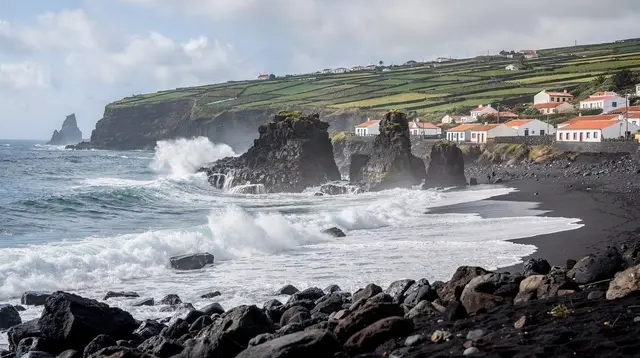
Ribeira Grande takes its name — “big stream” — from the ribeira that once ran, and still partly runs, through its centre, and the town grew up along its banks the way most Azorean settlements grew around fresh water and a landing point for boats. The historic core keeps the pattern typical of the island’s older towns: narrow streets paved in black basalt cobbles, whitewashed house fronts trimmed in dark volcanic stone, wrought-iron balconies, and a parish church anchoring the main square. Unlike Ponta Delgada’s compact old town, Ribeira Grande’s centre is looser and more workaday — a town hall, a market building, a scatter of cafés and small shops that still serve residents first and visitors second.
That workaday feel is the honest selling point. Ribeira Grande has not been rebuilt around tourism the way parts of Ponta Delgada have. Shops close for lunch, close early in the evening, and close altogether on Sundays, in keeping with the practicalities that apply across the smaller towns of São Miguel. A short walk through the centre — the square in front of the town hall, the riverside street, the market when it is open — gives a more grounded sense of daily Azorean life than a longer stop in a busier destination often does. It is not a place with a long checklist of sights; it is a place to slow down for half an hour on the way to somewhere else, and that is enough to make it worth the stop.
The town’s history runs deeper than its present modest size suggests. Ribeira Grande was, for long stretches of the island’s colonial past, one of its more important settlements, tied to the sugar economy that once anchored much of São Miguel’s early wealth before the island’s agriculture shifted toward the dairy, pasture and tea that define it today. Little of that industrial past is visible on the surface now, but the scale of the historic centre — larger than its current population might suggest — is a trace of it.
Today the municipality of Ribeira Grande is administratively significant well beyond the town itself: it covers a long stretch of the north coast, including the fishing town of Rabo de Peixe further along the shore, which makes Ribeira Grande the reference point on maps and road signs for a much wider area than its own streets.
Getting there and getting around
There is no train connecting Ribeira Grande to any other town on São Miguel — the island has no railway at all, a fact worth stating plainly, because it is one of the easiest assumptions to get wrong when comparing São Miguel to mainland Europe. Every route in and out of Ribeira Grande runs by road.
From Ponta Delgada, the fastest approach is the via rápida, the dual-carriageway that links the capital with Lagoa and Ribeira Grande, usually a drive of well under thirty minutes by rental car, which remains the practical default for getting around the island. Bus operators including Auto Viação Micaelense serve Ribeira Grande from Ponta Delgada and other towns, but their schedules are built around school runs and commuting patterns, not sightseeing, so a self-driven visit gives far more flexibility for stringing together a north-coast day.
Beyond the via rápida, the older EN1-1A road that rings the island also runs through the area, connecting Ribeira Grande onward to Rabo de Peixe, Capelas and the rest of the north coast circuit. Roads narrow quickly once you leave the main routes, so plan for a slower pace than the distances on a map suggest, and fill the tank before setting out — fuel stations thin out away from the larger towns.
Parking in the town centre is generally straightforward compared with Ponta Delgada, with informal or marked spaces around the main square and near the market, though it tightens on market days and during summer weekends when north-coast traffic is at its heaviest.
Ribeira Grande as a base for the north coast
The strongest argument for spending time in Ribeira Grande is not the town square — it is the map. Ribeira Grande sits almost exactly where the north-coast attractions cluster, which makes it a natural hinge point for a day’s driving rather than a single destination in its own right.
A short drive inland and uphill leads toward Caldeira Velha, the thermal waterfall and pools on the slope of the Água de Pau massif — one of the island’s most visited natural sites, covered in full on its own page rather than here. Along the coast in the other direction sit the tea plantations of Gorreana, founded in 1883 and the oldest working tea estate in continental Europe, and the smaller Porto Formoso plantation nearby — both easily reached from Ribeira Grande and often combined with a town stop on the same outing.
Toward the sea, Praia de Santa Bárbara is the north coast’s best-known surf beach, its own dedicated subject rather than a town-centre sight. Further along the coast, Rabo de Peixe keeps a genuine working fishing harbour, and Capelas, with its old whaling station, marks the western end of this stretch of coastline.
Treated this way, Ribeira Grande stops being a place you either visit or skip, and becomes what it actually is on the ground: the town you pass through, stop in briefly, and use as a reference point while assembling a day of thermal pools, tea fields, coastline and fishing villages. Visitors building an itinerary weighted toward Furnas, Nordeste or the north coast, rather than Sete Cidades and the west, sometimes choose to base themselves in or near Ribeira Grande for a night or two rather than commuting out from Ponta Delgada each day — it cuts driving time to the caldeira, the tea plantations and the eastern viewpoints, at the cost of a smaller choice of restaurants and a quieter evening than the capital offers.
Tours that start from Ribeira Grande
Because of its position on the road network, several tour operators use Ribeira Grande as a starting point for excursions into the surrounding hills and lakes rather than the town itself. A buggy tour setting off from Ribeira Grande toward the Sete Cidades caldera is one of the more popular ways to cover the winding backroads between the north coast and the west without driving them yourself, and the same route is also run as a quad buggy tour from Ribeira Grande to Sete Cidades for visitors who prefer riding solo or two-up.
For a slower, on-foot alternative, a private guided hike from Ribeira Grande to the Salto do Cabrito waterfall heads up into the hills behind the town, following streams and forest tracks that most visitors never see from the main road. Closer to Caldeira Velha itself, a guided hike combining the Janela do Inferno viewpoint with Caldeira Velha links the thermal waterfall to a lesser-known trail nearby, with transport arranged from the Ribeira Grande area.
Given its position a short drive from Praia de Santa Bárbara, Ribeira Grande is also a natural pickup point for beginners looking to try the north coast’s waves on a group surf lesson on São Miguel without arranging their own board and transport.
Eating and everyday practicalities
Food in Ribeira Grande follows the same honest, unfussy pattern as the town itself: small cafés and tasca-style restaurants serving Azorean staples — fresh fish, cornbread, local cheese and the linguiça and morcela sausages found across the island — rather than a curated visitor-facing dining scene. The market building is the best place to see, and sometimes buy, what is actually in season locally, from produce to fish landed further along the coast at Rabo de Peixe. As with the rest of São Miguel outside Ponta Delgada, small shops and cafés tend to close early in the evening and stay closed on Sundays, so plan meals and errands accordingly rather than assuming capital-city hours.
Practicalities are otherwise the same as anywhere on the island: the emergency number is 112, sockets are type C/F at 230V, tap water is safe to drink, and Portuguese is the working language, though English is understood in most tourism-facing businesses. The nearest hospital of any size is in Ponta Delgada, a short drive away along the via rápida, which is worth keeping in mind if a stay is centred on Ribeira Grande rather than the capital.
Ribeira Grande FAQ: second town basics
Is Ribeira Grande worth visiting on its own?
It rewards a short stop rather than a dedicated day. The historic centre, riverside streets and market are worth thirty to sixty minutes on the way to or from the north coast, but few visitors plan a whole day around the town itself.
How do I get from Ponta Delgada to Ribeira Grande?
By rental car it is a short drive along the via rápida, the dual-carriageway that links Ponta Delgada, Lagoa and Ribeira Grande, usually well under thirty minutes. Buses run on Auto Viação Micaelense routes but follow school and work timetables rather than sightseeing ones.
Is there a train between Ponta Delgada and Ribeira Grande?
No. São Miguel has no railway of any kind. The only ways between the towns are the road network, by rental car, or the island’s bus operators.
How far is Ribeira Grande from Caldeira Velha and the Gorreana tea plantation?
Both are a short drive from town, along the EN1-1A and the roads climbing toward the Água de Pau massif. Ribeira Grande functions as the practical landmark and turn-off point for reaching them, though neither sits inside the town itself.
Can I base myself in Ribeira Grande instead of Ponta Delgada?
Yes, and it suits itineraries weighted toward the north coast, Furnas or Nordeste. It has fewer restaurants and a smaller choice of accommodation than Ponta Delgada, and evenings are quieter.
What’s the difference between Ribeira Grande and Rabo de Peixe?
Ribeira Grande is the administrative and commercial town, with the historic centre, market and town hall for the wider municipality. Rabo de Peixe is a distinct fishing town further along the north coast, with its own working harbour and a different, more maritime character.
Is Praia de Santa Bárbara in Ribeira Grande itself?
It lies within the wider municipality of Ribeira Grande but is a separate beach with its own access and character, covered on its own page rather than as part of the town centre.
How long do I need to see Ribeira Grande’s centre?
Thirty to sixty minutes covers the main square, the riverside streets and the market at an unhurried pace, which is enough for most visitors passing through on a north-coast circuit.
For the sites nearby that this page only points toward, see the Caldeira Velha thermal waterfall guide, the Praia de Santa Bárbara surf beach guide, the Gorreana tea plantation guide and the Porto Formoso tea plantation guide. For a combined day out, the Ribeira Grande and Caldeira Velha day trip and the Gorreana tea plantation day trip both build a full itinerary around the town.
Practical planning for getting around without a train is covered in renting a car on São Miguel, the São Miguel bus guide and the wider point made in why a rental car is the default, not a shortcut. Ribeira Grande also fits naturally into a longer loop, such as the four-day full-island itinerary, and sits alongside Capelas and Gorreana as one of the fixed points of the north coast.
City Sightseeing on GetYourGuide
Verified deep-linked GetYourGuide tours. Book through these links and we earn a small commission at no cost to you.
GetYourGuide does not provide a product photo for this activity — the image shows the meeting point, photographed by us.