Caldeira Velha: São Miguel's Volcanic Thermal Waterfall
Is the hot water at Caldeira Velha natural or heated artificially?
The warmth at Caldeira Velha is entirely natural: geothermal heat rising through the active Água de Pau volcanic massif warms groundwater before it surfaces as a waterfall and a series of pools. Nothing here is heated mechanically, and the same volcanic system produces genuinely boiling ground elsewhere on São Miguel, which is why marked trails around these areas are never left.
A waterfall with a volcano underneath it
Most waterfalls are explained by rainfall and gravity. Caldeira Velha needs a different explanation, because the thing that makes it worth visiting is not the drop of the water but its temperature. The stream that spills over the rocks here, on the lower slopes of the Água de Pau massif above Ribeira Grande, is warm before it ever reaches the waterfall, and it stays warm in the pools it collects into below. That warmth is not a feature someone installed. It is geothermal heat rising through an active volcano, and understanding that single fact changes how the whole site should be read.
São Miguel is a volcanic island, and Água de Pau is one of its active volcanic systems, not a dormant lump of old rock. Magma sits close enough to the surface here that groundwater passing through the fractured ground is heated before it emerges. Caldeira Velha is simply the point on the massif where that warmed water happens to surface as a visible waterfall and a chain of pools, framed by ferns, hydrangeas and laurel. It looks like a garden feature. It behaves like one, in the sense that it is landscaped, maintained and easy to reach. But the heat itself is not a garden feature at all.
Why the heat is geothermal, not mechanical
It is worth being direct about this, because visitors arriving from places where a “hot spring” usually means a spa with a boiler somewhere behind the wall can assume the same is true here. It is not. There is no heating plant under Caldeira Velha. The temperature of the water is set entirely by geology: rain and groundwater sink into fractured volcanic rock on the flanks of Água de Pau, travel down toward heat sources associated with the magma system, and rise back to the surface warmed by that contact. By the time the water reaches the waterfall, it has already picked up the dissolved minerals, faint sulphur smell and mild iron tint typical of Azorean thermal water, alongside its temperature.
This matters for two reasons beyond curiosity. First, because it means the water’s character can shift slightly over time and after seismic activity, the way any geothermal feature can, rather than staying fixed the way a heated pool would. Second, because the same volcanic system that gently warms Caldeira Velha produces, elsewhere on São Miguel, ground that is genuinely too hot to touch and water that genuinely boils.
Caldeira Velha is the mild end of a spectrum of volcanic heat that runs, further inland, through the fumarole fields around Furnas to places where the danger is real and immediate, not scenic. Treating Caldeira Velha’s warmth as “just a nice hot spring” misses the fact that it sits on the same kind of ground as those more dangerous sites.
Active, not decorative: what that means on the ground
The word “active” is doing real work when applied to Água de Pau and to São Miguel’s volcanism generally. It does not mean an eruption is imminent. It means the underlying system is still capable of producing heat, gas and, occasionally, seismic activity, and that the landscape visitors walk through is a live product of that system rather than a fossil of one. The island’s volcanic history is not confined to a museum display; it is under the path.
A useful overview of how São Miguel’s various volcanic centres relate to each other, from Sete Cidades in the west to the Furnas caldera in the east, is laid out in this site’s volcanic history overview, which helps place Caldeira Velha and Água de Pau within the bigger picture rather than as an isolated curiosity.
Practically, this is why marked trails through these zones are treated as fixed, not advisory. Ground near active thermal features can look solid while sitting over water at or near boiling point, or over a thin crust above a fumarole. This is true around the Lagoa do Fogo crater and around the caldeiras of Furnas, and the same rule applies on the approaches to Caldeira Velha: stay on the path that exists, don’t cut across tempting-looking ground to get a closer look at steam or a pool, and don’t assume that because one patch of ground was cool underfoot the next one will be too.
Guides on organised hikes through this terrain enforce this as a matter of course, which is one practical reason to book a guided route rather than improvise one, especially on any itinerary that goes beyond Caldeira Velha itself and higher onto the massif.
Arriving at Caldeira Velha
The site sits just off the road that climbs from the north coast toward the interior of the island, a short distance inland from Ribeira Grande and easily folded into a wider loop of the island’s volcanic sights. There is parking near the entrance, and a modest entry fee applies to help maintain the paths, changing areas and the small botanical grounds around the pools. From the entrance, a short walk through planted ferns, camellias and hydrangea hedges leads down to the waterfall itself.
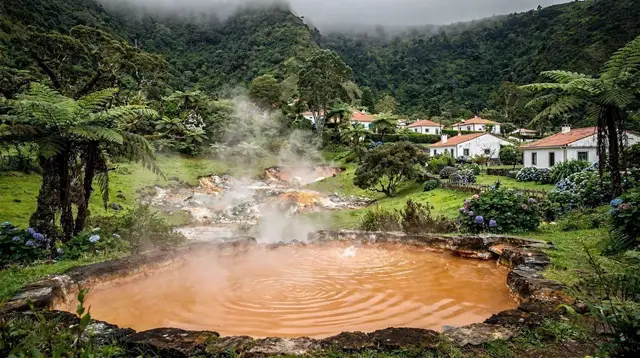
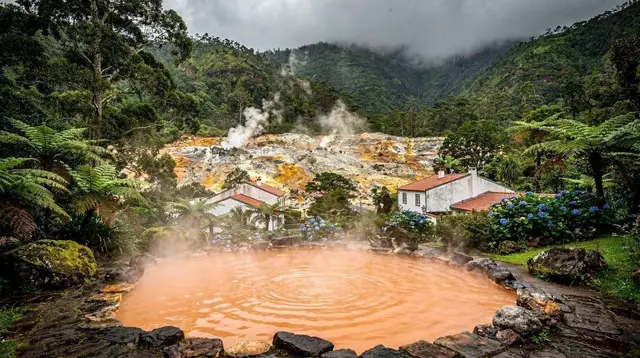
The waterfall is not large in the way that a mountain cascade is large. It is a compact, warm curtain of water dropping a few metres over volcanic rock, feeding a series of connected pools below where visitors can sit in the warmed water. The colour is a soft, slightly cloudy tint rather than the clear blue of a swimming pool, a sign of the dissolved minerals the water has picked up on its way through the rock, and the smell carries a faint mineral, faintly sulphurous edge that is common to thermal water across the island. None of this is a defect; it is what distinguishes genuinely volcanic water from a treated pool, and visitors who expect chlorinated clarity are looking for the wrong thing here.
Facilities are basic by design: a place to change, somewhere to rinse off afterwards, and paths kept clear of the vegetation that would otherwise close in quickly on this well-watered slope. It is not a spa with treatments or a restaurant on site. It is closer to a managed access point onto a natural feature than a resort.
Caldeira Velha at a glance
| Feature | What you’ll find |
|---|---|
| Setting | Slope of the Água de Pau massif, inland from Ribeira Grande |
| Heat source | Geothermal, from the active volcanic system beneath the massif |
| Water | Warm, mineral-tinted, mildly sulphurous, not chlorinated or clear |
| Access | Short walk from a car park; entry fee applies |
| Facilities | Basic changing area, paths, botanical grounds; no spa treatments |
| Trail rule | Marked paths only, on-site and on any onward route up the massif |
The pools and what to expect in the water
Visitors typically move between the pool directly under the waterfall, where the flow is strongest and the temperature least even, and the calmer pools further downstream, where the water has mixed and settled to a steadier warmth. None of it is scalding at the points open to visitors; the water has already lost its hottest edge by the time it reaches the accessible pools, which is a large part of why the site can be visited casually rather than only under supervision. That said, the water can stain light-coloured swimwear over time, in the same way other iron-bearing thermal water on the island does, and older, darker swimwear is the practical choice.
A short, focused guide to Caldeira Velha’s own pool exists on this site if you only need the visiting logistics rather than the wider volcanic context this page covers, and a broader comparison of São Miguel’s thermal pools is useful if you’re weighing Caldeira Velha against Terra Nostra’s iron-rich pool in Furnas or the smaller pools at Poça da Dona Beija. A general note on what to pack for iron-rich thermal water applies here as much as anywhere else on the island.
Best time to visit
Caldeira Velha is pleasant in any season, since the water’s temperature is not weather-dependent in the way sea temperature is, but conditions on the approach and on any onward hike higher up Água de Pau do change with the seasons. Drier months make for easier, drier trails and clearer views if a route continues up toward viewpoints on the massif; wetter months mean a lusher, more dramatic setting around the waterfall itself but muddier paths.
Midday in the busier summer weeks brings the most visitors to the pools; early morning or late afternoon is quieter. None of this changes the underlying character of the site, only the comfort of visiting it, and the general seasonal patterns covered in this site’s weather guide apply here as elsewhere on São Miguel.
Getting there and combining it with the rest of the massif
Caldeira Velha sits close enough to the via rápida that it is an easy stop for anyone driving between Ponta Delgada and the north coast, and it also functions as a gateway onto the wider Água de Pau massif for those wanting to go further.
Trails climb from this area toward Lagoa do Fogo, the crater lake near the middle of the island, and toward viewpoints that only open up when the cloud that regularly sits on the massif happens to clear. Because Lagoa do Fogo itself has no facilities of any kind and can be closed by weather, anyone linking the two should treat Caldeira Velha as the reliable, maintained part of the outing and the higher ground as the part that depends on the day.
For visitors who would rather have a guide handle navigation, timing and the practicalities of moving safely through this volcanic terrain, several routes combine Caldeira Velha with hiking higher on the massif. One option pairs the thermal pools directly with a hike toward the crater lake: a guided hike that links Fogo Lake with the hot springs at Caldeira Velha.
A more route-specific version follows the Janela do Inferno trail before descending to the pools, covered by a guided hiking route from Janela do Inferno down to Caldeira Velha. For those short on time or preferring not to hike, a private 4x4 tour that can be routed through the Água de Pau area covers the same volcanic terrain by vehicle rather than on foot.
Nearby volcanic ground worth understanding
Caldeira Velha is one point on a much larger volcanic system that shapes the whole island, and a short visit to it is a reasonable entry point into that bigger picture rather than the full story. The active ground at Furnas, further east, produces fumaroles hot enough to cook a meal underground, a genuinely different order of heat from what surfaces at Caldeira Velha.
The distinction between a caldera, a crater lake and a lava tube, all present within a short drive of each other on São Miguel, is covered in this site’s explainer on how calderas and lava tubes differ, which is worth reading before assuming every volcanic feature on the island behaves the same way. Broader questions about how safe the island’s volcanic and natural terrain actually is for visitors are addressed in is São Miguel safe: wildlife and hazards, which covers marked-trail rules of the kind that apply at Caldeira Velha in more general terms.
For anyone building an itinerary specifically around the island’s thermal features, a route focused on hot springs across São Miguel — Caldeira Velha included — is outlined in the thermal springs itinerary, and the hot springs and thermal category page lists the full set of pools and waterfalls the island offers. The volcanoes and craters category covers the drier side of the same system, from crater rims to lava tubes, for visitors who want the geology without the swimwear.
The honest summary
Caldeira Velha earns its place on an itinerary because the heat is real, not because the setting is unusually large or dramatic. It is a small, warm, mineral-tinted waterfall on the side of an active volcano, maintained enough to visit comfortably and wild enough that its water genuinely came from magma-warmed rock rather than a boiler. That single fact — geothermal, not mechanical — is also the reason the same island produces ground elsewhere that visitors are told, without exception, not to leave the marked path around. Caldeira Velha is the gentle end of that same system, and knowing that is most of what makes a visit here make sense.
Questions about visiting Caldeira Velha’s thermal waterfall
Is Caldeira Velha’s warm water heated artificially?
No. The heat comes from magma close to the surface inside the Água de Pau volcanic massif. Groundwater is warmed geothermally as it passes through fractured rock, then reaches the surface as a waterfall and a chain of pools. There is no boiler, pump heater or any mechanical system involved.
Why is the ground on São Miguel hot enough to boil water in places?
São Miguel sits on the Mid-Atlantic Ridge and is built entirely from volcanoes, several of which are still active. Furnas and the area around Água de Pau have shallow magma chambers, so heat reaches close to the surface and produces fumaroles, steaming ground and, in a handful of spots, water that genuinely boils.
Is it safe to leave the marked trail near Caldeira Velha?
No. Ground that looks solid can sit over scalding water or thin crust above a fumarole. Every path through São Miguel’s active volcanic areas, Caldeira Velha included, is marked for a reason, and staying on it is the entire basis of visiting these zones safely.
How warm is the water at Caldeira Velha?
It is comfortably warm rather than hot enough to cause harm, closer to a mild bath than a spa treatment, though it varies slightly by pool and by how close you are to where the water surfaces. It is never cold, and it is never boiling at the point where visitors enter it.
Is Caldeira Velha the same place as Terra Nostra Park?
No. Terra Nostra is a separate thermal garden in Furnas with an iron-rich orange pool that stains swimwear. Caldeira Velha sits on the opposite side of the island, on the slopes of the Água de Pau massif near Ribeira Grande, and its water and setting are distinct.
Can Caldeira Velha be combined with a hike further up the massif?
Yes. Guided routes exist that link the thermal pools with trails higher on Água de Pau, including approaches toward Lagoa do Fogo, letting a single outing cover both the volcanic waterfall and the crater lake above it.
Is Caldeira Velha open all year?
Yes, the site operates year-round, though opening hours and access can change with weather, and heavy rain or high wind can affect conditions on the approach paths. Checking current hours before setting out is worth it outside peak season.
Do I need to book anything in advance to visit Caldeira Velha?
Independent visits do not require booking. Guided hikes and tours that include Caldeira Velha as part of a wider volcanic itinerary do get booked ahead, especially in the busier months, since group sizes on these trails are limited.
Hot Springs on GetYourGuide
Verified deep-linked GetYourGuide tours. Book through these links and we earn a small commission at no cost to you.
GetYourGuide does not provide a product photo for this activity — the image shows the meeting point, photographed by us.