Caldeiras vs. Lava Tubes: São Miguel's Two Kinds of Volcanic Ground
What's the difference between a caldeira and a lava tube on São Miguel?
A caldeira is an active volcanic crater where the ground and water are still hot today, as at Furnas or Caldeira Velha. A lava tube such as Gruta do Carvão is a cooled, hollow channel left behind by lava that stopped flowing long ago — there is no heat, no steam and no activity inside it. One is a live system you approach with caution; the other is cold rock you can walk into.
Two Different Kinds of Ground Under Your Feet
São Miguel is built entirely out of volcanoes, but it is not one kind of volcanic ground. Drive across the island in a single day and you can stand on two completely different things that both get called “volcanic” in the same breath: a caldera where the earth is still doing something right now, and a lava tube where the earth finished doing something a very long time ago and has been quiet ever since. Visitors mix the two up constantly, and the mix-up matters, because the two kinds of ground ask for opposite behaviour. One rewards curiosity within firm limits. The other is simply cold rock you can explore on a fixed, guided path.
This page is a signpost, not a guidebook to either place. If you want the full detail on the lava tube at the edge of Ponta Delgada, that lives on its own page at Gruta do Carvão. If you want the full detail on the boiling ground and cooking pits at Furnas, that lives at how cozido das Furnas is cooked underground and at the Furnas caldeiras and fumaroles walking guide. What belongs here is the distinction itself: what a caldeira is, what a lava tube is, why São Miguel has both, and why treating them as interchangeable is the mistake that gets people hurt or simply gets them a worse day out.
What Makes a Caldeira “Active”
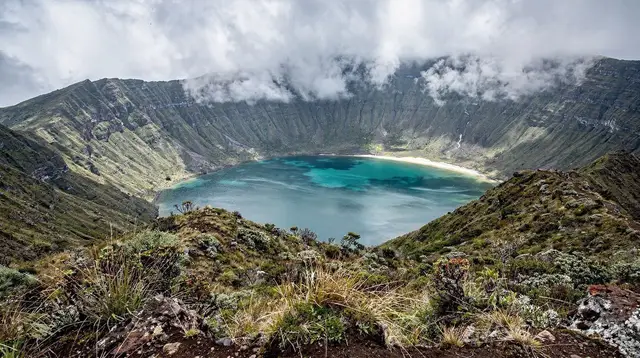
A caldeira, in the Azorean sense used on every sign and every tour brochure on São Miguel, is a large volcanic depression formed when a magma chamber emptied enough that the ground above it collapsed inward. São Miguel has several: the huge bowl that holds the village of Furnas and its lake, the west-island crater that holds Sete Cidades and its twin lakes, and the central crater lake of Lagoa do Fogo.
“Active” does not mean an eruption is imminent. It means the underlying system — magma still relatively close to the surface, groundwater heated by it — is live enough to keep producing measurable heat, gas and mineral-rich water at ground level today, not as a historical footnote.
At Furnas that heat is not subtle. Walk the caldeira floor near the Lagoa das Furnas and you pass caldeiras in the smaller, everyday sense too — the local word for the individual steaming pits and pools of boiling mud and water dotted across the ground, which is also where the word for the whole crater comes from. Restaurants lower pots of meat and vegetables into holes dug in that same hot ground and leave them to cook for five to seven hours on heat with no fire at all, which is covered in full on the cozido das Furnas guide.
A short walk away, Caldeira Velha on the slope of the Água de Pau massif channels the same kind of heat into a warm waterfall and bathing pools rather than a cooking pit. Different use, same underlying fact: the rock and water are genuinely warm right now because of magma, not because of the sun.
This is also why every one of these places is fenced, boardwalked or otherwise channelled onto a fixed route, and why that is treated as non-negotiable rather than as an overcautious suggestion. The crust over an active fumarole can be thin, the ground temperature under it genuinely close to boiling, and there is no way to tell a safe patch of grass from an unsafe one by eye. Staying on the marked path at Furnas, at Lagoa do Fogo, or anywhere else the island calls a caldeira is not a suggestion for the nervous, it is the entire safety system.
What a Lava Tube Actually Is
A lava tube is a completely different kind of feature, and it belongs to a completely different chapter of the island’s volcanic story. When a fast, fluid lava flow moves across the surface, its outer edges and top cool and harden into rock while the lava underneath keeps flowing, insulated by the crust that has formed around it. When the eruption feeding that flow eventually stops, the still-liquid lava inside can drain onward and out, leaving behind a hollow tunnel — a lava tube — inside rock that has since cooled completely and solidified for good.
São Miguel’s best-known example, Gruta do Carvão, sits on the outskirts of Ponta Delgada rather than inside any crater, because it has nothing to do with a crater. It is the leftover plumbing of an ancient lava flow, not a hole into a still-hot system.
There is no steam, no boiling water, no fumarole gas and no heat coming from beneath it — the rock inside sits at an ordinary cave temperature year-round, the same reason any cave anywhere feels cool and constant regardless of the weather outside. Walking through it, with a helmet and a guide on a fixed route as described on the lava tube walk guide, is a look at how lava moved centuries ago, not a look at anything still happening today.
That is the whole distinction in one sentence: a caldeira is a crater over a system that is still hot, a lava tube is a tunnel inside rock that has gone cold. Confusing the two — calling Gruta do Carvão a “caldeira” or describing Furnas as “just a cave with some steam” — is more than a vocabulary slip. It sets the wrong expectation for what a marked path is protecting you from, and on this island the marked path exists at Furnas because the ground can genuinely burn, not because a cave might be dark.
Side by Side: Caldeira vs Lava Tube
| Active caldeira (Furnas, Lagoa do Fogo, Sete Cidades) | Lava tube (Gruta do Carvão) | |
|---|---|---|
| What it is | A collapsed crater over a still-active volcanic system | A hollow tunnel left by a cooled, drained lava flow |
| Is it hot today? | Yes — boiling springs, steaming ground, warm pools | No — ordinary cave temperature year-round |
| Formed | Ongoing process, shaped by activity that continues now | A single event, long finished |
| Typical visit | Open-air walking on boardwalks and marked paths | Guided underground walk with a helmet, fixed route |
| Weather-dependent? | Yes — often clouded in, paths can close after rain | No — same conditions inside regardless of weather |
| Main hazard | Thin ground crust, near-boiling water and mud off-path | Low ceilings and uneven footing, like any cave |
| Where on São Miguel | Furnas, Sete Cidades, Lagoa do Fogo, Caldeira Velha | Edge of Ponta Delgada |
Where to See Each on São Miguel
If you only have time or appetite for one, the choice is really about what you want to feel, not about which is “better.” An active caldeira is an outdoor, weather-exposed visit where the landscape itself is doing something — steam rising off grass, mud bubbling in a roped-off pit, warm water running out of a hillside. A lava tube is a contained, indoor-feeling visit, dry and cool regardless of what the sky is doing, better suited to a rainy afternoon or a short window between other plans near Ponta Delgada.
| Site | Type | Where | Best paired with |
|---|---|---|---|
| Furnas caldeiras | Active caldeira | East of the island, inland | Furnas fumaroles walk, Terra Nostra thermal pool |
| Caldeira Velha | Active caldeira, thermal waterfall | Slope of Água de Pau, near Ribeira Grande | Ribeira Grande day trip |
| Lagoa do Fogo | Active crater lake, no facilities | Centre of the island | Lagoa do Fogo guide |
| Gruta do Carvão | Lava tube, cooled | Edge of Ponta Delgada | Ponta Delgada city day trip |
For most itineraries the two pair naturally rather than competing: a morning walk through the cool dark of Gruta do Carvão close to town, followed on another day by the open, steaming ground at Furnas or a bath in the thermal pools compared across the island. The broader volcanic history overview is worth reading first if you want the full arc of how São Miguel’s craters, tubes, and thermal fields all fit into one geological story rather than treating each stop as a one-off curiosity.
Why the Difference Matters for Safety
The reason to keep these two categories straight is not pedantry, it is that they carry genuinely different rules, and mixing up the rules is how people get hurt. Around an active caldeira, the instruction to stay on the marked path is a hard safety line: crust can be a few centimetres of cooled surface over water and mud close to boiling point, and there is no visual cue that tells a safe patch of grass from an unsafe one. That rule exists at Furnas, at the fumarole fields, and at Lagoa do Fogo, where the reserve additionally has no cafés, no ticket office and no facilities of any kind, and where cloud can close in with very little warning.
Inside a lava tube like Gruta do Carvão, the ground itself carries no thermal risk at all — the hazards are the ordinary ones of moving through any cave, low ceilings, dips and uneven rock, poor natural light, which is exactly why a helmet and a single fixed route are standard rather than optional. Wandering off that route is a bad idea for the same reason wandering off any unlit path is a bad idea, not because the rock might suddenly turn out to be hot.
Broader background on how the island handles both kinds of ground, plus the honest list of what actually is and is not risky about São Miguil’s outdoors in general, is covered on is São Miguel safe: wildlife and hazards — short version, the real hazards on this island are the sea, cliff edges, fog and active thermal ground, never a snake or a predator, since there are none.
One more distinction worth carrying with you: a caldeira and a caldeira lake are not automatically the same water everywhere on the island, and colour differences between pools or lakes are usually about light, mineral content and depth rather than proof of two separate systems. Sete Cidades’ twin lakes, for instance, are joined water, not two different substances, a point covered fully on that destination’s own pages rather than repeated here.
Booking a Guided Look at Both
Because the two kinds of ground sit in different parts of the island and call for different guiding, most visitors see them on separate outings rather than one combined trip. A jeep circuit is a practical way to reach the more remote active caldeiras and craters in one day with a driver who knows current road and weather conditions — worth checking against a booking such as a full-island jeep tour if the Lagoa do Fogo road or Furnas ground conditions are in any doubt on the day.
Around Sete Cidades and the Fogo lake specifically, a guided van route such as a full-day van tour taking in Sete Cidades and Lagoa do Fogo covers both craters with a driver handling the narrow, sometimes fogbound roads. For the thermal side of an active caldeira rather than the geology alone, a route built specifically around the island’s hot springs, such as a guided route through São Miguel’s volcanic thermal baths, is a straightforward way to see several caldeira-fed pools in one day without driving between them yourself.
None of these bookings substitute for the two dedicated pages this one points to. If Furnas and its underground-cooked meal are the plan, read cozido das Furnas explained before you go, since the restaurants there take the cooking-pit order and the timing, not the visitor. If the lava tube is the plan, read the Gruta do Carvão guide for opening arrangements and what the guided walk actually covers. This page’s job stops at making sure you know, before you arrive at either, which kind of ground you’re about to stand on.
Caldeiras and Lava Tubes on São Miguel: Common Questions
Is Gruta do Carvão inside a volcano crater?
No. Gruta do Carvão is a lava tube, a tunnel formed when the surface of a flowing river of lava cooled and hardened while liquid rock kept moving underneath, later draining out and leaving a hollow tube. It sits on the edge of Ponta Delgada, not inside a caldera, and it has been cold and inert for a very long time.
Can I get close to the boiling ground at Furnas?
Yes, on marked platforms and paths around the Furnas caldeiras, but only on marked platforms and paths. The ground there is thin crust over genuinely near-boiling water and mud, and stepping off the walkway is not a shortcut, it is a real burn hazard.
Are lava tubes like Gruta do Carvão dangerous to visit?
Not in the way an active caldera is. The rock is cold and stable, and the main risks are the ordinary ones of any cave: low ceilings, uneven footing and darkness, which is why a helmet and a fixed route are provided rather than free-form exploring.
Why does Furnas feel hot and Gruta do Carvão feel cold if both are volcanic?
Furnas sits inside an active caldera where magma close to the surface still heats groundwater into steam and boiling springs today. Gruta do Carvão is the leftover plumbing of a lava flow that finished erupting long ago; nothing underneath it is still hot, so the rock has cooled to the same temperature as any other cave.
Do São Miguel’s active caldeiras ever close to visitors?
Access to specific paths, platforms or the Lagoa do Fogo road can close for weather, landslide repair or ground conditions, and those closures are enforced for real reasons rather than caution for its own sake. Always check current access locally rather than assuming a route is open.
Is one better for a family visit, a caldeira or a lava tube?
They suit different ages and moods rather than one being simply better. A lava tube like Gruta do Carvão is a short, contained, weatherproof walk that works well with children, while an active caldeira such as Furnas is more of an open-air walking visit with more ground to cover and more supervision needed near hot spots.
Comparison on GetYourGuide
Verified deep-linked GetYourGuide tours. Book through these links and we earn a small commission at no cost to you.
GetYourGuide does not provide a product photo for this activity — the image shows the meeting point, photographed by us.