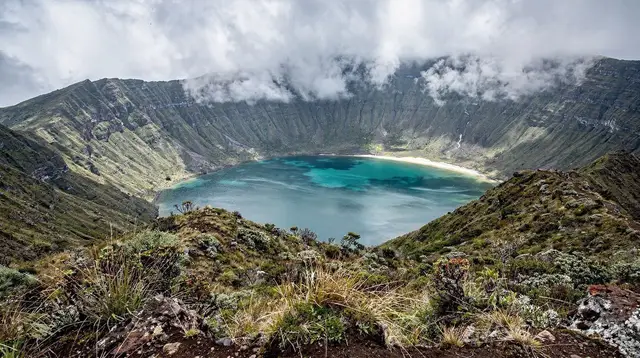
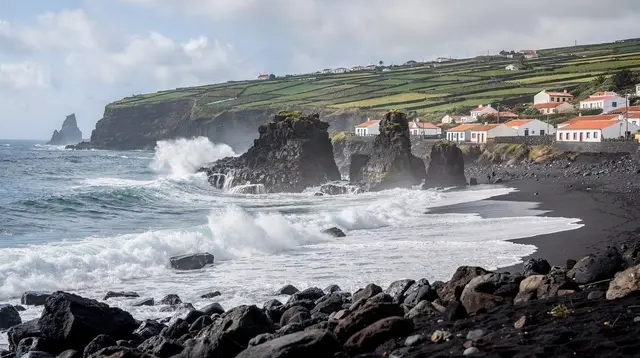
A working town on the north coast, and the natural staging point for São Miguel’s thermal springs and tea country.
São Miguel’s second town, on the road north
Ribeira Grande takes its name from the river that cuts through its centre — “big river” — and it has been the north coast’s principal town since colonial times, when it grew rich on grain, dye plants and, later, dairy. Today it’s São Miguel’s second-largest municipality after Ponta Delgada, a working town of churches, old merchant houses and a riverside core rather than a resort. Few visitors come for the town alone. Most arrive because Ribeira Grande sits at the junction of three things people do come for: a thermal waterfall on the mountain above it, two of Europe’s last working tea plantations along the coast beside it, and a proper Atlantic surf beach at its edge.
That positioning is the point of this page. Caldeira Velha, Gorreana and Porto Formoso, and Praia de Santa Bárbara each have their own detailed guide; this one exists to explain how Ribeira Grande connects them, what the town itself offers while you’re passing through, and how to plan a north-coast day that starts or ends here.
Getting there and getting around
From Ponta Delgada, Ribeira Grande is a 15-20 minute drive on the via rápida, the dual-carriageway that links the capital with Ribeira Grande and Lagoa. It’s worth being precise about what that road is and isn’t: it’s a free, ordinary dual-carriageway, not a toll motorway. São Miguel has no motorway vignette and no toll booths anywhere on the island — that system belongs to mainland Portugal, not the Azores, and nothing about the via rápida requires paying to use it.
That ease doesn’t extend uphill. The roads climbing from Ribeira Grande toward Caldeira Velha and the interior are the island’s ordinary narrow lanes, not extensions of the via rápida, and they can be reduced by fog or closed after heavy rain, particularly on the higher stretches. A rental car remains the practical way to link the town with its surroundings; buses run to a commuter and school timetable that rarely matches a day trip’s rhythm.
If you’re new to driving on São Miguel, the roads here are typical of the island: single carriageway once you leave the via rápida, cattle occasionally on the tarmac, and distances that look short on a map but take longer in practice.
Caldeira Velha: the thermal waterfall above town
On the flank of the Água de Pau massif, a short drive up from Ribeira Grande, Caldeira Velha is a thermal waterfall and a series of warm pools set in forest, one of the most photographed spots on the island. It has its own detailed page and its own thermal waterfall guide, so this page won’t repeat the practicalities of pool temperature, opening times or what to bring.
What matters here is the logistics: it sits close enough to Ribeira Grande to combine easily with a town visit, but the access road is one of those narrow uphill lanes rather than a fast link, and it’s worth checking conditions before you commit to the climb, since cloud and closures happen on this side of the island more than the coast. For a combined outing, the Ribeira Grande and Caldeira Velha day trip lays out a fuller route.
Gorreana and Porto Formoso: the tea coast
A short drive further along the coast from Ribeira Grande sit Gorreana, founded in 1883 and the oldest working tea plantation in Europe, and the smaller Porto Formoso estate nearby. Between them they are one of only two places left on the continent still growing and processing tea commercially.
Gorreana’s fields and factory have long been free to walk through on a self-guided basis; Porto Formoso is smaller and charges for a visit. Neither is detailed here — the Gorreana tea plantation guide and the Porto Formoso guide cover what to see at each — but Ribeira Grande is the obvious base for reaching both, sitting between them and the capital on the coast road.
Further along the same stretch of coast, Capelas keeps the remains of an old whaling station, and the fishing town of Rabo de Peixe sits just the other side of Ribeira Grande toward Ponta Delgada — both worth a stop if you’re already tracing this shoreline rather than destinations in their own right.
Praia de Santa Bárbara: the north coast’s surf beach
Ribeira Grande also gives access to Praia de Santa Bárbara, the island’s best-known surf beach, a stretch of dark sand facing the open Atlantic rather than a sheltered cove. It draws a different crowd from the south coast’s calmer bays: surfers and watersports visitors first, sunbathers second. Conditions here follow the open ocean rather than a caldera lake or a walled bay, so swell and currents are part of the deal, not an exception. The surf guide covers board hire, seasons and where to watch from if you’d rather not paddle out yourself.
Capelas and Rabo de Peixe: the coast either side
Two working villages flank Ribeira Grande along this stretch of coast, and both reward a short stop if you’re already tracing the shoreline rather than a special trip of their own. West toward Ponta Delgada, Rabo de Peixe is a fishing town in the fullest sense — boats, nets and a working harbour rather than a curated waterfront — and it sits close enough to slot into the same drive without a detour.
East of Ribeira Grande, Capelas keeps the physical remains of an old whaling station, a reminder that this coast hunted sperm whales commercially before the industry ended in the 1980s. The old whaling station guide and the wider whaling heritage and vigias guide cover what’s left to see and how the lookout system worked; the coastal trail at Capelas is a way to walk part of that shoreline rather than just drive past it.
The same history sits behind the vigias, or whale spotters, of Capelas, the men who once watched for whales from clifftop huts. Much of what remains today is preserved rather than active — winches, lookout posts and the station buildings standing as monuments to an industry that has since given way to watching whales rather than hunting them.
The town itself: what’s here
Ribeira Grande’s centre rewards a short walk more than a long one. The old town keeps a cluster of 16th- and 17th-century buildings around its main church, a riverside setting that gives the town its name, and a scale that’s easy to take in on foot in under an hour. It’s a working town rather than a curated one — shops serve residents as much as visitors, and it closes down earlier and more completely on Sundays than Ponta Delgada does. That’s not a complaint so much as a description: come here expecting a real north-coast town with springs and tea fields on its doorstep, not a purpose-built stop.
Where to base yourself: Ribeira Grande or elsewhere
Almost nobody bases an entire trip in Ribeira Grande, and there’s no need to. Ponta Delgada has the accommodation, restaurants and airport proximity to work as the island’s default base, and Ribeira Grande sits close enough — 15-20 minutes down the via rápida — that basing in the capital costs you nothing in access to the north coast.
Where Ribeira Grande earns its keep is as a stop within a north-coast day: start in town, climb to Caldeira Velha while the roads are clear, work along the coast through the tea plantations, and finish at Praia de Santa Bárbara if the surf or the light is right. The north coast circuit groups the activities available around town if you want to see the fuller list at a glance, and the broader thermal springs itinerary threads Caldeira Velha in among the island’s other pools.
Planning a north-coast day around Ribeira Grande
Ribeira Grande fits naturally into a wider look at how to sequence a visit to São Miguel. If you’re still deciding how many days you need on the island or how to plan a São Miguel itinerary from scratch, the north coast usually earns half a day rather than a full one, freeing the rest for Sete Cidades to the west or Furnas to the east.
For most itineraries, that half-day allowance is enough to combine the town, one thermal stop and one coastal viewpoint without feeling rushed. Travelers building a longer stay sometimes fold the whole north coast into a four-day full-island itinerary that also reaches the rest of the coastline.
Weather plays a bigger part in that planning than distance does. Conditions can shift within an hour on São Miguel, and it’s worth checking before committing to the climb up to Caldeira Velha, since a clear morning on the coast doesn’t guarantee a clear pass higher up the Água de Pau massif — the same caution the practical tips below repeat for a reason.
Getting further into the landscape
Beyond the thermal pools and tea fields, the hills above Ribeira Grande hold the kind of terrain that rewards a guided outing rather than a solo detour: waterfall hikes, canyon descents and buggy routes into the crater country toward Sete Cidades and Lagoa do Fogo. A buggy tour from Ribeira Grande out to the Sete Cidades caldera rim covers that ground without needing your own vehicle on the narrower mountain roads, and a guided hike that takes in Caldeira Velha and the Janela do Inferno viewpoint is a good way to see the waterfall properly rather than in passing.
For something more physical, a canyoning descent at Salto do Cabrito, on the slopes above town, drops through a series of waterfalls that aren’t reachable any other way. For a walking alternative that covers similar terrain without the wetsuit, a private guided hike to the Salto do Cabrito waterfalls follows the same ground on foot.
If canyoning itself is new to you, the what to expect and what to pack guides cover the basics before you book — both activities depend on weather and river levels, so guides typically confirm departures the day before rather than weeks in advance. None of these replace a look at things to do in hot springs and thermal or tea and pineapple plantations if you’d rather browse the full range first.
Practical tips for visiting Ribeira Grande
- Fuel up if you’re continuing east. Petrol stations thin out past the north coast towns, and it’s easier to fill the tank in Ribeira Grande than to hunt for one later.
- Check the road to Caldeira Velha before you climb. Fog and closures happen more often on the interior roads above town than on the coast; a clear morning in Ribeira Grande doesn’t guarantee a clear pass higher up.
- Sundays are quiet. Small-town shops close early through the week and largely shut on Sundays, so plan food and supplies around that rather than around a resort schedule.
- The via rápida is free. Don’t budget for tolls or a vignette between Ponta Delgada and Ribeira Grande — there is no such system anywhere on São Miguel.
- Pack for two coasts in one day. A morning at a warm thermal pool and an afternoon on an open Atlantic surf beach call for different kit; bring both a swimsuit for the pools and something warmer for the coast.
- Buses exist but plan around them, not with them. Auto Viação Micaelense’s timetable serves residents’ commuting and school hours; it isn’t built for a springs-and-tea day trip.
- Distances compress on a map, not in reality. Ribeira Grande, Caldeira Velha, the tea plantations and Praia de Santa Bárbara all look close together, but climbing to the thermal pools and threading the coast road both take longer than the map suggests.
Frequently asked questions about visiting Ribeira Grande
Is Ribeira Grande worth visiting on its own, or only as a stop?
Most visitors pass through rather than linger. The town has a handsome historic centre worth a short walk, but its real role is as the launch point for Caldeira Velha, the tea plantations and Praia de Santa Bárbara, which each have their own reason to visit.
How do I get from Ponta Delgada to Ribeira Grande?
By rental car, it is 15-20 minutes on the via rápida, the island’s dual-carriageway. Buses run on Auto Viação Micaelense’s timetable, which is built for commuters and students rather than sightseeing.
Is there a toll or vignette on the via rápida?
No. São Miguel has no toll roads and no motorway vignette of any kind. The via rápida is free to drive; only the mainland Portuguese motorway network uses tolls, and that has no bearing on the Azores.
How far is Caldeira Velha from Ribeira Grande?
It’s a short drive up onto the slope of the Água de Pau massif, on narrow uphill roads rather than the via rápida. Allow more time than the distance suggests, and check conditions first, since the higher roads can be closed or lost in fog.
Can I visit Gorreana and Porto Formoso in the same day as Ribeira Grande?
Yes. Both tea plantations sit a short drive along the coast from town and are commonly combined with Ribeira Grande and Caldeira Velha in a single north-coast loop.
Is Praia de Santa Bárbara safe for swimming, or only for surfing?
It’s an open Atlantic beach built for surf, with real swell and currents rather than a sheltered swimming bay. Confident swimmers use it, but it behaves differently from the calmer south-coast beaches.
Do I need a car to explore Ribeira Grande and the north coast?
Practically, yes. Caldeira Velha, the tea plantations and the smaller villages along the coast are spread out and poorly served by bus timetables built around school and work hours, not sightseeing.
What’s the best time of year to base a day around Ribeira Grande?
Any season works for the town, the tea estates and Caldeira Velha’s pools, which stay open year-round. June through September adds warmer water and better surf conditions at Praia de Santa Bárbara.