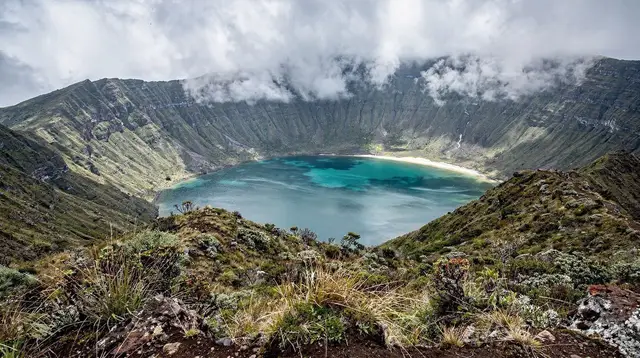
On the Road to Lagoa do Fogo
Leave Ribeira Grande heading south and the road starts to climb almost immediately, the pastures narrowing into laurel forest as the tarmac switches back up the flank of the Água de Pau massif. A few kilometres up, before the road gets serious about reaching the crater rim, a gate and a small car park mark Caldeira Velha: a hot waterfall dropping through tree ferns into a chain of warm, mineral-stained pools. It is one of the easiest thermal stops on the island to reach, and one of the easiest to get wrong by treating it as an afterthought on the way to somewhere bigger.
That somewhere bigger is Lagoa do Fogo, the crater lake further up the same road, and it deserves its own page rather than a paragraph here — this one is about what sits lower down, in the trees, where the water is warm rather than the view wide. If your plan for the day is “Lagoa do Fogo and maybe a stop at Caldeira Velha,” it is worth reading both pages before you leave, because the two sites have different weather rules and different reasons to close.
What Caldeira Velha Actually Is
The name means “old caldeira,” and it refers to a patch of ground on the lower slope of Água de Pau where volcanically heated water reaches the surface and falls as a small waterfall into a series of pools cut into the rock. The water carries dissolved iron and other minerals, which is why the stone and the pool floors are stained rust-orange rather than the grey of an ordinary Azorean stream. A wooden boardwalk threads through the surrounding forest of tree ferns, incense trees and introduced ginger lilies, giving the whole site a humid, faintly tropical feel that is unusual for the island’s cooler upland zones.
This is a managed site, not a wild spring you stumble on. There is a ticket gate, a car park, changing rooms and a defined circuit of boardwalk and pools, all built to let a steady flow of visitors soak without eroding the ground around a genuinely active thermal feature. That management matters: São Miguel sits on live volcanic plumbing, and the water reaching Caldeira Velha’s pools has travelled up through hot rock on its way to the surface.
For a fuller sense of how caldeiras, fumaroles and lava tubes fit together across the island, the volcanic history overview and the explainer on caldeiras versus lava tubes both cover the underlying geology without repeating it here.
The Boardwalk and the Pools
From the ticket gate, the boardwalk drops gently through the forest for a few minutes before the sound of falling water becomes obvious. The waterfall itself is modest by Azorean standards, a few metres of drop over black rock, but its heat is the point: unlike the island’s many cold streams, this one arrives warm, and the pools it feeds hold that warmth. There are several distinct pools along the circuit, each a slightly different temperature depending on distance from the cascade and how the water mixes with cooler runoff, so it is worth walking the full loop before choosing a spot to settle.
Changing rooms sit near the entrance, and most visitors arrive already in swimwear under their clothes to save time. The pool floors are natural volcanic rock rather than tiled surfaces, uneven and slippery in places, especially near the waterfall where spray keeps the stone wet. Footwear with grip, or at least care with bare feet, makes the short walk between pools much easier. The iron content that gives the water its colour will also mark light fabric, the same trade-off visitors accept at Terra Nostra Park and Poça da Dona Beija in Furnas — bring a swimsuit you are willing to sacrifice a little, and expect a faint sulphurous, mineral smell that a normal shower afterwards mostly removes.
Because the site is popular with both independent travellers and organised tours, the pools can feel crowded by mid-morning in high season. Early arrivals at opening time, or a visit in the last couple of hours before closing, generally find quieter water. A guided half-day that pairs the hot-spring walk with the wider Água de Pau landscape is one straightforward way to fit the visit around a fixed schedule rather than guessing at quiet windows: the Janela do Inferno and Caldeira Velha guided hiking tour combines a coastal viewpoint walk with time at the pools, with someone else handling the timing.
Getting There and When the Road Closes
Caldeira Velha sits directly on the road that climbs from Ribeira Grande toward the Lagoa do Fogo car park, which makes it one of the most convenient thermal stops on the island for anyone driving the north side. From Ponta Delgada it is roughly 25 to 30 minutes by car; from Ribeira Grande itself, closer to 10 to 15 minutes. There is no public transport that serves the site directly on a useful schedule, so a rental car, taxi or organised tour is the practical way in, in keeping with how most of the island’s interior sites work.
The stretch of road at Caldeira Velha’s altitude is usually open even when conditions higher up are not, but that is not a guarantee, and it is easy to conflate the two. The continuation of the same road toward Lagoa do Fogo climbs into a zone that is regularly closed by fog, high wind or maintenance, sometimes with no notice beyond a barrier at the roadside.
If your day’s plan includes both stops, treat Caldeira Velha as the reliable half and the crater lake as the conditional half, not the other way around, and check current road status locally before setting out rather than assuming a clear morning in Ribeira Grande means a clear pass higher up. A half-day trip focused on Lagoa do Fogo lays out that access question in more detail.
| From | Distance/time | Notes |
|---|---|---|
| Ponta Delgada | ~25-30 min drive | Via the via rápida to Ribeira Grande, then the mountain road |
| Ribeira Grande | ~10-15 min drive | Direct, same road that continues to Lagoa do Fogo |
| Lagoa do Fogo car park | ~15-20 min further up | Subject to closure by fog or wind, check before continuing |
Tickets, Times and What to Bring
Entry is paid at the gate, a modest per-person fee that covers maintenance of the boardwalk, changing rooms and the managed pool circuit. It is not a free roadside pull-off the way some Azorean viewpoints are, and it is not bookable in advance the way a restaurant table in Furnas needs to be — you simply arrive, pay, and go in, though arriving early avoids both queues and crowded pools. Bring a swimsuit you do not mind staining, a towel, a dry bag or plastic bag for wet things afterwards, and footwear with some grip for the wet rock. A change of clothes for the rest of the day is worth keeping in the car, since the mineral smell and slightly stained skin can linger for a while.
Like most of the island’s outdoor sites, weather here changes quickly and unevenly — it can be raining at this altitude while Ponta Delgada stays dry, or the reverse. Waterproofs for the short forest walk are sensible even on a day that starts clear.
| Item | Why |
|---|---|
| Swimsuit (old or dark-coloured) | Iron-rich water stains light fabric permanently |
| Towel and dry bag | Changing rooms exist but a towel speeds things up |
| Grippy sandals or water shoes | Pool floors are natural rock, slick near the falls |
| Light rain layer | Weather at this altitude shifts fast, independent of the coast |
| Cash or card for the gate | Entry is ticketed on-site |
Combining Caldeira Velha with the Rest of the North Coast
Because it sits so close to Ribeira Grande, Caldeira Velha slots naturally into a north-coast day rather than standing alone. A common pattern is to start in Ribeira Grande itself, walk its old centre, then drive up for an hour or two at the pools before heading either back down to the coast or onward toward the Água de Pau road. The Ribeira Grande and Caldeira Velha day trip guide walks through that pairing in full, and the standalone Caldeira Velha short walk guide and thermal waterfall guide go deeper on the site itself than there is room for here.
Travellers weighing this stop against the island’s other thermal options — Terra Nostra’s orange lake-sized pool in Furnas, the tidal spring at Ponta da Ferraria, or Poça da Dona Beija — will find a side-by-side rundown in the thermal pools of São Miguel compared guide.
Each of those sites is genuinely different in setting and logistics, and none of them substitutes for the other; a full day trying to hit all four is possible but rushed. For a broader itinerary, the rental car guide and the general north coast planning page cover how to sequence this stop with tea plantations, Gorreana included, and the rest of Ribeira Grande’s surroundings.
Travellers who prefer a set structure over self-driving can also cover Caldeira Velha as part of a longer guided day that includes the crater lake above it: the Fogo Lake hike with Caldeira Velha hot springs tour pairs a walk near the lake’s edge with time at the pools on the way back down, useful precisely because it removes the guesswork around whether the upper road will be open on a given day. A shorter option focused purely on the crater lake itself, for those who want to judge conditions on the day, is the Half Day Lagoa do Fogo tour.
Safety: Why the Marked Paths Matter
São Miguel is a farmed, inhabited island rather than a wilderness, but Caldeira Velha sits on genuinely active volcanic ground, and that fact deserves to be taken seriously rather than treated as scenery. Elsewhere on this same type of caldeira terrain, water reaches temperatures well past comfortable soaking and can boil at the surface — the fumarole fields around Furnas are the clearest example, and they are covered on their own pages rather than here, but the underlying process is the same one heating Caldeira Velha’s pools.
The managed boardwalk and the marked pool edges exist because ground temperature at these sites is not uniform, and stepping off a marked path onto unmanaged thermal ground is a real hazard, not an abstract warning line in a brochure.
In practice this means: stay on the boardwalk between the gate and the pools, use only the pools that are open to bathers rather than any hot ground you notice nearby, and treat staff instructions about closures — whether for water temperature, weather or maintenance — as final rather than negotiable. The same discipline applies up the road at Lagoa do Fogo, where paths near the crater rim and any exposed hot ground should never be left for a shortcut. None of this makes Caldeira Velha a dangerous visit for an ordinary traveller who keeps to the paths; it makes it a site where the paths are doing real work, not just guiding foot traffic.
For visitors building out a longer, more active day around this part of the island, an organised jeep circuit is one way to combine several stops, including the Água de Pau uplands, without worrying about road closures derailing self-driven plans: the São Miguel: Island on Jeep tour covers a wider loop with local drivers who track road conditions daily.
Visiting Caldeira Velha: Common Questions
Is Caldeira Velha the same as Lagoa do Fogo?
No. Caldeira Velha is a thermal waterfall and pool site partway up the access road, at a modest altitude and in forest. Lagoa do Fogo is the crater lake much further up, a separate nature reserve with no facilities of its own. They share one road but are two different stops.
How hot is the water at Caldeira Velha?
Warm rather than scalding, with the temperature varying by pool and by how close you sit to the cascade. It is comfortably hot for soaking, not a boiling caldeira, though the island’s volcanic ground does produce genuinely boiling water elsewhere, which is exactly why the marked paths matter here.
Will the orange water stain my swimsuit?
Yes, the iron-rich mineral water can mark light-coloured fabric over time, the same way it does at Terra Nostra and Poça da Dona Beija. Bring a swimsuit you do not mind staining, and expect a mineral smell that lingers until you shower.
Can the road to Caldeira Velha be closed?
The stretch through Caldeira Velha itself is usually passable, but the continuation up to Lagoa do Fogo is regularly closed by fog, wind or maintenance work. Treat any plan that depends on reaching the crater rim the same day as conditional, and check locally before committing the whole afternoon to it.
Is there an entry fee?
Yes, entry is ticketed at the gate, payable on-site, with a modest per-person charge that funds the boardwalk and changing facilities. It is not a free roadside stop the way some island viewpoints are.
Can I combine Caldeira Velha with Ribeira Grande in one visit?
Easily. The site sits a short drive above Ribeira Grande, so most visitors treat the two as one outing, adding the town’s old streets or the nearby tea plantations before or after the pools.
Are the hot pools safe for children?
Older children who can swim generally do fine under close supervision, but the pool floors are natural rock, slippery near the cascade, and the water is genuinely hot in places. Keep young children away from the areas closest to the waterfall itself.
Is Caldeira Velha the same kind of thermal site as Furnas or Ponta da Ferraria?
No, and the three should not be confused when planning a day. Furnas is an inland caldera village with its own springs and cooking pits, Ponta da Ferraria is a tidal hot spring where the sea meets a lava flow, and Caldeira Velha is a waterfall-fed pool complex on the Água de Pau slope. Each has its own page and its own logistics.