A black-sand village on São Miguel’s west coast
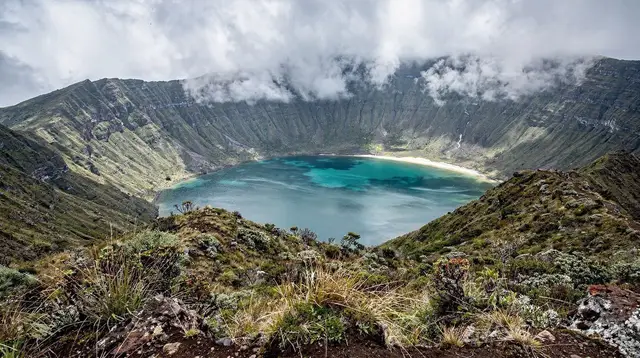
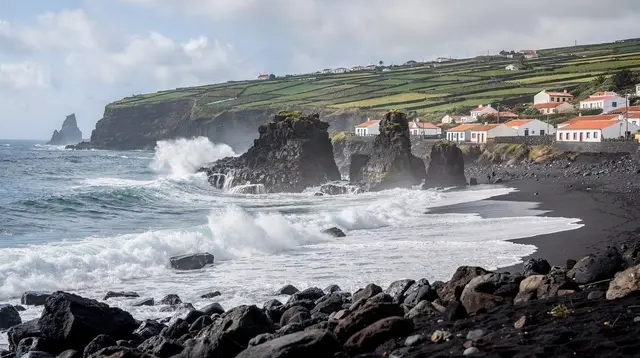
Mosteiros is a small fishing village at the western tip of São Miguel, built along a shoreline of black volcanic sand and a line of rock stacks standing just offshore. It belongs to the same westward stretch of the island as Sete Cidades, sitting on the outer, seaward side of the caldera that holds the island’s best-known twin lakes. Where Sete Cidades is about a crater, two lakes and a rim of viewpoints, Mosteiros is about the coast below it: a working village, a dark beach, and a set of stacks that catch the evening light.
The two places are usually visited together, and this page assumes that context rather than repeating it. For the lakes, the caldera geology, and the classic viewpoints above the village, the fuller picture is on the Sete Cidades page and in the Sete Cidades volcano explained guide. What follows here is Mosteiros itself: the beach, the stacks, the village, and the practical business of getting there and back.
Where Mosteiros sits
Mosteiros sits on the outer curve of the Sete Cidades massif, roughly where the caldera’s rim drops down to meet the Atlantic. The road down from the crater rim passes through or near Ginetes, a small hillside settlement between the lakes and the coast, before reaching the village and its beachfront. There is no separate destination page for Ginetes on this site; it is best understood as a waypoint on the descent from Sete Cidades to Mosteiros rather than a stop in its own right.
Continue further along the coast past Mosteiros and you reach Ponta da Ferraria, where a natural hot spring meets the sea at the foot of a lava flow. Mosteiros and Ponta da Ferraria are often paired into the same afternoon, but they are different places with different things to offer: Mosteiros is a black-sand beach and a photogenic stretch of coast, Ponta da Ferraria is a specific, tide-dependent hot spring with its own paid spa.
Tide times, safety, and the mechanics of the spring belong to that page, not this one; see the Ponta da Ferraria tide times guide and the hot spring swimming guide if that is the stop you are planning.
Practically, most visitors reach Mosteiros by rental car from Ponta Delgada, about 35-40 minutes away depending on whether the route runs over the Sete Cidades rim or drops in more directly along the coast road. Public transport reaches the west coast, but on school and work timetables rather than sightseeing ones, so a car remains the practical default here as on most of the island; see renting a car on São Miguel for the basics.
The beach: black sand, not tropical sand
The single fact worth getting right about Mosteiros is the color of its beach. The sand is black, a product of the island’s volcanic rock ground down by the sea, not the pale or golden sand associated with tropical beach postcards. It photographs strikingly against white surf and grey Atlantic light, and it can also get genuinely hot underfoot in direct summer sun, which is worth knowing before walking out barefoot at midday.
The sea along this stretch is the open North Atlantic, not a sheltered lagoon. Water temperature runs roughly 17-24 degrees Celsius across the year, cooler in winter and at its warmest toward the end of summer, and the coast here is regularly worked by swell rather than sitting flat and calm. On a good, settled day in July or August it can be a genuinely pleasant swim; on a day with wind or a groundswell running in from the Atlantic, it is a place to watch the waves rather than get in among them.
Neither the black sand nor the sometimes-lively sea should be read as a defect — this is what a volcanic Atlantic island beach actually looks and feels like, distinct from the beaches most visitors associate with a tropical holiday. For a closer look at conditions in the water, the snorkeling guide to Mosteiros’ black sand and sea stacks and the island-wide surf season and water temperature guide both go into more detail than fits here.
The sea stacks
Just off the beach, a small cluster of rock stacks rises out of the water — the Ilhéus dos Mosteiros. They are what most photographs of the village are built around: dark, weathered columns of rock standing against the surf, often lit from behind or beside in the last hour before sunset. They are best appreciated from the shore, the headland above the beach, or from a boat passing along this stretch of coast; approaching them by swimming is not something to attempt casually, since the water around them can be deeper and more exposed to swell than it looks from the sand.
Late afternoon and early evening tend to give the most dramatic light on the stacks, particularly with the sun going down over open water to the west, which makes Mosteiros a favorite stop for photographers finishing a day on the west side of the island. If timing a visit specifically around the light and the stacks matters more than fitting a hike or a drive around them, a guided option built for exactly that can be worth the structure: a guided photography session timed to the coastal light around the stacks takes the guesswork out of when and where to stand.
The village
Mosteiros itself is a working fishing village rather than a resort town: a scatter of houses along the shore road, a small harbor, and a handful of simple restaurants and cafés serving fresh fish and everyday Azorean cooking. It is a reasonable stop for a meal on a longer west-coast loop, though options are limited compared with Ponta Delgada or the larger towns, and they thin out further still if continuing on toward Ponta da Ferraria. There is no significant nightlife or shopping here; the appeal is the coast, not the town center.
What to do around Mosteiros
Most visits to Mosteiros are built around one or more of a short list of things: walking the black-sand beach and photographing the stacks, taking in the coastal views from the road above the village, and using Mosteiros as one stop on a longer west-coast circuit that also covers Sete Cidades and Ponta da Ferraria.
For travelers who want the crater lakes, the rim viewpoints, and the descent to Mosteiros folded into a single guided outing, a guided hike linking the Sete Cidades twin lakes and Serra Devassa ridge down to the Mosteiros side of the massif covers the whole arc from caldera to coast on foot.
For a broader loop that also takes in the north-coast fishing town of Rabo de Peixe and the old whaling settlement at Capelas in the same day, a full-day expedition through Rabo de Peixe, Mosteiros and Capelas covers more of the island’s western and northern coast than a self-drive afternoon usually allows.
Travelers who would rather set their own pace but skip the driving and route-planning can build Mosteiros into a custom day with a private jeep tour that can add extra time at the beach and the sea stacks, useful for anyone who wants to linger for photographs without holding up a group itinerary. For a more standard half-day introduction to the whole Sete Cidades and Mosteiros area with a fixed schedule, a half-day Sete Cidades tour is the simplest option to book in advance.
None of this requires a guide — the coast road and the beach are easy to reach and walk independently — but for travelers without a rental car, or who want the caldera-to-coast walk without route-finding on unfamiliar trails, these are the bookable options that cover Mosteiros directly rather than only the lakes above it.
Combining Mosteiros with the rest of the west coast
Because Mosteiros sits between the Sete Cidades caldera and Ponta da Ferraria, it rarely functions as a stand-alone destination. A typical west-coast day starts at the Sete Cidades viewpoints in the morning — see the half-day Sete Cidades guide for a workable schedule — drops through Ginetes to Mosteiros around midday for the beach and the stacks, and finishes at Ponta da Ferraria in the late afternoon if the tide and sea state allow a stop at the hot spring.
The full version of that day, with timings and what to skip if running short, is laid out in the Mosteiros and Ponta da Ferraria day trip guide and the broader Sete Cidades day trip itinerary.
Hydrangeas line much of this route from June into September, at their thickest along the roads around the caldera rim above Mosteiros; the hydrangeas and Sete Cidades viewpoints photo guide covers where and when they are at their best if that is part of the appeal of the drive.
When to go
Summer, roughly June to September, gives the warmest and most reliably swimmable water at Mosteiros, alongside the greenest landscape and the hydrangeas along the approach road. Outside those months the beach and stacks are still worth the stop for the scenery and photography, but the sea is colder and less predictable, and swimming becomes more of an if-the-conditions-allow proposition than a plan to build a day around.
As with the rest of the island, weather on this stretch of coast can shift quickly and does not always match conditions a short drive away — a calm morning at Mosteiros is not a guarantee of the same at Ponta da Ferraria or up on the Sete Cidades rim, so it is worth checking the sea and sky again at each stop rather than assuming the day holds steady.
Getting there and around
Driving is the practical way to reach Mosteiros, whether self-driven or as part of a guided tour. From Ponta Delgada, the road runs west through or near the Sete Cidades area before descending to the coast; from the caldera rim itself, the drop down through Ginetes to Mosteiros is short but winding, with narrow sections typical of the island’s secondary roads. For general notes on driving conditions, fog on the passes, and what a west-coast route actually feels like behind the wheel, see driving on São Miguel: what to expect.
There is limited parking along the beach road and near the harbor in the village itself, generally sufficient outside the busiest summer weeks. As with the rest of the west coast, this is not a route to rely on for fuel — filling up in Ponta Delgada or one of the larger towns before setting out is the safer habit, since stations thin out on this side of the island.
Questions about visiting Mosteiros
Is the sand really black in Mosteiros?
Yes. The beach is volcanic black sand, not the pale or tropical sand seen elsewhere, and it can heat up quickly in direct summer sun. It is a working feature of São Miguel’s geology, not a stretch to be corrected on arrival.
Is it safe to swim at Mosteiros beach?
It depends on the day. The open Atlantic here runs roughly 17-24 degrees Celsius by season and can carry real swell, so check conditions before going in and treat any red-flag or rough-sea day as a no-swim day. Calmer, shallower spots exist along the coast on quieter days.
How do I get from Ponta Delgada to Mosteiros?
It is about 35-40 minutes by rental car, heading west through the Sete Cidades area and down to the coast, or via Ginetes on the shorter run in from the caldera rim. Public buses reach the west coast on limited timetables, so a car is the practical option for a half-day loop.
Can I combine Mosteiros with Sete Cidades in one day?
Yes, this is the most common way to see it. Mosteiros sits just below and beyond the Sete Cidades caldera, so many visitors do the crater viewpoints and lakes in the morning and drop down to the coast at Mosteiros afterward.
What are the sea stacks near Mosteiros called and can I get close to them?
They are known locally as the Ilhéus dos Mosteiros, a small cluster of rock stacks just offshore from the beach. They are best seen and photographed from the shore and headland, not approached by swimming out on days with any real swell.
Is Mosteiros close to Ponta da Ferraria?
Yes, Ponta da Ferraria is a short further drive along the coast from Mosteiros, on the same westward stretch. It has its own sea-level hot spring and a separate paid spa, both covered in detail on its own page rather than here.
Is there anywhere to eat in Mosteiros?
There are a handful of small, simple local restaurants and cafés in the village, mostly serving fresh fish and Azorean home cooking rather than a wide tourist menu. Options thin out further along the west coast, so this is a reasonable place to stop for a meal on a west-coast loop.
When is the best time to visit Mosteiros?
June to September gives the warmest water and calmest average conditions for the beach, while the sea stacks and coastal views are worth seeing in any month. Outside summer, treat it as a scenic and photography stop rather than a swimming one.