A Volcano You Swim Inside, Not a Beach You Walk To
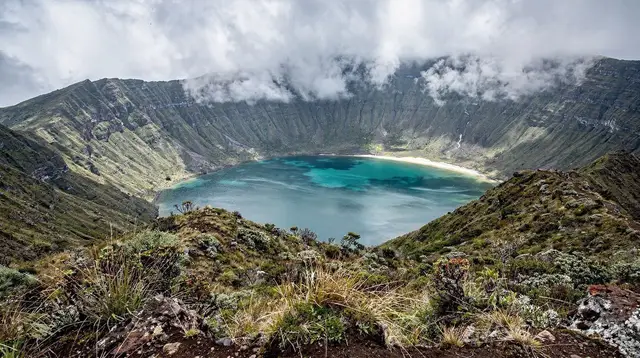
Off the south coast of São Miguel, a short boat ride from the harbour at Vila Franca do Campo, a ring of dark rock breaks the surface of the Atlantic. From above it reads as a near-perfect circle: the rim of a volcanic crater that collapsed and flooded long ago, leaving a sheltered pool of seawater enclosed by cliffs on every side but one. That gap is where the boats go in, and where, on the right day, you can slip into water that feels several notches calmer than the ocean just outside it.
This page covers the islet itself: what it is, how the visit actually works, and the limits that shape every trip out there. It does not retell the story of Vila Franca do Campo as the island’s former capital, or walk through the town’s streets and history — that belongs on the Vila Franca do Campo destination page and its day trip guide. What matters here is narrower and more practical: this is a nature reserve with a daily cap on visitors, the only way in is a boat from Vila Franca’s marina, and that boat only runs in season, weather allowing. Everything else about planning a visit follows from those three facts.
What the Ilhéu Actually Is
The islet is what is left of a volcanic cone that partly collapsed, letting the sea in and leaving a horseshoe-shaped rim of cliffs around a sheltered lagoon. It sits a few hundred metres off the coast, close enough to see clearly from the Nossa Senhora da Paz viewpoint above the town, but far enough that reaching it means a proper boat crossing rather than a swim or a scramble across rocks. Inside the ring, the water is markedly calmer than the open Atlantic beyond it, and considerably clearer on a good day — the combination that makes this one of the few spots on São Miguel where open-water swimming feels genuinely inviting rather than something to brace for.
It is small. There is no village, no permanent building of any size, and nothing resembling a resort. What visitors get is the crater itself: rock walls rising around a pool of seawater, birdlife using the cliffs, and, in season, a landing point where boats moor while people swim.
A Nature Reserve, Not an Open Beach
The Ilhéu de Vila Franca is a protected nature reserve, and that status is the reason a visit here works differently from turning up at any other stretch of São Miguel’s coast. Access is capped: only a set number of visitors are allowed on and around the islet at any one time, to protect the seabird colonies that nest on the cliffs and to keep the pressure on a small site manageable. On a busy August afternoon, that cap is often the thing that determines whether your chosen sailing has space at all, not the weather.
This is worth internalising before you plan a south coast day: the Ilhéu de Vila Franca is not a beach you can walk onto whenever you like. It behaves more like a timed, capacity-limited attraction that happens to be reached by water instead of a gate.
The Only Way In: The Marina at Vila Franca do Campo
There is exactly one departure point for the Ilhéu de Vila Franca: the marina at Vila Franca do Campo, on São Miguel’s south coast, roughly 25 minutes’ drive from Ponta Delgada along the EN1-1A. No boats leave from Ponta Delgada’s Portas do Mar, from Caloura a little further along the coast, or from anywhere else on the island. If a visit to the islet is on your plan, Vila Franca do Campo’s harbour is where your day starts and ends, whether you drive yourself, join an organised pickup, or combine it with time in the town.
The crossing itself is short, typically well under fifteen minutes each way in calm conditions, out through the harbour mouth and across open water to the gap in the crater rim. It is brief, but it is still open sea, and that short stretch is exactly what gets cancelled when conditions turn.
When the Boats Actually Run
Sailings to the Ilhéu de Vila Franca run in season, broadly from June to September, and only when the sea state allows it. That window is not a marketing suggestion; it reflects the fact that this stretch of the south Atlantic can turn choppy quickly, and no operator sails a small boat with passengers through swell for a swim stop. Outside the summer season, and on plenty of days within it, the crossing simply does not go, no matter how far in advance you have booked.
| Period | Typical conditions | Crossings |
|---|---|---|
| June - September | Warmest sea, most settled weather, longest run of sailing days | Most likely to run, still weather-dependent day to day |
| Late spring / early autumn (May, October) | Sea cooler and more changeable | Occasional operator sailings, far from guaranteed |
| November - April | Wetter, windier, rougher Atlantic swell | Crossings do not run |
The practical takeaway is simple: treat any booking as provisional on the sea state on the day, keep a backup plan for your south coast time, and never build a trip to São Miguel around this specific stop if your dates fall outside June to September. The boat tours weather and cancellations guide covers how operators handle this across the island generally, and it applies here as directly as anywhere.
Getting In and Swimming Around the Crater
Once a boat is inside the ring of rock, the character of the water changes noticeably. The cliffs cut the worst of the wind and swell, and the sea inside settles into something closer to a large, enclosed pool than open ocean. Most trips anchor or moor near the landing point, and swimming happens directly off the boat or from a fixed point on the rock, usually by ladder rather than a beach entry — there is no sand here, and depth close to the rock can be considerable.
Snorkelling is popular inside the crater on clear days: visibility varies with recent weather and the state of the tide, but the enclosed water and volcanic rock walls make for a different underwater scene than the open-coast spots elsewhere on the island. The dedicated snorkelling inside the crater guide goes into gear and conditions in more depth; this page’s job is simply to flag that swimming and light snorkelling, not beach lounging, are what a visit here is built around.
Facilities on the islet itself stay basic and seasonal: a landing area, lifeguard presence on busier operator sailings, and not much beyond that. There are no shops, no shade structures to speak of, and no fresh water on site, so plan as you would for any exposed coastal outing — sun protection, a hat, and a full water bottle before you board.
Booking a Boat
Access is entirely through boat operators sailing from the Vila Franca do Campo marina, and trip lengths and inclusions vary. A straightforward option is a half-day boat trip from Vila Franca do Campo that builds in swimming time inside the islet, which suits visitors who want the crater experience without extending the day much further.
For a longer outing that folds the islet into a broader south coast morning, some operators run a combined trip pairing whale watching further offshore with swimming stops and a lunch break, which works well if you would rather not choose between the islet and time on the water looking for marine life.
Whichever option you choose, confirm two things before paying: that the sailing includes actual time in the water at the islet (some south coast boat trips pass close by without stopping to swim), and what the operator’s policy is if the crossing is called off for sea conditions. Reasonable operators rebook or refund; ones that will not answer that question directly are worth avoiding.
What to Bring
- Swimwear worn under your clothes, plus a change of dry clothes for afterwards
- A towel — boats rarely provide one
- Reef-safe sunscreen, reapplied after swimming
- A hat and sunglasses for the crossing, which offers little shade
- Water and a light snack; there is nothing to buy on the islet itself
- Waterproof or dry storage for phones and cameras — spray on the crossing is normal
- Sturdy sandals for the landing point, which is rock rather than sand
Building It Into a South Coast Day
Vila Franca do Campo sits at the centre of São Miguel’s south coast, and a morning at the islet pairs naturally with time elsewhere along this stretch. Many visitors combine the crossing with a walk through Vila Franca do Campo itself, a stop in Caloura with its small fishing harbour, or a drive through Lagoa and Água de Pau further along the coast.
The Vila Franca islet and coast walk guide lays out a version of this combined day step by step, and the whales and sea itinerary folds a boat crossing like this one into a wider plan built around the island’s coast and marine life. If you are mapping out several days on São Miguel rather than a single outing, the classic three-day itinerary is a reasonable frame to slot a south coast morning like this one into.
For visitors arriving without their own boat connections from elsewhere in the archipelago, it is worth remembering that São Miguel has no scheduled ferry service from mainland Portugal: every boat trip here, including this one, is a short local sailing rather than part of any longer inter-island route. If Caloura’s own boat trips or the harbour scene there interest you as well, the Caloura harbour and south coast boat trips guide covers that separately.
Travellers who want to stay on land rather than water that day still have options nearby: a quad-buggy route along back roads above the coast near Vila Franca do Campo covers some of the same stretch of coastline from above, with sweeping views back down over the islet itself, and is a reasonable alternative or add-on for anyone in the group who would rather not get in the water. For general activity planning around this stretch of coast, the things to do near the Ilhéu de Vila Franca page rounds up the options in one place.
What to Expect, Realistically
Set expectations before the day rather than on it. This is a short, seasonal, weather-gated outing, not an always-available beach day: sailings run roughly June to September, the number of visitors allowed at the islet on any given day is capped, and a rough sea cancels the crossing outright, with no substitute route in. None of that makes it any less worth doing — swimming inside a flooded volcanic crater is not something most coastlines offer — but it does mean building in flexibility. Keep a spare morning or afternoon free on your south coast days if the islet is a priority, book ahead once your dates are fixed, and treat any sailing outside the summer months as unlikely rather than simply “worth asking about.”
Questions About Visiting the Ilhéu de Vila Franca
Can you swim at the Ilhéu de Vila Franca in winter?
Effectively no. The crossing only runs in season, roughly June to September, because it depends on a calm sea. Outside those months operators do not run the boat, regardless of demand.
Do you need to book in advance?
Book ahead if you can, especially in July and August. The islet caps the number of visitors allowed inside at once, and popular sailing times sell out. Even so, every booking stays conditional on the sea state on the day.
Can you just walk or drive out to the islet?
No. There is no bridge, causeway or path. The only way in is by boat from the marina at Vila Franca do Campo, a few minutes across open water.
Is the water inside the crater rough?
Inside the ring of rock, the water is usually far calmer than the open Atlantic around it, which is the main reason people swim there. Getting to and from the islet still means crossing open sea, which is why sailings are cancelled in swell.
Are there facilities on the islet?
Facilities are minimal and only present in season: a small landing point, basic lifeguard cover on busier days, and little else. There are no shops, restaurants or permanent structures, so bring water and sun protection with you.
How long does a visit actually last?
Most boat trips budget half a day in total once you count driving to Vila Franca do Campo, the crossing, time inside the crater, and the return. Swimming time inside the islet itself is usually closer to 45 minutes to an hour on a standard sailing.
Is the islet suitable for young children or non-swimmers?
It suits confident swimmers best. The water is deep close to the rock in places, there is no beach to wade in from, and getting in and out is usually by ladder from the boat. Ask the operator directly if you are travelling with young children or hesitant swimmers.
What happens if the boat is cancelled for weather?
Operators cancel or reschedule rather than sail into unsafe conditions, and most rebook you for another sailing or refund the trip. Building a spare day into your south coast plans, rather than a single fixed date, is the safer way to plan around it.