São Miguel in Winter: What to Expect in the Low Season
What is São Miguel like in winter, from November to March?
Daytime temperatures sit around 14-17°C and the sea holds at roughly 17-18°C, with rain possible on any given day. Thermal pools, caldeiras, tea plantations and museums all stay open year-round, but boat trips and whale watching are cancelled far more often than in summer.
A Different Island, Not a Closed One
Between November and March, São Miguel trades its busiest crowds and driest skies for something quieter and greener. It does not shut down. There is no snow to plan around, no seasonal lift closure, no Christmas market built into the island’s calendar — none of that exists here, and any page or listing that suggests otherwise is describing somewhere else. What actually changes is simpler: the air turns cooler and wetter, the Atlantic gets a little rougher, and boats stay in harbour more often than they go out. Everything built into rock — the thermal pools, the caldeiras, the tea plantations, the museums — keeps running exactly as it does in July.
This guide is about that specific stretch of the year, roughly November through March, and what a visit inside it actually feels like on the ground. It does not try to rank São Miguel’s best season overall — that comparison lives on a dedicated guide to the island’s month-by-month rhythm — and it does not cover winter driving conditions on the EN1-1A and the mountain passes, which is its own subject entirely.
What the Days Actually Feel Like
Daytime temperatures in the low season typically sit around 14-17°C, which is mild rather than cold — closer to a fresh spring day in northern Europe than a genuine winter. Nights are cooler but rarely harsh. The sea holds at roughly 17-18°C, cool enough that only committed swimmers go in without a wetsuit, but not so cold that it feels shocking underfoot at the black-sand beaches around Mosteiros.
Rain is the defining feature, and honesty matters more here than optimism: it is possible on any given day of the low season, sometimes as a single grey afternoon, sometimes as a string of short, hard showers separated by sun. What rain in the Azores is not, usually, is an all-day soaking that ruins a trip outright. Because the island is small and volcanic, with a steep central ridge running from Sete Cidades to Nordeste, weather can differ completely from one side to the other within the same hour.
Ponta Delgada can be sitting under a clear sky while Furnas, fifty minutes east and tucked inside its own caldera, is wrapped in cloud and drizzle. No forecast captures that reliably, and no page on this site will pretend otherwise — the honest approach is to build flexibility into a winter plan rather than to chase a single weather promise.
Daylight is shorter than in summer, which matters for pacing a day rather than for what you can actually do. Plan the outdoor half of a day — a walk, a viewpoint, a thermal pool — for the morning or early afternoon, and leave the museums, markets and restaurants for whenever the light or the rain make that the easier choice.
What Stays Open Through the Low Season
The single most useful thing to understand about winter here is that almost nothing volcanic or agricultural closes for the season. Heat from the ground, water in a caldera, and tea bushes on a hillside do not know what month it is.
| Category | Winter status | Notes |
|---|---|---|
| Thermal pools (Terra Nostra, Poça da Dona Beija, Caldeira Velha) | Open year-round | Warmer water against cool air is arguably at its best now |
| Caldeiras and fumaroles (Furnas) | Open year-round | Steam is more visible in cold, damp air |
| Tea plantations (Gorreana, Porto Formoso) | Open year-round | Fields are quieter, factory tours unaffected |
| Museums and indoor sights | Open, normal hours | Least weather-dependent option on a wet day |
| Cozido das Furnas | Served year-round | Cooked underground on volcanic heat, unaffected by rain |
| Whale watching and boat trips | Reduced departures | Cancelled far more often for sea conditions than in summer |
| Ilhéu de Vila Franca boat crossing | Season-dependent | Runs in season only, weather permitting, even then |
| Hiking trails (PR network) | Open, conditions vary | Some coastal paths close after landslides — check before setting out |
A morning at the iron-rich thermal pool in Terra Nostra Park is, if anything, a better experience in a cool, damp December than in a crowded August — the water sits around 35-40°C against air that makes the warmth register properly, and the gardens around it are near-empty. The pool still stains swimwear permanently regardless of season, so bring something you don’t mind sacrificing.
Furnas itself, the village built inside an active caldera, keeps steaming and bubbling exactly as it does in summer. The cozido das Furnas tradition — pots of meat and vegetables lowered into holes in the hot ground by the Lagoa das Furnas and cooked for five to seven hours on volcanic heat, with no fire involved — runs every day of the year, rain or shine, because the heat source is entirely underground.
a half-day trip through Furnas, its caldeiras and thermal pool is a practical way to see the caldera’s highlights without depending on a clear sky, since the geology is the main event and it is entirely indifferent to weather.
The island’s two working tea plantations, Gorreana and the smaller Porto Formoso, don’t pause for winter either — see the comparison of both if choosing between them. Neither has an off-season closure, since the bushes are perennial and the factories process tea through most of the year.
What Slows Down
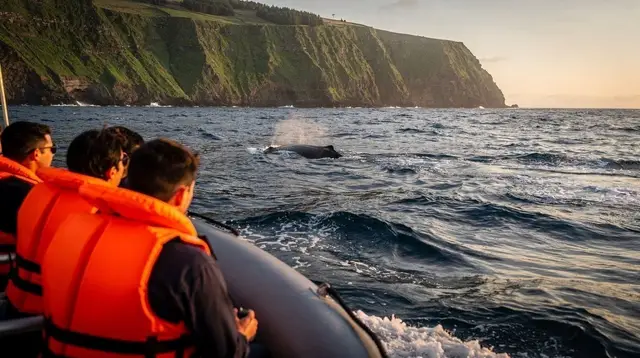
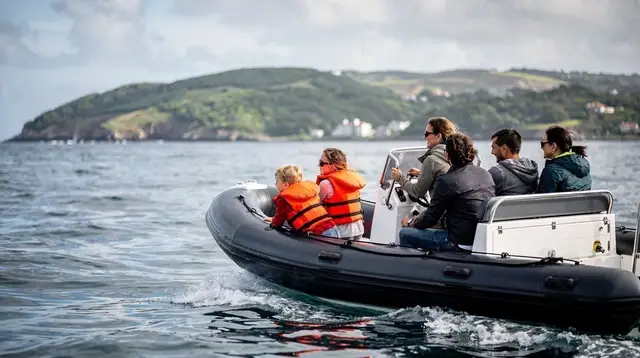
The honest counterweight to all of that openness is the sea. Boat-based activities — whale watching, the seasonal crossing to the Ilhéu de Vila Franca, harbour tours from Caloura and Ponta Delgada’s marina — are cancelled noticeably more often between November and March than during the summer months, because Atlantic swell picks up and operators cancel rather than run in conditions they judge unsafe or simply unpleasant.
Sperm whales and dolphins are resident year-round, so trips still operate whenever the sea allows it, but the cancellation pattern is worth understanding before booking, and the same caution applies to boat tours generally. No operator, in any season, can promise a sighting — the vigias, the shore lookouts descended from the whaling era, improve the odds; they don’t guarantee the animals show up.
Some coastal and mountain roads and trails become less reliable too. The route up to Lagoa do Fogo is sometimes closed in poor weather, and a handful of PR-marked coastal paths shut after landslides — always worth checking the regional trails site rather than assuming a route is open.
None of this makes winter a write-off. It makes it a season where land-based, geology-driven activities are the reliable core of a trip, and boat trips are a bonus to build around rather than depend on.
A Realistic Shape for a Winter Trip
Rather than a fixed itinerary, it helps to think in terms of a rotation: pair an outdoor half-day with an indoor or thermal half-day, and keep the boat-based plans loosely held.
A jeep-based day works well precisely because it is vehicle-first — you’re inside a covered vehicle between stops rather than exposed on foot for hours, and the driver-guide knows which side of the island is drier on a given morning. a full day touring the island’s viewpoints and villages by jeep covers a wide sweep of São Miguel in exactly this format, useful precisely because it doesn’t hinge on one forecast holding for eight hours.
The west of the island, around Sete Cidades and Ponta da Ferraria, rewards a similar approach — the caldera lakes and the sea-level hot spring are both worth seeing even under grey skies, since low winter light can make the twin lakes at Vista do Rei look genuinely dramatic rather than washed out. a guided day covering the western caldera, viewpoints and coastline is a low-effort way to see that side of the island without gambling an entire self-drive day on one weather window. The hot spring at Ponta da Ferraria lies in the sea at the foot of a lava flow, safe for bathing only around low tide, so check tide times beforehand.
For a wet morning specifically, Ponta Delgada’s old town is a reasonable fallback — the Portas da Cidade arches, the Forte de São Brás and the covered stalls of the Mercado da Graça are all either indoors or brief enough between showers to work around. Save the exposed coastal walks and viewpoint-hopping for whichever afternoon turns out clear, and treat the itinerary as something to reorder daily rather than lock in weeks ahead.
Packing and Practicalities for the Wet Season
A proper waterproof jacket earns its space far more than an umbrella, which the island’s wind makes close to useless outside a sheltered street. Layers matter more than heavy insulation — 14-17°C with humidity and a breeze can feel cooler than the number suggests, but a warm coat built for a continental winter is overkill. Closed shoes with real grip are worth having for wet volcanic stone, cobbled old-town streets and any of the caldeira boardwalks around Furnas. A swimsuit for the thermal pools is essential regardless of season — pack one you’re willing to let the iron-rich water stain, since that mineral colour does not wash out.
Practically, low season brings real upside: car rental and accommodation both ease off outside the June-to-September peak, restaurants around Furnas and Ponta Delgada rarely need the advance booking that a July evening does, and the island’s best-known viewpoints and pools are markedly quieter. Fuel stations remain sparse outside the main towns year-round, so the usual advice to fill up before a Nordeste circuit still holds regardless of the month.
Who Winter Actually Suits
Low season on São Miguel suits travellers who want the island itself — its caldeiras, thermal water, tea fields and small towns — more than a beach-and-sunshine holiday. It suits photographers drawn to moody light and empty viewpoints, couples and solo travellers happy to build a day around whichever side of the island is dry that morning, and anyone put off by the summer’s tighter restaurant bookings and busier car parks at Sete Cidades and Ponta Delgada’s marina.
It suits less well anyone whose trip depends on a guaranteed boat crossing to the Ilhéu de Vila Franca, on calm water for coasteering or kayaking, or on the kind of reliably dry, warm days that make Sete Cidades’ lakes glow the deepest blue and green under full sun. Those experiences are not gone in winter — they’re simply less certain, and worth planning around rather than depending on outright.
a 4WD tour through Furnas’ back roads and viewpoints is a good example of an activity built for exactly this uncertainty: covered transport, a geology-and-village focus that doesn’t rely on the sea, and a route that can shift with the weather on the day.
FAQ: São Miguel’s Low Season, Explained
Is São Miguel worth visiting in winter?
Yes, for travellers who want a quieter island, lower prices and green scenery rather than a beach holiday. Thermal pools, caldeiras, tea plantations and towns stay fully open, and the mild, wet climate is closer to a Portuguese autumn than a cold-weather trip.
Does it snow on São Miguel?
No. São Miguel sits in the mid-Atlantic at low elevation and winter lows rarely trouble double figures below zero, let alone reach freezing at sea level. There is no snow, no Christmas market built around it, and no ski season to plan around.
How much rain should I expect between November and March?
Rain is possible on any given day, and some days bring several short showers rather than one long downpour. It rarely rains everywhere at once — Ponta Delgada can be dry while Furnas, on the other side of the island, is under cloud.
Are the thermal pools open in winter?
Yes. Terra Nostra Park, Poça da Dona Beija, Caldeira Velha and the other thermal sites operate year-round, and a warm mineral pool in cool, damp air is arguably at its best in the low season.
Can you still see whales on São Miguel in winter?
Sperm whales and dolphins are resident year-round, so trips still go out, but sea conditions cancel a noticeably higher share of departures between November and March than in summer. Sightings are never guaranteed at any time of year.
Is it worth visiting Furnas and the tea plantations in the low season?
Yes — the cozido tradition, the caldeiras, Terra Nostra’s thermal pool, and both Gorreana and Porto Formoso tea plantations run through the winter months, largely indifferent to the weather above ground.
What should I pack for São Miguel in winter?
Layers, a proper waterproof jacket, closed shoes with grip for wet stone, and a swimsuit you don’t mind staining for the iron-rich thermal pools. An umbrella is close to useless in the island’s wind and is better left at home.
Are prices and crowds lower on São Miguel in winter?
Yes. Accommodation and car rental both ease off outside the June-to-September peak, restaurants rarely need advance booking, and the busiest viewpoints and pools are noticeably quieter.
Seasonal Guide on GetYourGuide
Verified deep-linked GetYourGuide tours. Book through these links and we earn a small commission at no cost to you.
GetYourGuide does not provide a product photo for this activity — the image shows the meeting point, photographed by us.