Ribeira Grande: Your Base for North Coast Watersports
Is Ribeira Grande a good base for watersports on São Miguel?
Yes. Ribeira Grande is the island's second town, linked to Ponta Delgada by the via rápida dual carriageway, and it sits a short drive from the surf beach of Praia de Santa Bárbara. It has everyday services, parking and a working harbour, which makes it a sensible north-coast base even though it is not itself a beach resort.
Why Ribeira Grande Works as a North Coast Base
São Miguel’s watersports scene sits almost entirely on its north coast, and Ribeira Grande is the town that anchors it. It is the island’s second town after Ponta Delgada, with real infrastructure — shops, fuel stations, a health centre, a harbour, banks and restaurants that stay open outside the tourist calendar. That matters more than it sounds: on an island where fuel stations thin out fast once you leave the main towns, and where small-village shops close early and on Sundays, having a proper town as your base for the north coast removes a lot of friction.
The town’s other advantage is straightforward geography. Ribeira Grande sits directly on the via rápida, the dual-carriageway that links Ponta Delgada with Ribeira Grande and Lagoa — one of the few stretches of fast, direct road anywhere on São Miguel, where most routes are narrow and wind through farmland. A drive from central Ponta Delgada to Ribeira Grande takes roughly fifteen to twenty minutes on this road, which makes the town a genuinely practical base whether you are staying in the capital and day-tripping north, or basing yourself in Ribeira Grande itself and using it as a hub for the coast.
From Ribeira Grande, the island’s main surf beach, Praia de Santa Bárbara, is a short drive along the coast road. This guide is deliberately about Ribeira Grande’s role as a base, not about the surf break itself — for wave conditions, best swell directions and how the beach works day to day, the dedicated Praia de Santa Bárbara surf guide covers that ground properly.
The Via Rápida and What It Changes
It is worth understanding exactly what the via rápida is, because it shapes how people plan a north coast day. It is a proper dual carriageway, not the narrow EN1-1A that rings most of the rest of the island. It connects Ponta Delgada with Ribeira Grande and continues toward Lagoa, and it is the fastest road São Miguel has. Everywhere else, expect single-lane roads, tight village centres, and drives that take longer than the map distance suggests.
Practically, this means Ribeira Grande behaves almost like a northern extension of the capital rather than a remote outpost. Someone staying in Ponta Delgada for a week can reasonably treat the north coast, and Ribeira Grande specifically, as a half-day or full-day excursion without the drive itself eating the day. Someone basing themselves in Ribeira Grande, in turn, is not cut off from the capital’s services, restaurants or airport — João Paulo II airport is close to central Ponta Delgada, and the via rápida makes that connection quick in both directions.
For general driving conditions on the rest of the island — narrower roads, fog on the high passes, cattle crossings — see driving on São Miguel: what to expect and, if you have not yet arranged a vehicle, renting a car on São Miguel. A car remains the practical default here; buses run on school and work timetables, not sightseeing ones, and reaching the coast on your own schedule is difficult without one.
What “North Coast Watersports” Actually Means Here
It helps to be precise about what the north coast offers, because it is not one uniform stretch of beach. The defining feature of this coast is that it faces the open Atlantic directly, which is exactly what gives it consistent swell and makes it the island’s surf coast — in contrast to the more sheltered south coast around Vila Franca do Campo and Caloura, which favours calmer boat trips and swimming rather than waves.
| Activity | Where on this stretch | Typical draw |
|---|---|---|
| Surfing | Praia de Santa Bárbara | The island’s established surf beach, consistent swell |
| Coasteering | Volcanic shoreline around the north coast | Cliff-edge scrambling and jumps on lava rock |
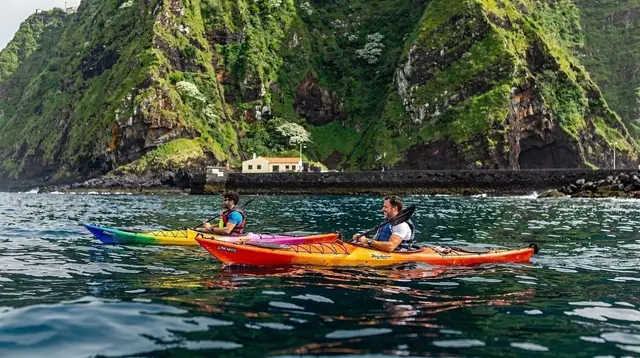
| Sea kayaking | Sheltered pockets near town | Calmer paddling away from the open swell |
| Diving | North coast dive sites, weather permitting | Volcanic reef structure, more exposed than the south |
| Sunset boat trips | Departing from harbours island-wide | A calmer way to see the coastline from the water |
Surfing is the activity Ribeira Grande is most associated with, because of its proximity to Santa Bárbara, but it is not the only water activity based around this part of the island. Coasteering — moving along the volcanic coastline by a mix of scrambling, swimming and cliff jumps — suits this kind of rugged shore, and safety here depends heavily on sea state and local guidance; the coasteering safety guide explains what that means in practice.
Diving is possible along the north coast too, though conditions are generally more exposed than the calmer sites further south — see São Miguel diving and water temperature: what to expect for a realistic picture of visibility and swell.
None of these activities should be treated as available on demand regardless of weather. São Miguel’s Atlantic conditions change fast, and the whole island runs on a working assumption that boat trips, surf sessions and coasteering outings get rescheduled or cancelled more often here than package-holiday marketing tends to admit.
A Word on Booking, and a Word of Caution
No surf school, rental shop or dive operator is named in this guide, deliberately. Ribeira Grande and the stretch around Santa Bárbara host several operators over the course of a season, and which ones are trading, well-regarded or even open changes from year to year — this page sticks to what is stable: the town’s role, the road that reaches it, and the kind of activities on offer. When you are ready to book, look at current listings and reviews locally rather than relying on any single name printed in a guide.
What is worth booking rather than improvising, especially in July and August, is a proper surf lesson if you are new to the sport. Learning in genuinely close-together Atlantic swell is a different experience from a resort beach elsewhere, and a guided introduction session gets you into the water safely with someone reading the conditions for you.
a group surf lesson on São Miguel is a straightforward way to get into the water with instruction rather than guessing at conditions alone, and for a more personal pace, a private surf lesson on the island works well for families or anyone who wants one-on-one coaching rather than a group class.
Season and Water Temperature
The north coast is surfable year-round, but conditions and comfort shift with the seasons. Water temperature runs roughly from the high teens Celsius in winter to the low-to-mid twenties by late summer, and a wetsuit is standard practice here at any time of year — thinner in summer, thicker in the cooler months. Full detail on swell patterns and the best months to plan around sits in the dedicated São Miguel surf season and water temperature guide; this page keeps to the broader picture relevant to choosing a base.
Broadly, the island’s driest and warmest stretch runs from June to September, which is also when the sea is at its most comfortable for anyone new to cold-water surfing. April through June and September into October offer a workable middle ground — greener landscapes, thinner crowds, and conditions that remain entirely surfable.
November through March brings more wind and rain and a noticeably cooler sea, which does not stop surfing on the north coast but does call for a proper wetsuit and a realistic view of how often a session gets cancelled by weather. As with the rest of the island, conditions can differ from one side of São Miguel to the other on the same day, so a forecast checked the morning of a planned session is worth more than one checked days in advance.
Beyond the Water: What Else Ribeira Grande Offers
Because it is a proper working town rather than a beach resort, Ribeira Grande also works as a base for people combining watersports with the island’s other north-coast attractions. Caldeira Velha, the thermal waterfall and pools on the slope of the Água de Pau massif, sits close by and pairs naturally with a coastal day — see the Ribeira Grande and Caldeira Velha day trip guide or, for the pools themselves, the Caldeira Velha thermal waterfall guide.
A morning surf session followed by an afternoon warming up in a thermal pool is a genuinely common way to spend a north coast day on São Miguel, and the geography makes it easy: neither stop is far from the other, and both are close to Ribeira Grande itself.
For a broader read on the town beyond its role as a base — its history, its centre, its harbour — the Ribeira Grande second town guide covers that in more depth. And if the sea state on a given day rules out surfing or coasteering, the town’s proximity to inland attractions and to Ponta Delgada means a change of plan is easy rather than a wasted day; a look at what to do around Ribeira Grande or the wider surfing and watersports category gives a sense of the alternatives.
If you would rather spend a calmer evening on the water than an active one, a traditional boat sunset tour is a lower-key way to see the coastline, and it runs independently of surf conditions since it does not depend on swell.
When Conditions Don’t Cooperate
North coast weather is genuinely changeable, and a day that starts flat can build wind and swell by early afternoon, or the reverse. Because Ribeira Grande sits on a real road network rather than at the end of a single track, a wash-out morning does not strand you. The via rápida gets you back to Ponta Delgada quickly, and inland options — Caldeira Velha’s pools, the tea plantations further along the coast, or a look at driving on São Miguel to plan a longer loop — are all realistic backups.
For those who would rather trade a wet or windy coastal morning for dry land entirely, a buggy tour from Ribeira Grande toward Sete Cidades covers very different terrain and does not depend on sea conditions at all, which makes it a sensible fallback when the Atlantic is not cooperating.
Planning Notes
A few practical points worth carrying into any north coast plan built around Ribeira Grande as a base. Fuel up before heading further along the coast toward Nordeste, since stations thin out east of Ribeira Grande. Parking in the town itself is generally straightforward compared with central Ponta Delgada. And because the whole island runs on Azores time — one hour behind mainland Portugal all year — double-check any tour or lesson departure time against local time rather than assuming it matches a mainland Portugal itinerary.
Ribeira Grande will not be the most photogenic stop on a São Miguel itinerary, and it does not try to be. Its value is functional: a real town, a fast road to the capital, and a short hop to the island’s surf coast, which together make it one of the more sensible bases for anyone building a trip around the water rather than around sightseeing alone.
Ribeira Grande and North Coast Watersports: Frequently Asked Questions
Is Ribeira Grande a good base for watersports on São Miguel?
Yes. It is the island’s second town, connected to Ponta Delgada by the via rápida, and a short drive from Praia de Santa Bárbara. It offers shops, fuel, parking and a harbour, without the crowding of a resort strip.
How far is Ribeira Grande from Ponta Delgada?
Roughly 15 to 20 minutes by car along the via rápida, the dual-carriageway that links Ponta Delgada with Ribeira Grande and Lagoa. It is one of the few stretches of fast, direct road on the island.
Can you surf directly in Ribeira Grande town?
The town itself sits on a small bay rather than an open surf beach. The nearby surf break is Praia de Santa Bárbara, a short drive along the coast, which has its own dedicated guide on this site.
What other watersports happen along the north coast near Ribeira Grande?
Beyond surfing at Santa Bárbara, the north coast supports coasteering on the volcanic shoreline, some sea kayaking in sheltered stretches, and occasional diving, all more weather-dependent here than on the calmer south coast.
Do I need to book a surf lesson or rental in advance?
In peak summer weeks, yes — surf schools and rental points along the north coast get busy in July and August. Outside high season, booking a day or two ahead is usually enough.
What is the water temperature like on the north coast?
The Atlantic around São Miguel runs roughly 17 to 24 degrees Celsius depending on the month, with the warmest water in late summer and early autumn. A wetsuit is standard for surfing here year-round, thinner in summer and thicker in winter.
Is the north coast calmer than the south coast for watersports?
No, generally the opposite. The north coast faces the open Atlantic and carries more swell and wind, which is what makes it the island’s surf coast, while the south coast around Vila Franca do Campo and Caloura is more sheltered for boat trips and swimming.
Is Ribeira Grande walkable, or do I need a car?
A rental car is the practical default on São Miguel, and that holds for Ribeira Grande. Buses connect it to Ponta Delgada on school and work timetables rather than sightseeing ones, so a car gives far more flexibility for reaching the coast and the surf beach at flexible hours.
Surfing on GetYourGuide
Verified deep-linked GetYourGuide tours. Book through these links and we earn a small commission at no cost to you.
GetYourGuide does not provide a product photo for this activity — the image shows the meeting point, photographed by us.