Povoação and Ribeira Quente: A South-East Day Trip
How do you get from Furnas to Ribeira Quente, and can you see both in a day?
Furnas sits inland in its own caldera; Ribeira Quente is its beach, reached by a short drive over the ridge that separates the crater from the coast. Povoação lies just north of that road. Together the loop takes half a day to a full day, easily done as one trip by rental car.
Furnas gets most of the attention on São Miguel’s south-east, and for good reason. But Furnas sits inland, inside its own caldera, and the sea it borrows its reputation from is not actually there. The coast belongs to a different place: Ribeira Quente, a small fishing village on the other side of the ridge, reached by crossing over rather than driving along the shore. Add Povoação to the north, and you have a loop that many visitors drive past without stopping — worth an afternoon, or a full day if you slow down.
Crossing the Ridge: How Furnas, Povoação and the Coast Fit Together
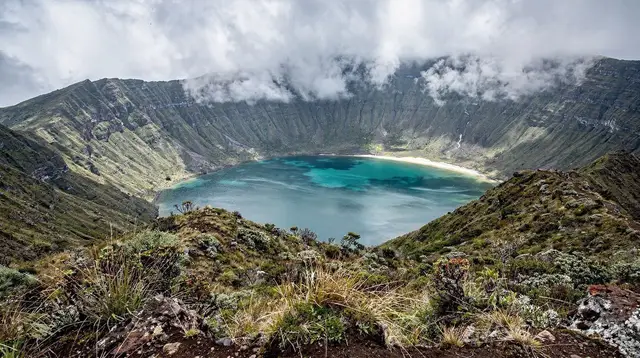
The geography here trips people up more than almost anywhere else on the island. Furnas occupies the floor of an active volcanic caldera, closed in on most sides by steep crater walls. Its lake, its steaming ground and its thermal parks are all landlocked. To reach salt water from Furnas, you drive out of the caldera and over a ridge — the same wall that keeps the crater’s climate so different from the coast just a few kilometres away. On the far side, the road drops down into Ribeira Quente, a working village built along a narrow strip between the hills and the Atlantic.
Povoação sits at a different point on this same stretch of coastline, a little further north and reached more directly from the main road that runs along São Miguel’s eastern side. It is not inside a caldera itself, but it shares the same in-between character: a river valley town that acts as a hinge between the interior and the coast, and a natural stop if you are threading together Furnas, the coast and points further east toward Nordeste.
None of this is complicated once you have driven it, but it catches out first-time visitors who assume Furnas has a beach of its own. It does not. If a photo of black sand and open ocean is what drew you to search for Furnas, the place you actually want is Ribeira Quente.
Planning the Drive
There is no single official route that ties Povoação and Ribeira Quente together — it depends on where you start. Most people build the day around Furnas, since it sits in the middle:
| Starting point | Route | Approximate drive time |
|---|---|---|
| Furnas village | Over the ridge road to Ribeira Quente | 15-20 minutes |
| Furnas village | Down to Povoação, then on to the coast road | 20-25 minutes |
| Ponta Delgada | Via the EN1-1A and the Povoação turn-off | 45-55 minutes |
| Vila Franca do Campo | South coast road toward Povoação and Ribeira Quente | 25-35 minutes |
These are driving times only, without stops, and they assume dry, clear conditions — the ridge road can slow down considerably in mist or heavy rain, which is common enough on this side of the island that it is worth building slack into the plan rather than a tight schedule.
A rental car is the practical way to link all three places in one outing; see renting a car on São Miguel and driving on São Miguel: what to expect if this is your first visit. Public buses do reach this corner of the island, but on school and work schedules rather than tourist ones, so they are not a realistic way to string together a half-day loop.
One practical warning worth repeating: fuel stations thin out fast once you leave the main towns. Fill the tank in Ponta Delgada, Ribeira Grande or Vila Franca do Campo before setting out for Povoação, Furnas and the coast — there is no guarantee of finding a station once you are on the smaller roads toward Ribeira Quente or continuing on toward Nordeste.
Povoação: A Working Town on the Way
Povoação is not a sightseeing destination in the way Furnas or Sete Cidades are, and this guide will not try to make it one. It is a real, working town in a river valley, with a small harbour area and roads branching off toward both the interior and the coast. Its value on a day trip is largely as a hinge point: a natural place to pause, get a coffee, or simply break up the drive between the caldera towns and the coastline.
Some visitors use Povoação as their base for the day precisely because it sits between Furnas and Ribeira Quente rather than deep inside either one. If your plan for the day also includes heading further east toward Nordeste’s coastal road or the waterfall park at Ribeira dos Caldeirões, Povoação keeps you closer to that continuation than staying in Furnas would.
Ribeira Quente: Furnas’ Beach, Across the Ridge
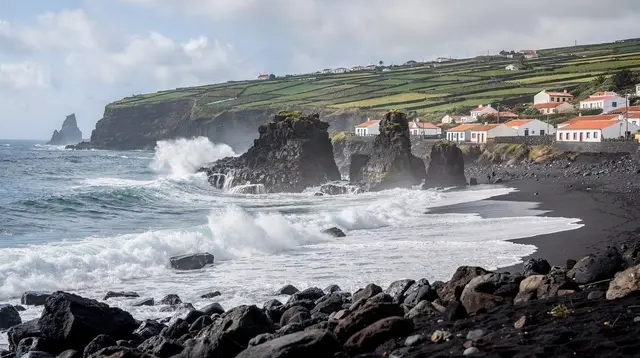
Ribeira Quente is a small, still largely working fishing village, strung out along a narrow shelf of land between steep green hills and the open Atlantic. Its name, roughly “hot stream,” is a reminder that the same volcanic ground responsible for Furnas’ thermal features runs underneath this coast too — there is warmth in the geology here, even if the sea itself is not tropical.
That last point is worth stating plainly, because photographs and casual descriptions of “Furnas’ beach” can set the wrong expectation. This is black volcanic sand and open North Atlantic water, not a turquoise Caribbean cove. Sea temperature runs roughly 17 to 24 degrees Celsius across the year — cool in winter, at its warmest in late summer — and conditions depend on swell and wind on any given day rather than a predictable calm. For more on what the water is actually like here, see not the Caribbean: black sand and Atlantic swell and Furnas is inland, its beach is Ribeira Quente.
That said, on a calm day the setting is genuinely pretty: dark sand backed by cliffs and pasture, small fishing boats pulled up along the shore, and none of the crowds of the island’s better-known viewpoints. It rewards a slow walk more than an ambitious swim.
For a closer look at the water itself, a short boat trip along this stretch of coast is one of the more relaxed ways to see it — the Povoação coast boat tour with water activities and drinks runs from this stretch of the south-east coast and includes time in the water rather than only viewing it from the rail, weather and sea state permitting.
Combining the Coast with the Interior
Because Ribeira Quente and Povoação sit so close to Furnas as the crow flies, and so far from it in character, many visitors pair the coastal half of the day with a look at the caldera above. This guide deliberately does not cover Furnas village, the cozido tradition or the thermal park in detail — that ground is covered fully in the Furnas day trip guide. If a half-day on the coast is only part of your plan, that page is the natural next stop for the caldera side of things.
For active travellers, a half-day tour built around Furnas and the ridge crossing is a straightforward way to see both sides without renting a car for a single day. The São Miguel Furnas half-day tour covers the caldera itself, while a longer full-day option built around the boat and coast, such as the private São Miguel full-day boat tour, extends the day out onto the water rather than back into the crater.
Extending East Toward Nordeste
Ribeira Quente and Povoação also make a natural launch point for continuing further along the south-east coast toward Nordeste and its viewpoints, or inland to the waterfall park at Ribeira dos Caldeirões. If your day has room for it, the stretch of coastal and inland scenery east of here is some of the least visited on the island — see hiking the Nordeste trails for a longer, more active version of the same corner of São Miguel.
Travellers who want to go further into the hills rather than along the coast can also look toward the trailhead at Faial da Terra, a short drive beyond Ribeira Quente, which serves as the starting point for the Salto do Prego waterfall walk — covered separately in the Faial da Terra hiking guide rather than here, since it is a distinct outing in its own right.
For visitors who prefer to get out on the water rather than walk the coast road, sea kayaking along this shoreline is a good match for the scenery — see sea kayaking the Ribeira Quente and Furnas coast and, further along the south coast, sea kayaking between Vila Franca do Campo and Caloura for a comparison of what each stretch offers.
And if the volcanic ground beneath the eastern half of the island interests you as much as the coastline does, the São Miguel east escape covering Nordeste and Serra da Tronqueira ties the ridge scenery above Ribeira Quente into the wider laurel-forest landscape further east.
What to Pack and Expect
A few practical notes for this corner of the island:
| Situation | What to expect |
|---|---|
| Swimming at Ribeira Quente | Black sand, open Atlantic, 17-24°C depending on season; check swell before entering |
| Fuel | Sparse beyond Povoação, Ribeira Grande, Vila Franca do Campo — fill up first |
| Weather on the ridge road | Can differ sharply from Furnas or the coast; fog and rain more common than in Ponta Delgada |
| Phone signal | Generally reliable in the villages, patchier on the ridge road itself |
| Facilities | Limited outside the main village centres; plan meals around Furnas or Povoação |
None of these are dramatic obstacles, but they are the kind of small planning details that make the difference between a relaxed loop and a rushed one. This is a quiet, still largely local part of São Miguel, and it rewards travellers who treat it that way rather than trying to tick it off quickly on the way to somewhere else. For a broader sense of how much time this side of the island deserves within a longer trip, see how many days you need on São Miguel and east coast versus west coast São Miguel.
Povoação and Ribeira Quente: Frequently Asked Questions
Is Ribeira Quente the same place as Furnas?
No. Furnas is inland, inside a volcanic caldera. Ribeira Quente is a separate fishing village on the coast, on the other side of the ridge that closes off the caldera to the south. They are connected by a short mountain road, not by a beachfront.
How far is it from Furnas to Ribeira Quente?
About 15-20 minutes by car over the ridge road, depending on where in Furnas you start and how often you stop at the viewpoints along the way. Povoação, on the more direct route down from the highway, adds only a short detour.
Is the sea warm at Ribeira Quente?
It is Atlantic water, not Caribbean water. Expect roughly 17 to 24 degrees Celsius depending on the season, cooler in winter and warmest in late summer. The beach is black volcanic sand, and swell and currents vary, so check conditions before swimming.
Can I do this without a rental car?
It is difficult. Buses on this stretch of the south-east run on school and work schedules rather than sightseeing timetables, and the ridge road between Furnas and Ribeira Quente has limited service. A rental car or a guided tour is the practical option.
Are there petrol stations along the way?
They are few once you leave Ponta Delgada, Ribeira Grande or Vila Franca do Campo. Fill up before heading into the Povoação, Furnas or Nordeste circuit rather than assuming you will find a station on the smaller roads.
What is there to do in Povoação itself?
Povoação is a quiet working town with a small harbour area, river valley scenery and access roads toward both Furnas and the coast. It is more a staging point and a place to break the drive than a sightseeing stop in its own right.
Can I combine this day trip with Nordeste or Faial da Terra?
Yes, and many visitors do, since all three sit along the same south-east stretch of the island. It makes for a long day, so most people either start early or split it across two half-days rather than rushing all three.
Day Trips on GetYourGuide
Verified deep-linked GetYourGuide tours. Book through these links and we earn a small commission at no cost to you.
GetYourGuide does not provide a product photo for this activity — the image shows the meeting point, photographed by us.