Furnas Is Inland: Ribeira Quente Is Its Beach
The morning I went looking for the sea in Furnas
I had booked a room near Furnas for two nights, and on the first evening, full of Terra Nostra steam and thinking about the cozido I’d eat the next day, I asked the woman at the front desk which way to walk for the beach. She looked at me for a second longer than the question deserved, then said, kindly, that there wasn’t one — not in Furnas itself. I’d need to drive. That’s the moment this whole piece comes from.
It’s an easy mistake, and I don’t think it’s a silly one. São Miguel is an island, the guidebooks are full of black-sand coves, and Furnas gets photographed constantly — steaming ground, a green lake, gardens, thermal pools. Nothing about those pictures screams “landlocked,” even though that’s exactly what it is.
Furnas is a caldera, not a coastal village
Furnas sits inside an active volcanic caldera in the eastern half of the island, ringed by a wall of hills. That’s the whole reason it exists as a destination: the same volcanic plumbing that gives it fumaroles, mineral springs, and a lake where cozido cooks slowly underground for hours also seals it off from the coast. You can stand at the edge of Lagoa das Furnas and watch the crater walls rise on every side. There’s no gap where the ocean gets in.
The thermal park at Terra Nostra reinforces the illusion a little, because a big iron-orange pool full of tourists feels like a resort, and resorts feel coastal by default. It isn’t. That pool is fed by mineral springs rising out of the same caldera floor, and it will stain your swimsuit a rusty tint no amount of washing will fully remove — a good thing to know before you pack your favourite one.
So where does the beach actually go?
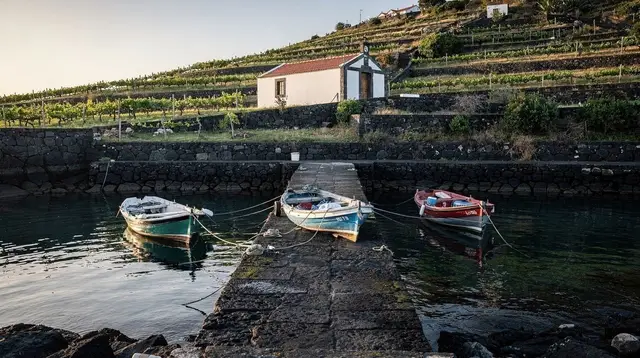
Over the ridge, on the south coast, in a village called Ribeira Quente. The name means “hot stream,” another clue that the volcanic system reaches all the way down to where it meets the sea. It’s Furnas’ beach in every practical sense — it’s the closest coastline, and locals who live in the caldera drive there the way someone from a landlocked town drives to the shore. But it’s a genuinely separate place: its own strip of houses, its own small harbour, its own black-sand beach facing open Atlantic swell rather than a crater lake.
The drive between them is short in distance but not in feel. You climb out of Furnas, cross the rim of the caldera, and drop down the other side toward the water — the kind of road where the view changes completely in ten minutes. It’s one of my favourite short drives on the island precisely because of that contrast: steaming ground and hydrangea hedges give way to open sea within a few kilometres.
| From Furnas to… | Distance (road) | What you’re going for |
|---|---|---|
| Ribeira Quente beach | around 10 km, roughly 15-20 min | black-sand beach, open Atlantic swimming |
| Povoação | around 8 km | small town, river valley, coastal views |
| Faial da Terra | around 20 km | trailhead for the Salto do Prego waterfall |
| Vila Franca do Campo | around 20 km via the coast road | islet boat trips, harbour town |
Why this matters for how you plan the day
If you’ve read that Furnas is a must-see and pencilled in “beach afternoon” right after lunch, you’ll lose time realising the water isn’t a walk away. I’d rather you know that before you arrive than while standing at a hotel desk like I was.
The fix is simple: treat Furnas and Ribeira Quente as two stops on the same loop, not one destination with two names. A typical day I’d actually recommend — and one I’ve now done more than once — starts with the caldera in the morning: the fumaroles, the thermal walking routes, maybe a soak at Terra Nostra or Poça da Dona Beija before the coach groups arrive.
Cozido gets ordered ahead and collected around midday, because the pots go into the ground on volcanic heat with no fire at all, and that’s not a process you can rush. Then, once lunch is done, you drive over the ridge to Ribeira Quente for a swim, a walk along the seafront, or just to watch the Atlantic do something the crater lake never will: move.
If hiking is more your pace than driving, the ridge itself is walkable — the trail down through Faial da Terra to the Salto do Prego waterfall covers similar ground on foot, ending near the coast rather than in Ribeira Quente proper, but it gives you the same geography lesson at walking speed, which honestly explains the landscape better than any map.
For a guided version of that split day, both Furnas: Full Day Tour and a Furnas: Volcano Wonders Tea Plantation Waterfall Tour style itinerary cover the caldera thoroughly without promising a beach that isn’t there, and a shorter half-day version works well if you’re basing yourself in Ponta Delgada and only have the morning to spare.
If you’d rather add tea and lunch to the mix, there’s also a tea plantation and waterfall combination that threads the caldera, a working tea estate, and a waterfall stop into one day.
One village, one caldera, two very different waters
None of this is a complaint about Furnas — quite the opposite. I think the caldera is more interesting precisely because it isn’t trying to be a beach town. It’s a farmed, steaming, slightly surreal pocket of the island doing something a coastline never could: cooking your lunch underground while you swim in orange, iron-rich water half a kilometre away. Ribeira Quente does the ordinary, wonderful thing a beach does, and it does it better for being unhurried and mostly local.
The mistake isn’t wanting both. It’s expecting them to be the same stop. Plan the drive, and you get a genuinely great pairing — inland thermal weirdness in the morning, open Atlantic in the afternoon — rather than a frustrating hour spent looking for sand that was never going to be there.
Furnas and Ribeira Quente, the questions people actually ask
Does Furnas have a beach?
No. Furnas is entirely inland, inside a volcanic caldera. There’s no coastline within the village or its immediate surroundings — the nearest beach is over the ridge in Ribeira Quente.
How far is Ribeira Quente from Furnas?
Around 10 km by road, which is roughly a 15-20 minute drive over the caldera rim. It’s one of the shorter drives on the island but a dramatic one, moving from crater lake and fumaroles to open sea.
Can I walk from Furnas to the sea?
Not directly into Ribeira Quente on a short walk, but the hiking trail down through Faial da Terra to the Salto do Prego waterfall follows similar terrain toward the coast for anyone who’d rather hike than drive.
Is Ribeira Quente worth visiting on its own?
Yes. It’s a small, quiet fishing village with a black-sand beach and a genuinely local feel, without the crowds that gather around Furnas’ thermal sites in season. It also makes a good stop between Furnas and Povoação.
Can I do Furnas and Ribeira Quente in one day?
Comfortably. A common pattern is caldera sightseeing and a thermal soak in the morning, cozido at midday, and the short drive to Ribeira Quente for the afternoon — see our Furnas day trip guide for a full outline.
Why is Furnas inland if São Miguel is an island?
Because it sits inside an active caldera whose crater rim happens to be well above sea level and set back from the coast. The same volcanic activity that produces its hot springs and fumaroles is what created the enclosed basin in the first place.
Is the sand at Ribeira Quente black?
Yes, like most beaches on São Miguel — it’s volcanic sand, darker and coarser than the pale sand found elsewhere in the world. The water is open Atlantic, so conditions depend on the swell rather than a sheltered bay.
Beaches & Natural Pools on GetYourGuide
Verified deep-linked GetYourGuide tours. Book through these links and we earn a small commission at no cost to you.
GetYourGuide does not provide a product photo for this activity — the image shows the meeting point, photographed by us.