Salto do Prego: The Waterfall Hike from Faial da Terra
How do you hike to Salto do Prego from Faial da Terra?
A signed trail leaves the village of Faial da Terra, follows a stream through working farmland and pasture, crosses the restored hamlet of Sanguinho, and reaches the Salto do Prego waterfall and its pool in roughly 45 minutes to an hour each way on foot. There is no vehicle access beyond the village.
Where the trail starts: Faial da Terra
Faial da Terra sits at the end of a road that curls down the south-eastern flank of São Miguel, past the boundary between Povoação and the wider Nordeste area. It is a small, working village — a church, a scatter of houses, vegetable plots, and cattle grazing on the steep green slopes above it — and it is also the only way in on foot to Salto do Prego waterfall and the restored hamlet of Sanguinho. There is no other approach. The road stops at the village, and from there the rest of the valley belongs to a footpath, a stream, and the farms that line both.
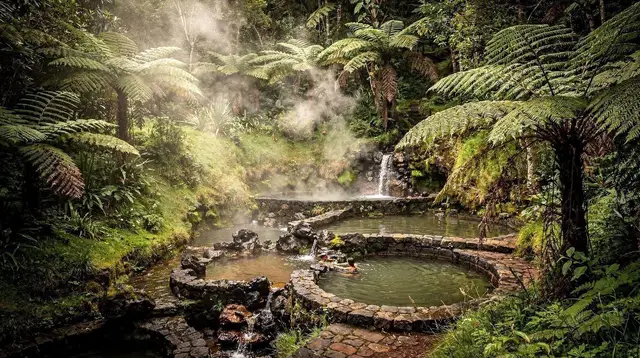
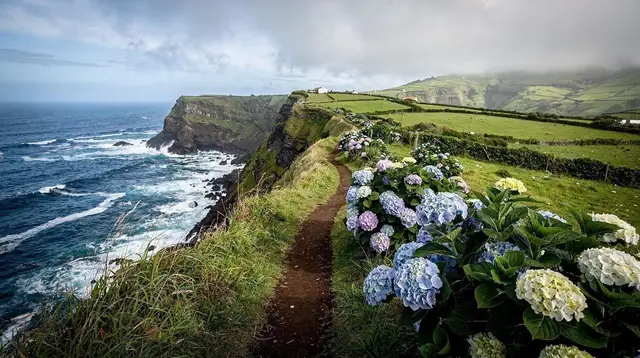
That last point matters more than it sounds. It is easy, looking at photographs of a waterfall dropping into a green ravine, to picture this corner of the island as untouched wilderness. It is not. São Miguel is a farmed, inhabited island from coast to coast, and this valley is no exception: fences, gates, grazing land and smallholdings run right up against the trail for most of its length. You are walking through someone’s working land, not around it, and the cattle you meet on the path have as much right to be there as you do.
The walk from Faial da Terra to Sanguinho
The path leaves the lower end of Faial da Terra and follows the Ribeira do Salto upstream, climbing gently rather than steeply. Underfoot it is a mix of packed earth, stone, and a few short paved stretches near the village, turning to a narrower dirt track further up. Several small wooden bridges carry the trail back and forth across the stream, and after rain these crossings can be slick, so the sturdy shoes matter more here than the fitness required — this is a walk, not a climb.
About halfway along, the path reaches Sanguinho, a hamlet that was abandoned for decades and has since been restored: a handful of small stone buildings and mills sitting in a clearing by the water, kept up rather than rebuilt from scratch. It is a good place to pause. There is no café and no shop, just the buildings, the stream, and the quiet that comes from being a 40-minute walk from the nearest road. From Sanguinho, the trail continues upstream through more of the same farmed valley — pasture on the open stretches, denser vegetation in the gullies — until the ground steepens and the sound of falling water becomes the clearest sign that Salto do Prego is close.
Salto do Prego and its pool
The waterfall itself drops in a single, fairly narrow fall into a pool at its base, set in a tight, green amphitheatre of rock. It is not a wide curtain like some of the falls around Ribeira dos Caldeirões further north, but a compact, self-contained spot that rewards the walk rather than announcing itself from a distance. There are no railings, no ticket booth and no staff. What you find is what is there: cold stream water, rock, and whatever weather the day has brought.
Some walkers swim in the pool below the falls. Nothing stops you, but nothing looks after you either — there is no lifeguard and no rescue point, and the water stays cold even in August. Treat it as wild swimming, because that is exactly what it is: fine on a calm day for a confident swimmer, and not the place to test yourself for the first time or to let children swim unwatched.
Getting to the trailhead
Faial da Terra is roughly 45 minutes to an hour’s drive from Ponta Delgada, depending on which side of the island you come from, and considerably closer if you are already based around Furnas or Povoação.
A rental car is the practical way to get there, since bus services to this stretch of coast are thin and built around school and work timetables rather than day trips — see our notes on driving conditions before you set off, since the roads down to the village are narrow with tight bends. There is informal parking in Faial da Terra itself, close to where the trail begins; the village is small enough that you will not miss it.
If you would rather not navigate the drive and the trail alone, a guided option covers the walk and takes care of logistics. a guided hike to Salto do Prego that builds in a picnic stop along the way is the most direct match for this exact route, following the same path from Faial da Terra to the waterfall with a leader who knows the crossings and the pace.
Timing, difficulty and what to bring
Most walkers cover the out-and-back in 1.5 to 2 hours of walking, plus however long they linger at Sanguinho and the waterfall — half a day is a realistic total once you include the drive. The gradient is gentle to moderate; this is a valley walk, not a summit climb, and it suits anyone reasonably fit and comfortable on an unpaved path with a handful of stream crossings. It is not a route for a stroller, and it is not the place for smart shoes: the ground turns to mud quickly after rain, which on this side of São Miguel can arrive with little warning.
| To bring | Why |
|---|---|
| Sturdy, grippy shoes | Packed earth and stone, muddy after rain, several small bridges |
| A light rain layer | Weather on this coast changes fast and without much notice |
| Swimwear and a towel | Optional, for the pool at the base of the falls |
| Water and a snack | No shops or cafés between Faial da Terra and the falls |
| Cash | Nothing along the trail takes cards |
Farmland, not wilderness
It is worth repeating, because it is the detail most guidebooks skip: this is not a nature reserve and it is not empty land. Cattle graze the open pasture the path runs through, small holdings and vegetable plots edge the trail near the village, and the fields you pass belong to people who work them. Close gates behind you, keep dogs on a lead if you bring one, and give grazing animals room rather than trying to walk between them and the fence line. Our broader note on why São Miguel is farmed, not a wilderness covers the same pattern across the island — pasture and hedgerow reaching almost everywhere, including corners that look, in a photograph, like nobody has ever set foot there.
This also means the walk is not the place to expect the island’s rarer wildlife. The priolo, São Miguel’s endemic bullfinch, survives only in the laurel forest of the Serra da Tronqueira further inland — a different habitat with a dedicated trail of its own, and not part of the Faial da Terra route. If that side of the island’s nature interests you, our guide to the Serra da Tronqueira priolo trail covers it separately. What you will see here instead is a lived-in valley: fields, a restored hamlet, a working village at either end.
Combining Salto do Prego with the rest of Nordeste
Faial da Terra sits at the southern edge of a stretch of coast that rewards a full day rather than a quick stop. If you are driving yourself and want to see the clifftop viewpoints and villages further north along the same coastline, that is a separate day out covered in our Nordeste coastal day trip guide, which does not overlap with this walk — it is built around the road, not the footpath from Faial da Terra.
For a guided day that takes in more of the area’s waterfalls in one outing, a small-group tour of Nordeste’s waterfalls that includes lunch covers more ground than the Salto do Prego walk alone, useful if your time on this side of the island is limited to a single day.
Travellers who would rather cover distance by vehicle and only walk short stretches often choose a private 4x4 tour through Nordeste’s back roads and viewpoints, which reaches spots a rental car cannot and pairs well with a shorter version of this hike.
And if the water itself is the draw rather than the walk to it, canyoning groups make use of the same general terrain a little further north: a guided canyoning descent through the waterfalls of Ribeira dos Caldeirões is a different, more technical way to experience falling water on this coast, with ropes, wetsuits and an instructor rather than a footpath.
Planning around the rest of São Miguel
Faial da Terra and Salto do Prego fit naturally into a longer stay on the island’s eastern side, alongside Furnas and Povoação, rather than as a stand-alone reason to drive out from Ponta Delgada and back in one go. If you are still working out how much time to give the island as a whole, our guide on how many days you need on São Miguel and the five-day in-depth itinerary both allow a slower pass through this side of the island rather than rushing it.
Travellers building a hiking-focused trip specifically will find this walk sits well alongside others in our Nordeste hiking itinerary and in the wider comparison of São Miguel’s best hikes, which sets Salto do Prego’s easy valley walk against steeper, longer routes elsewhere on the island.
Pack with the terrain and the weather in mind rather than the season on the calendar; our general packing list for São Miguel covers the layers and footwear that suit this kind of trail. And because cattle, uneven ground and cold water are the real considerations here rather than anything more dramatic, it is worth reading our broader note on what is and is not a hazard on São Miguel before you go — there is nothing venomous or dangerous waiting in this valley, but a slick bridge or an unwatched swim is a real, ordinary risk worth taking seriously.
Questions about the Salto do Prego hike from Faial da Terra
How long is the hike from Faial da Terra to Salto do Prego?
Reckon on about 45 minutes to an hour each way at an easy pace, so 1.5 to 2 hours round trip before you factor in time at the pool. It is a there-and-back walk along the same stream valley, not a loop.
Is the trail to Sanguinho and Salto do Prego signposted?
Yes. It follows a numbered PR trail out of Faial da Terra with waymarks along the way. The path is easy to follow in clear weather, though markings can be harder to spot after heavy rain has knocked back vegetation over the route.
Can you swim at Salto do Prego?
There is a natural pool at the base of the waterfall and people do swim in it, but the water is cold, untreated stream water, not a managed pool. There is no lifeguard, no changing room and no facilities, so swim only if you are a confident swimmer and the flow looks calm.
Is the Salto do Prego hike suitable for families with children?
Older children who can manage an unpaved, sometimes muddy path with stream crossings and no barriers generally do fine. It is not a stroller-friendly walk, and adults should keep a close eye on anyone near the pool and the rockier ground close to the falls.
What should I bring for the walk to Sanguinho and Salto do Prego?
Sturdy shoes with grip, a layer against sudden rain, water, and a swimsuit and towel if you plan to get in the pool. Cash is worth carrying too, since there is nowhere to pay by card once you leave Faial da Terra.
Is Faial da Terra a wilderness reserve?
No. It is a working village surrounded by pasture and smallholdings, and the trail runs past fields, fences and grazing cattle rather than through protected empty land. Farming continues right up to the path, so gates should be left as you find them.
Can I drive beyond Faial da Terra to reach the waterfall?
No. The road ends at the village, and Salto do Prego and Sanguinho are reached on foot only, along the trail. There is parking in Faial da Terra itself, near the start of the path.
Is there a shorter way to see a waterfall near here without the full hike?
Salto do Prego itself has no shortcut, since the trail from Faial da Terra is the only way in. Travellers short on time or mobility often visit the waterfalls around Ribeira dos Caldeirões instead, which sit much closer to a road.
Hiking Trails on GetYourGuide
Verified deep-linked GetYourGuide tours. Book through these links and we earn a small commission at no cost to you.
GetYourGuide does not provide a product photo for this activity — the image shows the meeting point, photographed by us.