Why São Miguel Feels Farmed, Not Wild
I landed on São Miguel expecting, if I’m honest, something closer to Iceland with palm trees: a raw, uninhabited volcanic backdrop where the humans would feel like an afterthought. What I got instead, somewhere on the road between Ponta Delgada and Sete Cidades, was a line of dairy cows crossing the tarmac at their own pace while a farmer waved me to a stop with the flat of his hand. I sat there for four minutes. It was, without exaggeration, one of the best four minutes of the trip.
An island built on pasture, not left alone
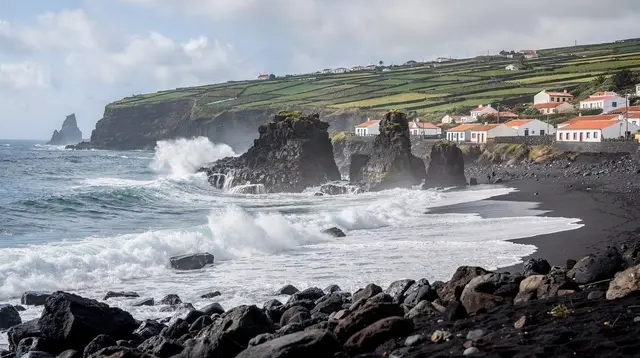
São Miguel is 744 km², home to roughly 137,000 people — more than half of everyone who lives in the entire Azores archipelago, spread across nine islands. That single fact reframes the whole place. This isn’t a nature reserve with a visitor centre bolted on; it’s a working island, and farming is the industry that shapes what you actually see out the car window. Pasture, hedgerow, small towns, cattle. Locals call it the Ilha Verde, the green island, and the green in question is grass kept short by grazing, not a forest canopy.
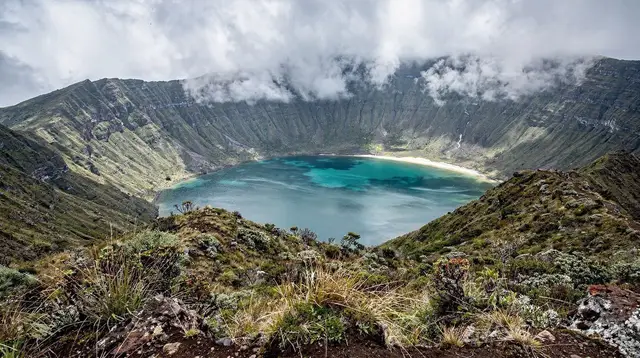
I think a lot of visitors arrive with a mental image assembled from drone footage: the twin lakes at Sete Cidades, the steaming ground at Furnas, the crater lake at Lagoa do Fogo — all shot from above, all conveniently empty of people. Seen that way, São Miguel looks like a park you walk into. Seen from the ground, on the EN1-1A that rings the island, it looks like what it is: a farmed landscape with volcanic bones showing through.
Where the pasture is thickest
Drive the interior between Lagoa and Água de Pau and you’re mostly looking at hedgerowed fields, milking sheds, and narrow lanes built for tractors before they were built for rental cars.
The same is true heading toward Nordeste: pasture climbs the hillsides right up to where the laurel forest of the Serra da Tronqueira takes over — one of the only patches of the island genuinely left to itself, and not coincidentally the one place the endemic priolo still survives. Even Vila Franca do Campo, the island’s original capital until the 1522 landslide buried it, sits surrounded by working fields rather than scrubland.
The exception, and it’s a real one, is Lagoa do Fogo. No café, no ticket booth, no bins, frequently no visibility because it’s sitting inside a cloud. That’s the closest São Miguel gets to true wilderness, and it earns the word precisely because it’s the odd one out.
The misconception worth demolishing
If you come expecting an untouched, national-park version of the Azores — no farms, no fences, no human noise — you’ll spend the trip mildly disappointed by things that were never the point. The tea rows at Gorreana, still hand-picked on a working plantation, aren’t a photo backdrop; they’re an actual business, Europe’s oldest surviving one of its kind.
The greenhouses around Fajã de Baixo growing pineapple for two slow years aren’t scenery, they’re agriculture. Even the cozido cooked in the ground by Lagoa das Furnas is a farming-adjacent ritual — restaurants booking a hole in a public caldera, on a schedule, because the heat is a resource the town shares.
None of that is a compromise on the island’s beauty. I’d say it’s the reason the beauty holds up over several days instead of one. A landscape with nothing living in it gets exhausting to look at; a landscape with cows, hedges, church towers and a woman hanging washing between two hydrangea bushes gives your eye somewhere to land.
What I’d tell someone packing for this trip
Stop treating the drive between viewpoints as dead time. The stretch of road you’re tempted to power through to get to the next crater rim is, more often than not, the actual island — Ribeira Grande’s working fishing quarter, the tea fields near Porto Formoso, the whaling-era buildings at Capelas. A full-island jeep day makes this obvious fast, because a jeep driver who lives here will point out the farm boundaries and the old lava walls without you asking.
this full-day jeep circuit of the island is the version of “seeing São Miguel” I’d actually recommend to someone who wants the working landscape explained, not just photographed. If you’d rather walk it, the hike up to the crater lake takes you straight through grazing land before the terrain turns properly wild near the rim — you feel the transition under your own feet, which a car window never quite delivers.
Cattle on the road stop being an annoyance once you accept they’re not a detour from the real São Miguel — they are it. Same with the fences you’ll open and close on some of the Nordeste trail sections, or the smell of a milking shed drifting across Caldeira Velha’s thermal pools on a still morning. It’s a lived-in place with 137,000 people making a living off pasture, tea, dairy and tourism side by side, not a diorama assembled for visitors.
The comparison that clarified it for me
I’ve since done a version of this trip on Terceira, and the difference is worth naming: Terceira reads more urban and monumental around Angra do Heroísmo, São Miguel reads more rural everywhere outside Ponta Delgada. If you’re weighing the two, how São Miguel and Terceira actually compare is worth a read before you commit days to either. And if part of your trip includes a cruise stop or a short window in the capital, the contrast between the town and the countryside is even sharper — a guided day tracing some of the island’s quieter corners makes that contrast obvious inside a single afternoon.
None of this means skip the postcard spots — Vista do Rei still stopped me mid-sentence, and I’ll defend Terra Nostra to anyone. It means don’t mistake São Miguel for a wilderness it never claimed to be. It’s a small, green, working island that happens to sit on a volcano, and the farming is not the part to drive past.
Planning around the working landscape
A couple of practical notes follow directly from all this. First, if a herd is crossing, you wait — there’s no horn-worthy urgency to it, and it’s over in a few minutes. Second, build slack into your route rather than treating every non-viewpoint stretch as wasted time; how many days you actually need on São Miguel goes up once you stop rushing between the famous stops. And if the farmed, unhurried version of the island sounds like your kind of trip rather than a compromise, a half-day around the Furnas caldera and its villages is a gentle, low-key place to start.
tours.Opinion
Verified deep-linked GetYourGuide tours. Book through these links and we earn a small commission at no cost to you.
GetYourGuide does not provide a product photo for this activity — the image shows the meeting point, photographed by us.