Why Cozido das Furnas Is Cooked in the Ground, Not Over a Fire
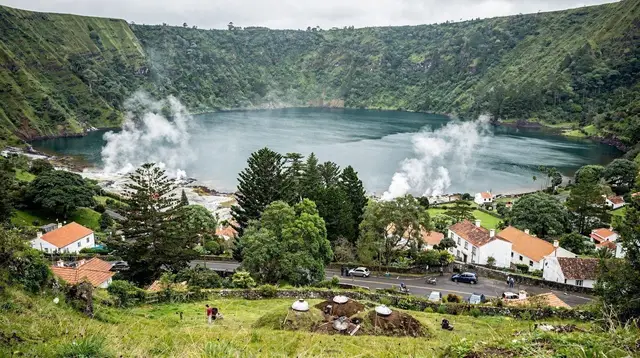
The first time I smelled Furnas before I saw it, I assumed something was wrong. Sulphur, faint and mineral, drifting through a valley that otherwise looks like any green corner of the Azores. Then I came around the bend by the Lagoa das Furnas and saw steam standing up out of the grass in thin columns, and understood that nothing was wrong at all. The ground here is simply hot, all the time, and has been for longer than anyone has kept a written record of it.
That heat is the whole story of cozido das Furnas, and it is a stranger story than most people expect before they arrive. I had pictured a barbecue pit, coals glowing under a lid, someone tending a fire the way you’d tend one anywhere else in the world that cooks meat slowly. There is no fire. There is a hole.
What is actually happening in the ground
Along the shore of Lagoa das Furnas, in a fenced and managed patch of steaming earth, local restaurants dig holes straight down into soil that sits naturally somewhere around boiling point a short way below the surface. This is the same geology that powers the caldeiras and fumaroles elsewhere in the village, the same system that heats the iron-rich water at Terra Nostra and the pools at Poça da Dona Beija. Furnas sits inside an active volcanic caldera, and this particular stretch of shoreline happens to be one of the places where that heat comes closest to the surface with the least fuss.
Into that hole goes a sealed metal pot, packed with layers of meat, cabbage, carrots, potatoes and blood sausage, tied shut and lowered on a rope in the mid-morning. Earth goes back over the top. From then on nobody touches it. There’s no flame to feed, no coals to turn, nothing to check. The pot sits in ground heat for five to seven hours, cooking on nothing but the volcano itself, until it’s hauled back up by the same rope sometime around midday and driven, still faintly steaming, straight to the restaurant that owns it.
I found that gap oddly moving, actually. Most slow food asks for attention. This asks for none. The mountain does the work while the cooks go and do something else.
Who the hole actually belongs to
This is the part I got wrong before I went, and I’ve since heard other visitors get wrong in the same way: the holes at Lagoa das Furnas are not a public barbecue pit where anyone can show up with a pot. They belong, in practice, to the handful of restaurants and caterers in Furnas who have used that ground for generations and manage the timing, the spacing and the safety of it. You don’t book a hole. You book a table, at a restaurant, and the restaurant handles everything that happens underground on your behalf — see this guide to booking a table near Furnas if you’re planning around it.
That distinction matters because it changes what a visit actually looks like. You’re not going to cook anything yourself, and nobody is going to hand you a spade. What you can do is walk the lakeside path in the late morning, watch the steam rise off ground that looks perfectly ordinary until you notice nobody’s grass grows quite the same there, and if your timing is good, see a pot come up on its rope before lunch. Then you go and eat the results at a table, usually with a view back toward the lake or the caldeira itself.
Because the pots are limited and the demand is not, especially from June through September, a table with cozido on the menu that day is worth reserving ahead rather than hoping for. I made the mistake once of turning up at 1pm in August assuming a plate would be waiting; it wasn’t, and I ate soup instead while apologising to nobody but myself.
The bigger picture this sits inside
What struck me most, once I understood the mechanism, was how ordinary it made the volcano feel. Furnas isn’t dramatic in the way a lava flow is dramatic. It’s quieter than that — a valley that happens to sit on top of something enormous, where the caldeiras bubble at the edge of the village car park and a Sunday lunch cooks itself underground a few hundred metres away. The same heat that stains your swimsuit orange at Terra Nostra, that keeps Poça da Dona Beija at bathing temperature year-round, is what turns raw pork and cabbage into cozido without anyone lighting a match.
If you want to understand that system properly before or after eating, the wider overview of São Miguel’s volcanic history lays out how Furnas connects to the rest of the island’s geology, and a proper walk through the fumarole fields makes the heat tangible in a way a plate of food alone doesn’t. Furnas itself sits inland, in the caldera; its beach, Ribeira Quente, is over the ridge entirely, a fact that trips up more visitors than you’d think when they go looking for sand near the lake and find none.
What I’d tell someone going for the first time
Book the table before you book anything else that day. Go to the lakeside holes in the late morning if timing allows, more for the steam and the strangeness of it than for a guaranteed show — the lifting isn’t choreographed for visitors, and restaurants pull pots on their own schedule. Don’t expect a fire, don’t expect a demonstration, and don’t expect to do any of the cooking yourself. What you’re actually watching, if you catch it, is a village using the ground under its feet the way it has for well over a century, without ceremony, because the ground simply makes it possible.
If you’d rather have someone else handle the logistics of the day entirely, a guided [Furnas full-day tour](Furnas: Full Day Tour) folds the cozido lunch into a route that also covers the thermal park at Terra Nostra and the caldeira fields, which solves the booking problem for you.
There’s also a [van tour built around a full day in Furnas](Van Tour Furnas Full Day) for a smaller-group version of the same idea, and a combined [tea plantation, waterfall and volcano route](Furnas: Volcano Wonders Tea Plantation Waterfall Tour) if you want the geothermal side of the island paired with Gorreana’s tea fields on the way there.
For a wider loop that takes in Povoação and Ribeira Quente alongside Furnas, or a self-drive version of the day using our own Furnas itinerary, you can build the cozido lunch into a longer circuit rather than an out-and-back from Ponta Delgada. Either way, go hungry, go booked, and don’t be surprised when the strangest thing about lunch turns out to be the ground it came from.
Cozido das Furnas: questions before you book
Can I dig my own hole and cook a pot at Lagoa das Furnas?
No. The ground there is communal and managed by the local restaurants, which hold the spots, dig the holes, and handle the timing. Visitors book a meal, not a hole.
How long does cozido das Furnas actually cook?
Around five to seven hours, entirely on geothermal heat, with the pots going down mid-morning and coming up around midday for lunch service.
Is there an open flame involved at any point?
No. The heat comes from the ground itself, part of the same volcanic system that fuels Furnas’ fumaroles and mineral springs. Nothing is grilled or flame-cooked.
Do I need to book a table for cozido in advance?
Yes, especially in the June to September high season. Restaurants take a limited number of pots down each morning, so a table without a reservation may mean cozido has sold out for the day.
What is actually in a cozido das Furnas pot?
A mix of meats such as beef, pork, chicken and blood sausage, layered with cabbage, carrots, potatoes and sweet potato, all sealed in a covered pot that slow-cooks in the steam and heat rising through the soil.
Is the smell of sulphur near Lagoa das Furnas dangerous?
The rotten-egg smell comes from the same hydrogen sulphide venting through the fumaroles nearby. It is unpleasant in strong pockets but not something a short visit to the caldeiras or the lakeside holes poses a health problem for.
Can I watch the pots being lowered or raised?
Yes, the lakeside holes are in a public spot beside Lagoa das Furnas, and both the morning lowering and the midday hauling-up are visible if your timing lines up, though the actual scheduling belongs to the restaurants, not to visitors.
Food & Gastronomy on GetYourGuide
Verified deep-linked GetYourGuide tours. Book through these links and we earn a small commission at no cost to you.
GetYourGuide does not provide a product photo for this activity — the image shows the meeting point, photographed by us.