Sea Kayaking the South Coast: Vila Franca do Campo to Caloura
What does sea kayaking between Vila Franca do Campo and Caloura actually show you?
You paddle a volcanic shoreline of sea cliffs, coves and caves on São Miguel's south coast, launching near the town that was the island's capital until 1522 and working west toward the small fishing hamlet of Caloura. It is open Atlantic water rather than a sheltered lagoon, so the route and the distance covered depend on the swell that day.
A paddle along São Miguel’s working south coast
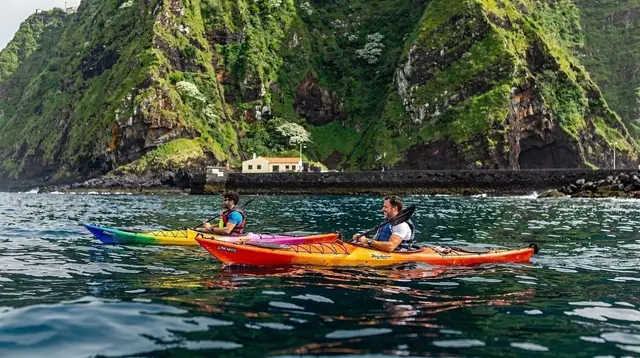
The stretch of coastline between Vila Franca do Campo and Caloura is one of the few places on São Miguel where sea kayaking is a genuinely local activity rather than a resort add-on. There is no marina strip of rental huts here, no roped-off swimming area, and no promise of flat water. What there is: a low volcanic shoreline of black rock, sea caves, small coves and grazing land running down almost to the cliff edge, paddled by boats that launch from the town beach and work along the coast as far as conditions allow that day.
This guide covers the paddling itself — what the coast looks like from a kayak, how trips are usually run, and what changes with the weather. It does not cover the caldera lakes in the island’s interior; if you are picturing calm turquoise water framed by a crater rim, that is Sete Cidades, and the Sete Cidades lakes kayaking guide is the right page for that trip. This one is open Atlantic water, and it behaves like it.
Starting point: a town that used to be the capital
Trips launch from or near Vila Franca do Campo, a harbour town on São Miguel’s south coast that is easy to underestimate from the water. Until 1522 it was the island’s capital, the seat of its government and its main settlement. That year an earthquake triggered a landslide off the slopes above the town that buried much of it and killed a large part of the population. Ponta Delgada took over as capital in the aftermath, and Vila Franca rebuilt on a smaller footing, which is roughly the size and role it has kept since.
None of this is visible as a ruin from a kayak — the old town is simply gone, replaced by the working harbour and waterfront you launch from — but it explains why a fishing town this size carries a cathedral-sized church and a layout that reads as more than a village. The former-capital guide covers that history in more depth if you want it before or after paddling.
From the water, the town presents as a harbour wall, a run of waterfront houses, and the green slope behind climbing toward the hilltop chapel of Nossa Senhora da Paz — visible from the sea on a clear morning, though it is a separate visit on land. A short crossing offshore sits the Ilhéu de Vila Franca, the flooded remains of an old crater now protected as a nature reserve with a capped number of daily visitors.
Some kayak routes pass close to it or land there in season, weather allowing; others treat it as a backdrop rather than a stop. If the islet itself, and swimming inside its sunken crater, is what you are after rather than the paddle, the dedicated islet boat trip guide and snorkelling-inside-the-crater guide describe that experience directly.
What the coast looks like from the water
Leaving Vila Franca’s shelter, the shoreline toward Caloura is a run of dark volcanic rock shaped by centuries of Atlantic swell: low cliffs, arches, sea caves you can sometimes paddle into on a calm day, and small pocket coves that are only reachable by boat or on foot from farmland above. Pasture runs close to the cliff edge in places, with cattle visible from the water, and there is little of the manicured, ornamental coastline you find on postcard beach towns elsewhere. This is a working shore — some of it farmed, some of it fished, none of it landscaped for visitors.
Wildlife along this stretch is incidental rather than promised. Seabirds nest in the cliff faces, and it is not unusual to see terns or shearwaters working the water close to a kayak. Whales and dolphins are possible but not part of the plan on a kayaking trip specifically — boats built for that purpose head further offshore, and the whale and dolphin watching guide is the better resource if that sighting is your actual goal. Guides on the water will point things out as they come up, but nothing on this coast is staged for a camera.
Caloura: the other end of the paddle
Caloura sits further along the same south coast, a small hamlet built around a natural harbour that has sheltered boats since well before tourism existed here. It is smaller and quieter than Vila Franca — a cluster of houses, a harbour wall, a natural swimming spot cut into the rock, and vineyards on the slopes behind that supply some of São Miguel’s small wine production. Trips that run the full stretch between the two towns use Caloura as either a turnaround point or, depending on the operator and the day’s plan, an alternative launch or landing.
Because Caloura’s harbour offers real shelter where the open coast does not, it doubles as a base for other water activities that need calmer water to start from, including some snorkelling spots close to shore — covered in the Caloura snorkelling guide — and coasteering trips that swim and scramble the same volcanic shoreline a kayak paddles past.
Reading the swell: the honest version
Nothing about this coast is sheltered from the Atlantic. It faces open ocean, and the swell that reaches it is the same swell that shapes the rest of São Miguel’s southern shoreline — sometimes a gentle roll that barely affects paddling, sometimes enough to close a route or cancel a trip outright. There is no cove geometry, headland, or local feature along this stretch that reliably blocks incoming swell the way a caldera or an enclosed bay would. Any claim that this particular section is calm because of its shape should be treated with real skepticism; conditions here are set by the ocean on the day, not by the coastline.
In practice this means a few things worth planning around:
- Morning departures are common because the sea is often calmer before the wind builds through the day.
- Operators will genuinely shorten, reroute or cancel a trip if the swell is too much for the kayaks and group involved — this is a safety call, not an inconvenience built to disappoint you.
- A route that reaches the Ilhéu de Vila Franca or continues all the way to Caloura on one day might turn back early on the next, with no pattern you can predict from a forecast alone.
- Booking flexible dates, particularly outside the calmest months, reduces the chance of a wasted trip more than any amount of research into the “best” launch time.
The kayaking safety guide comparing open Atlantic water to the caldera lakes goes into more detail on how sea kayaking here differs from the sheltered lake paddling elsewhere on the island, and is worth reading before you book if you have not paddled open ocean before.
Booking a trip
Several operators run guided kayak trips from Vila Franca do Campo along this stretch of coast, generally in stable double or single sea kayaks with a guide leading the group. A typical outing runs two to three hours, with a safety briefing on the beach, a paddle out along the coast toward the islet and sometimes on toward Caloura, and a return by the same or a similar route.
a guided kayak trip along the coast and its sea caves toward the islet is the closest match to the route described above, with a guide setting the pace and explaining the coastline as you go.
If you would rather set your own pace on the water, renting a kayak directly in Vila Franca do Campo is the self-guided option, best suited to paddlers who are already confident in open water and comfortable reading conditions themselves. For a trip built specifically around reaching and exploring the islet by kayak, an islet-focused kayaking experience out of Vila Franca do Campo is the more direct choice.
If the idea of being in the water rather than sitting in a boat appeals more, a coasteering outing on the Caloura coastline covers some of the same shoreline on foot and by swimming — a genuinely different activity, and one worth considering as an alternative rather than an add-on to a kayak trip on the same day.
Comparing the options
| Trip | Format | Best suited to |
|---|---|---|
| Guided coast and islet kayak tour | Guided, group pace, 2-3 hours | First-time sea kayakers, anyone wanting the coastline explained |
| Premium kayak rental | Self-guided, own pace | Confident paddlers comfortable in open water |
| Islet kayaking experience | Guided, focused on the islet | Paddlers prioritising the Ilhéu de Vila Franca specifically |
| Caloura coasteering | Guided, swimming and scrambling | Travellers who want to be in the water, not just on it |
Practical notes for the day
Bring a swimsuit worn under quick-dry clothing, a full change of dry clothes left in your vehicle or bag on shore, and shoes that can get wet — most launches are from a beach or slipway, not a pontoon. Sun protection matters even under cloud, since reflected light off the water adds up quickly. Operators supply the kayak, paddle and a buoyancy aid; a dry bag for a phone or camera is worth bringing yourself if your operator does not provide one.
This coast sits on the south side of the island, which means it is generally reached by car from Ponta Delgada or as a stop on a wider south coast day out. There is no train on São Miguel and bus timetables are built for residents rather than sightseeing, so a rental car or an organised transfer is the practical way to reach Vila Franca do Campo in time for a morning departure.
For activities across this section of coast beyond kayaking, the things to do near Vila Franca do Campo and kayaking and paddling category pages list the fuller range, and the surf and water temperature guide is useful background if you are trying to judge sea conditions for yourself before travelling. For wider trip planning beyond this one activity, how many days you need on São Miguel and the general travel tips section cover the rest of the logistics.
FAQ: sea kayaking Vila Franca do Campo to Caloura
Is the water between Vila Franca do Campo and Caloura sheltered from the Atlantic?
No. This stretch faces the open Atlantic and nothing about the coastline shelters it from ocean swell. Guides read conditions each morning and shorten, reroute, or cancel a paddle when the sea is too rough, so treat any published route as a plan, not a guarantee.
Do I need previous kayaking experience?
Guided trips along this coast are generally pitched at first-timers in stable double or single sea kayaks, with a safety briefing and a slow first stretch to build confidence. You should still be a reasonably comfortable swimmer, since capsizes near rocks are handled in the water, not from a boat.
Can I paddle out to the Ilhéu de Vila Franca on this trip?
Some operators route close to the islet or land there when the sea allows it, but it is not guaranteed on every departure. If reaching the islet itself is your priority, a dedicated islet boat trip or islet-kayaking tour is the more reliable choice.
How is this different from kayaking the Sete Cidades lakes?
Sete Cidades is flat, sheltered fresh water inside a volcanic caldera in the island’s west, with no swell, tide or salt spray to plan around. The south coast between Vila Franca do Campo and Caloura is open sea, and the two trips have almost nothing in common beyond both using a kayak.
Is coasteering an option instead of kayaking here?
Yes, Caloura is also a base for coasteering, which swaps the boat for swimming, scrambling and jumping along the same volcanic shoreline. It suits a different kind of traveller than kayaking does, and the two are usually booked as separate activities.
What should I bring on a south coast kayak trip?
A swimsuit under quick-dry clothing, a change of dry clothes and a towel left in the vehicle, sun protection even on a grey day, and shoes that can get wet, since most launches are from a beach or slipway rather than a pontoon. Operators supply the kayak, paddle and buoyancy aid.
When is the best time of year to paddle this coast?
Late spring through early autumn brings the calmest average sea state and the warmest water, roughly 22 to 24 degrees Celsius in summer, though any single day can still turn choppy. Winter trips run on quieter weather windows but are cancelled far more often, which is normal for open-sea paddling here rather than a sign anything went wrong.
Kayaking on GetYourGuide
Verified deep-linked GetYourGuide tours. Book through these links and we earn a small commission at no cost to you.
GetYourGuide does not provide a product photo for this activity — the image shows the meeting point, photographed by us.