Sea Kayaking at Ribeira Quente: Furnas' Coast on the Water
Can you sea kayak on the coast near Furnas?
Yes, but not from Furnas itself. Furnas sits inside an inland caldera with no sea access; its coastline is Ribeira Quente, a fishing village on the far side of the ridge, about a 15-20 minute drive away. Sea kayaking happens from Ribeira Quente's small harbour and beach, on the open south-east Atlantic, not on any of the lakes or thermal water in Furnas.
Furnas and Its Coast Are Two Different Places
The single most common mix-up in trip planning around Furnas is geographic, and it matters for anyone hoping to paddle. Furnas is a village sitting inside an active volcanic caldera in the middle of São Miguel, ringed by a steep crater wall. It has steaming ground, mineral springs, a crater lake used for cooking cozido, and a famous thermal garden — but it has no coastline. There is no channel, river mouth or waterway that leads from the caldera down to the Atlantic. You cannot put a kayak in anywhere near the village of Furnas and paddle out to sea, because the sea is not there.
The coast that belongs to this part of the island is Ribeira Quente, a small fishing village on the far side of the ridge that closes off the Furnas caldera to the south-east. It is reached by a mountain road that climbs out of the valley, crosses the rim, and drops back down to sea level — a drive of roughly 15 to 20 minutes from central Furnas, not a walk and not a paddle.
Locals sometimes shorten this to “Furnas’ beach,” which is accurate in the loose sense that it is the nearest coast to the caldera and shares the same parish history, but it is a separate settlement with its own harbour, its own black-sand beach, and its own stretch of open Atlantic. If a description of São Miguel implies you can kayak straight from the thermal pools to the sea, it has confused the two places.
This guide covers what happens on the water side of that ridge: sea kayaking along the Ribeira Quente coast, and the wider stretch of south-eastern shoreline it belongs to, including nearby Povoação. For the caldera itself — the fumaroles, the cooking pits and the thermal park — see the separate Furnas fumaroles and caldeiras walking guide, which does not touch the coast at all.
What the Ribeira Quente Coastline Actually Looks Like
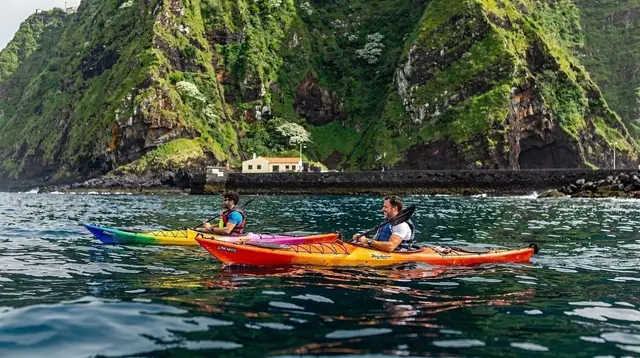
Ribeira Quente sits where the green, terraced slopes of the Furnas massif meet the sea in a series of dark cliffs, coves and a short run of black volcanic sand. The village itself is low-key: a working harbour with a handful of fishing boats, a seafront promenade, a public beach, and a scatter of cafés rather than a resort strip. That plainness is part of the draw for kayaking — the water in front of the village is relatively sheltered by the shape of the bay, while paddling a little further along the coast in either direction opens onto exposed headlands, sea caves cut into the cliff base, and views back up at the green wall of the Furnas ridge from a angle almost nobody sees from land.
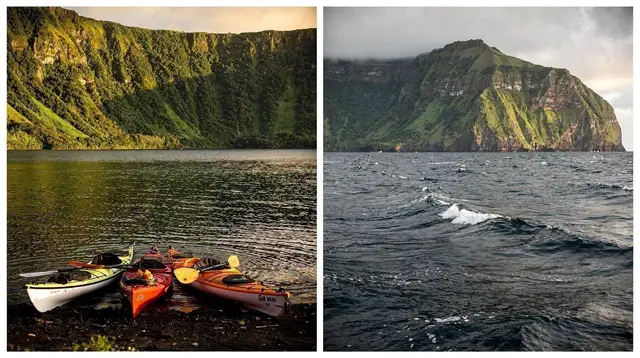
This is genuine open-ocean coastline, not a lagoon or a harbour pool. The water is the North Atlantic, subject to swell, wind chop and tidal movement, and it behaves very differently from the calm caldera lakes elsewhere on the island. A short paddle from the beach into the sheltered part of the bay is a mild, scenic outing suitable for most fitness levels with a guide; rounding a headland into open swell is a different proposition and is where guided trips draw the line depending on conditions that day.
Away from the guided trips, the village’s own black-sand beach is public and free to use on its own, with no boat, kayak or tour required — a straightforward place for a swim or a walk if a paddle gets cancelled for weather, or a way to see the same stretch of coast from the sand either side of a booked session.
Families travelling with younger children who are not ready for open-water paddling often split up this way, with part of the group on the water and part on the beach; for a broader sense of what suits children on this side of the island, see São Miguel with kids and the family-friendly activities guide, both of which cover calmer, land-based alternatives nearby.
Sea Kayaking Here vs. Lake Kayaking Elsewhere on São Miguel
São Miguel’s other well-known paddling spot, the twin lakes of Sete Cidades, could hardly be more different in character, and mixing the two up leads to real disappointment or, worse, real risk. The table below lays out the contrast plainly.
| Ribeira Quente (sea) | Sete Cidades (lakes) | |
|---|---|---|
| Water body | Open North Atlantic coastline | Sheltered lakes inside a dormant caldera |
| Swell / chop | Yes, wind- and weather-dependent | None — flat water |
| Typical difficulty | Beginner-friendly in the bay; harder off headlands | Beginner-friendly throughout |
| Weather cancellations | Common, tied to sea state | Rare, tied to wind and rain only |
| Wildlife | Seabirds, occasional dolphins offshore | Freshwater birdlife, no marine life |
| Scenery | Cliffs, sea caves, the Furnas ridge from the water | Caldera walls, twin blue and green lakes |
For a fuller comparison of what “open Atlantic” actually means for planning versus the island’s caldera lakes, see sea kayaking safety: open Atlantic vs. caldera lakes. Neither is objectively better — they are different activities that happen to share a boat and a paddle.
Launch Points and How Trips Are Run
Guided sea kayaking on this stretch of coast typically launches from one of two points: the beach or small harbour at Ribeira Quente itself, or the coast a short distance away near Povoação, where some operators combine kayaking with snorkelling or a short boat tour into a single water-activities outing. Because the coastline here is rural and lightly developed, there is no permanent kayak rental kiosk on the beach the way you might expect at a resort destination — trips are pre-booked with a guide who brings the boats, paddles and safety gear to the launch point, briefs the group on shore, and leads the paddle in a small group with at least one guide boat or kayak alongside.
A typical outing runs one and a half to two and a half hours on the water, paddling along the base of the cliffs, in and out of small coves, and sometimes into shallow sea caves where the swell allows. Groups are kept small, both for safety on open water and because the coves and cave entrances are not wide enough for a crowd. Life jackets are standard and non- negotiable; most operators also require closed shoes and will hold a dry bag for phones and cameras, since a coastal paddle here is genuinely wet work compared with a lake outing.
For a broader water-activities option that folds a paddling or swimming stop into a longer boat trip along this coast, the Povoação coast boat tour with water activities and drinks covers the same stretch of Atlantic from the deck of a larger boat, with time in the water at anchor rather than a full kayak circuit — useful if part of your group wants to paddle and part prefers to relax on board.
Season and Weather: The Honest Version
The Ribeira Quente coast is at the mercy of the open Atlantic, and that shapes the calendar more than anything else. Roughly May through September brings the calmest average sea state, the warmest water and air, and the highest share of trips that run as scheduled. July and August add the warmest conditions of all but also the busiest weeks island-wide, so booking a day or two ahead is sensible rather than essential.
Outside that window, from November through March, the island’s honest low season applies here in full: daytime temperatures around 14-17°C, rain possible on any given day, and a sea state that cancels boat and kayak trips considerably more often than in summer. Trips are not impossible in these months — some days are calm and clear — but plan a coastal paddle as a “if the weather allows” activity rather than a fixed appointment, and build a backup into the day. April, June, September and October sit in between: a reasonable balance of calmer seas, fewer crowds and lower prices than peak summer.
Because weather on São Miguel changes hour by hour and place by place, it is entirely normal for Furnas to sit under drizzle in its caldera while Ribeira Quente, a short drive and a ridge away, has flat calm water and sun. Checking conditions on the morning of a booked trip, rather than relying on a forecast checked days earlier, is standard practice for every operator on this coast.
Getting There Without a Rental Car
Ribeira Quente is easy to reach if you already have a car, but it is not a place many visitors pass through by chance, so it is worth deciding in advance how you will get there. Most independent travellers on São Miguel drive themselves; if you have not rented a car yet, the guide to renting a car on São Miguel and the practical notes in driving on São Miguel: what to expect cover the mountain road over the ridge from Furnas, which is narrow in places but paved and well used.
Travelling without a car is possible but takes more planning on this particular route, since Ribeira Quente sits off the island’s main bus corridors. The São Miguel bus guide and the wider multi-day itinerary without a car are the places to check current options before booking a kayak trip here; many visitors without a car instead book a tour that includes transport from Ponta Delgada or Furnas, which sidesteps the question entirely.
Pairing a Kayak Trip With the Rest of the Area
Because Ribeira Quente sits only 15-20 minutes from Furnas by road, most visitors treat the coast and the caldera as two halves of one day rather than separate trips. A common pattern is a morning kayak session while the sea is calmest, followed by an afternoon in Furnas for the caldeiras, the Terra Nostra thermal pool and a cozido lunch that was ordered that morning — see the Furnas day trip guide for how that timing works in practice.
Others fold the coast into a longer loop of the south-east that also takes in Povoação; the Povoação and Ribeira Quente day trip guide lays out that route stop by stop.
For visitors who want the caldera experience itself packaged with transport and a guide, the São Miguel: Furnas Half Day Tour covers the crater villages and thermal park without the driving, and pairs naturally with an independently booked morning on the water. Anyone specifically chasing the underground-cooked meal that Furnas is known for can also book the Cozido das Furnas Thermal Pools experience, which handles the cozido reservation directly.
Further along the south coast, Vila Franca do Campo and Caloura offer a second cluster of sea-based activity, including the sheltered, swim-inside islet of Ilhéu de Vila Franca. The south-coast sea kayaking guide covering Vila Franca and Caloura is the place to compare that stretch against Ribeira Quente if you are deciding which coast to paddle, and the Ilhéu de Vila Franca boat trip guide covers the separate, seasonal boat crossing to the islet itself, which is not part of a Ribeira Quente kayak trip.
For those with a full day and a private guide, the Private São Miguel Full Day Boat Tour can be built around this south-eastern coastline, combining time on the water near Ribeira Quente and Povoação with stops elsewhere along the shore, arranged directly with the operator around the day’s sea state.
Safety Notes Specific to This Coast
A few points are worth stating plainly rather than assuming. First, this is open ocean, not a swimming pool or a lake: currents run stronger near headlands and cave mouths than in the sheltered bay, and conditions that look calm from the beach can be different fifty metres offshore.
Second, there is no lifeguard service covering kayak routes along this coast, which is exactly why guided trips exist — a qualified guide reads the day’s sea state, chooses a route that matches the group’s ability, and calls off or shortens a paddle when conditions turn. Third, water temperature sits in the same range as the rest of São Miguel’s coast, cold enough (roughly 17-24°C depending on season) that a wetsuit or splash jacket is worth having even on a summer trip, and operators typically provide one as standard.
The occasional dolphin sighting offshore, noted in the comparison table above, is a bonus rather than something to plan around — this coast is not a dedicated whale-watching route, and sightings from a kayak are opportunistic. Visitors who want a reliable chance of seeing cetaceans should treat that as a separate activity; the whale watching season guide explains when and where boats specifically target sperm whales and dolphins, which is a different kind of trip from a coastal paddle out of Ribeira Quente.
Fog is also worth planning for. The ridge above Ribeira Quente and the Furnas caldera both catch low cloud regularly, and a foggy morning on the drive over from Furnas does not necessarily mean fog on the water below — but it can. Building in flexibility around the exact start time of a kayak trip, rather than booking transport and paddling back to back with no slack, avoids the most common source of a rushed or missed morning on this coast.
The Bottom Line
Furnas and its coast are genuinely two places joined by a short drive, not one place joined by a paddle. The caldera holds the thermal pools, the fumaroles and the cozido pits; the coast, over the ridge at Ribeira Quente, holds the sea kayaking, the black-sand beach and the open Atlantic. Treat them as a two-part day — water in the morning while the sea is calmest, caldera in the afternoon — and the geography stops being a source of confusion and becomes simply the shape of a very good day out.
Kayaking on GetYourGuide
Verified deep-linked GetYourGuide tours. Book through these links and we earn a small commission at no cost to you.
GetYourGuide does not provide a product photo for this activity — the image shows the meeting point, photographed by us.