4 Days on São Miguel Without a Car
Why São Miguel Works Without Renting a Car
São Miguel has no train, so a car is not the only alternative to walking — it is one of two. The other is a mix of guided day tours and the island’s local bus network, and for a first visit that combination covers more ground than most people expect. This four-day plan leans on both: two guided minibus excursions for the sights that are genuinely awkward without a car, a full day on foot in Ponta Delgada, and a final, looser day using the public bus.
It is not a substitute for a full circuit of the island. Nordeste and Lagoa do Fogo are deliberately left out — both reward the kind of last-minute flexibility a car gives you when fog rolls in or a viewpoint road closes, and neither has a bus service built for sightseeing. What is left is still substantial: the caldera lakes of Sete Cidades, the thermal valley of Furnas, the Terra Nostra garden, and the old streets of the capital, plus a taste of the working south coast at Caloura.
One honest caveat before Day 1: local buses on São Miguel run on school and commuter timetables, not tourist ones. A village bus in the morning does not guarantee a bus back in the afternoon. Check the timetable before you leave Ponta Delgada, and treat the return trip as the part of the day that needs planning, not the part you improvise. See the São Miguel bus guide for how the network actually runs, and guided tours vs self-drive for how this plan compares with renting.
Day 1: Ponta Delgada on Foot
Start in the capital, which rewards a full day of walking more than any other town on the island. Begin at the Portas da Cidade, the three 18th-century arches that once marked the harbour entrance and now frame the main square, then walk into the old town covered in the Ponta Delgada old town walking guide. The black-and-white cobbled streets lead past the Igreja Matriz de São Sebastião and on to the Forte de São Brás, the harbour fortress that still houses a small military museum.
Break for lunch at the Mercado da Graça, the covered market where fishmongers, cheese stalls and fruit sellers operate around a central courtyard — a good, cheap introduction to what actually ends up on Azorean plates. In the afternoon, walk the modern waterfront at Portas do Mar, the marina and cruise terminal built into a long stone breakwater, before heading slightly inland to the edge of town for the Gruta do Carvão, a lava tube formed by an eruption roughly 700 years ago and open for short guided visits — details in the Gruta do Carvão lava tube walk.
If you’d rather have a local guide narrate the town’s history than read plaques, the Ponta Delgada historic tour aboard the vintage Lagarta tram covers most of the same ground with commentary and no walking required, which is a reasonable option on a jet-lagged first day. Everything in Ponta Delgada is within a compact centre, so this day needs no bus at all — the whole point of starting here.
Day 2: Sete Cidades by Guided Minibus
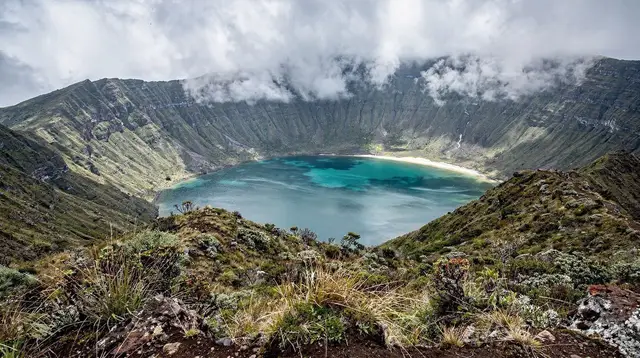
Sete Cidades is the sight most visitors picture when they think of São Miguel, and it is also the one place on this itinerary where a guided tour is clearly the practical choice over the bus. The village sits inside a volcanic caldera, and the classic view — the twin lakes Lagoa Azul and Lagoa Verde side by side from Vista do Rei — only makes sense once you understand it is one lake system, not two separate colours of water; the difference is light and depth, explained further in the Sete Cidades caldera guide.
Book the half-day minibus tour to Sete Cidades and its viewpoints, which typically loops through Vista do Rei, the Boca do Inferno viewpoint above Lagoa do Canário, and down into the caldera village itself, with stops timed around the group rather than a bus schedule. It removes the need to coordinate a same-day return, which on the public network is not guaranteed for this route.
Because Sete Cidades sits in a working caldera village, expect small cafés, a church on the lakeshore, and hydrangea hedges lining the road if you’re travelling between June and September — see the hydrangeas and Sete Cidades viewpoints photo guide for when the flowers actually peak. Tours here fill up in high season, so book at least a few days ahead in July and August; outside those months a day or two’s notice is usually enough.
Day 3: Furnas, Vila Franca do Campo and Terra Nostra
The third day is the longest and covers the most ground, which is exactly why it should be a guided excursion rather than a bus itinerary stitched together on the fly. Furnas sits in its own active caldera on the east side of the island, and its signature dish, cozido das Furnas, is cooked in pots lowered into holes in the naturally hot ground by the Lagoa das Furnas — five to seven hours on volcanic heat, no fire involved, and pulled out at midday by the restaurant that booked the hole, not by visitors. The full mechanics are in cozido das Furnas explained.
The Furnas half-day tour typically covers the steaming caldeiras by the lake, a walk through the village, and time at the Terra Nostra botanical garden, where the thermal pool runs a striking iron-orange colour at around 35-40°C — worth knowing in advance, because it will permanently stain a light-coloured swimsuit. For travellers who want the walking element built in rather than optional, the private Furnas tour combining the lake hike with Terra Nostra Park is a slower-paced alternative worth comparing before you book.
Tours running the full valley circuit often route back to Ponta Delgada via Vila Franca do Campo, the island’s original capital until a 1522 landslide buried the town and shifted power west; the Furnas Valley day trip is one version of this combined route.
From the harbour here, in calm season, boats run out to the Ilhéu de Vila Franca, a flooded crater islet — a detail worth knowing even if the sea is too rough on your particular day, since access always depends on conditions rather than a schedule. Read more in the Vila Franca do Campo former capital guide and the Terra Nostra thermal pool guide before you go, so you know what’s included in the tour and what costs extra.
Day 4: A Free Day — Caloura by Local Bus or a Slow Morning in Town
With the two demanding excursions done, the fourth day is deliberately lighter, and it’s the one place in this itinerary where the public bus genuinely works. Auto Viação Micaelense runs services from Ponta Delgada along the south coast toward Lagoa and on to Caloura, a small fishing harbour with a natural swimming area cut into the volcanic rock — a modest, low-key contrast to the tour-bus pace of the previous two days.
This is exactly the trip where the school-and-commuter nature of the timetable matters most: there may be a reasonable outbound service mid-morning and then a long gap before anything comes back. Check the current Auto Viação Micaelense timetable the evening before at your accommodation or at the Ponta Delgada bus terminal, and don’t board without knowing the return time — this is the one mistake that turns a relaxed day into a stranded afternoon. If the timetable doesn’t line up, the fallback is simple and just as valid: stay in Ponta Delgada, revisit the market or waterfront at a slower pace, and treat Day 4 as recovery rather than another checklist.
Either version closes the loop on why this itinerary is built the way it is: no ferry connects São Miguel to the mainland, no train crosses the island, and the choice on the ground is really between renting and combining tours with buses — not between renting and “getting by.”
Table: How the Four Days Break Down
| Day | Focus | Transport | Booking needed |
|---|---|---|---|
| 1 | Ponta Delgada old town, market, waterfront, lava tube | On foot | None, or historic tram tour |
| 2 | Sete Cidades caldera and viewpoints | Guided minibus tour | Yes, ahead in July-August |
| 3 | Furnas, cozido, Terra Nostra, Vila Franca do Campo | Guided minibus tour | Yes, ahead in high season |
| 4 | Caloura or a slow morning in Ponta Delgada | Local bus (Auto Viação Micaelense) or on foot | Check timetable the day before |
What This Itinerary Deliberately Skips
Nordeste and Lagoa do Fogo are the two obvious absences, and both are left out for the same reason: they punish rigid planning. Lagoa do Fogo has no café, no ticket office and no facilities of any kind, and the crater is frequently sealed in cloud with no way to know in advance — a car lets you turn back or return another day, a bus or fixed tour slot does not. Nordeste’s coastal viewpoints and the Ribeira dos Caldeirões waterfall park are spread along a long, winding circuit that a rental car covers comfortably in a morning but that has no equivalent bus route built for visitors. Both are realistic additions on a return trip with a car, or as a guided full-island tour rather than public transport.
Frequently Asked Questions About Visiting São Miguel Without a Car
Is it actually possible to see São Miguel properly without renting a car?
Yes, for the island’s core sights. Guided minibus tours reach Sete Cidades and Furnas comfortably, and Ponta Delgada itself is fully walkable. The trade-off is flexibility: Nordeste and Lagoa do Fogo are harder to reach well without a car.
Do local buses reach Sete Cidades and Furnas?
Auto Viação Micaelense does run routes toward both areas, but on school and work timetables rather than tourist ones, and same-day return trips are not always convenient. A guided tour removes that uncertainty for these two destinations.
How far ahead should the guided tours be booked?
In July and August, book the Sete Cidades and Furnas tours several days ahead, since minibus capacity is limited and popular departure times sell out. Outside peak summer, a day or two’s notice is usually enough.
Why doesn’t this itinerary include Nordeste or Lagoa do Fogo?
Both require the flexibility a rental car gives against fog, closed passes and long, winding roads. Neither has a public bus route designed for sightseeing, and no standard minibus tour reliably covers them alongside Sete Cidades or Furnas.
What does Auto Viação Micaelense actually operate?
It is the main public bus operator connecting Ponta Delgada to towns and villages across São Miguel, including routes toward the south coast, Ribeira Grande and beyond, on schedules built around school and commuter demand.
Can this four-day plan work in the low season, from November to March?
Yes. Thermal pools, the Terra Nostra garden and the Furnas and Sete Cidades tours generally keep running through winter, though boat trips to the Ilhéu de Vila Franca are cancelled far more often, and days are shorter and wetter.
Is Ponta Delgada worth a full day on its own?
Yes. The old town, market, waterfront and lava tube fill a full day of walking comfortably, and starting the trip here avoids needing any transport at all on Day 1.
What’s the biggest mistake to avoid with this itinerary?
Assuming a bus back exists just because a bus out did. Always check the return timetable for Auto Viação Micaelense before setting out on Day 4, and book the Sete Cidades and Furnas tours ahead in high season rather than on arrival.
tours.4 days
Verified deep-linked GetYourGuide tours. Book through these links and we earn a small commission at no cost to you.
GetYourGuide does not provide a product photo for this activity — the image shows the meeting point, photographed by us.