Whale Watching Boat Trip in São Miguel: What to Expect
What actually happens on a São Miguel whale watching boat trip?
A small boat leaves from Ponta Delgada or another south-coast harbour and is guided to cetaceans by radio contact with a vigia, a shore-based spotter descended from the island's whaling lookouts. Trips run two to three hours and go ahead whenever the sea allows, in any month of the year.
A trip built around a shore-based lookout, not a fixed route
A São Miguel whale watching boat does not simply motor out and hope. It leaves harbour already in radio contact with a vigia — a spotter stationed on high ground along the coast, scanning the water with binoculars and, at some posts, an old-fashioned telescope. The word and the job both come from the island’s whaling past: before whaling ended in the Azores in the 1980s, vigias stood at the same lookout points calling bearings to open whaling boats.
Today the same skill points tourist boats toward cetaceans instead of harpoons. A short guide to that history lives in the vigia system explained and in how whaling heritage shaped today’s watching; a wider look at the end of Azorean whaling covers the shift itself.
In practice this means the boat’s course on any given day is decided from shore, updated as animals move, rather than fixed in advance. You will not know exactly where you are headed when you board — only that someone on land is already watching the water for you.
Where the boats leave from
Most departures are from Ponta Delgada, whose marina at Portas do Mar is the main hub for whale watching operators on the island, alongside sailing and other boat tours from the capital.
A smaller number of operators run from the south coast, out of Vila Franca do Campo or the fishing harbour at Caloura, which puts you closer to the water off the south shore from the first minutes at sea. Either way, check-in is usually at a kiosk or office near the departure point, not at the boat itself, and it is worth arriving with time to spare — a delayed check-in can mean missing the slot a vigia has already lined up.
a three-hour whale and dolphin watching trip from Ponta Delgada is the most common format and a reasonable first booking if you are unsure which style of trip to pick.
The stretch of coast around Capelas, west of Ponta Delgada, is where some of the busiest vigia posts once stood, back when the job was calling bearings for open whaling boats rather than tourist ones. That history is laid out in more detail in Capelas’ old whaling station, and the village itself is covered as a stop on the north coast in the Capelas guide. None of this changes where you will actually board today — Ponta Delgada, Vila Franca do Campo or Caloura remain the departure points — but it explains why the vigia system exists at all.
Boarding and the safety briefing
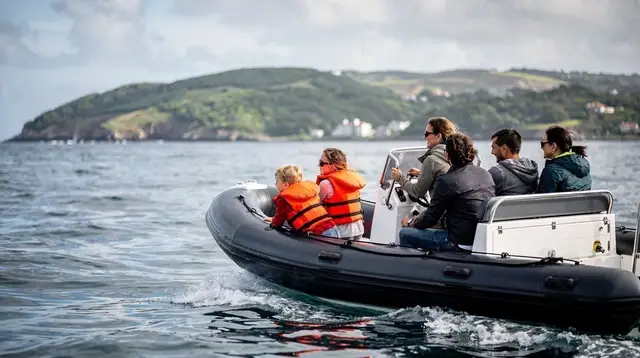
Every operator runs a short safety briefing before leaving the harbour: life jackets, where to sit, how to move around a boat that will be rolling once outside the shelter of the bay, and what to do if you feel unwell. On a rigid inflatable this briefing matters more than it might seem — the ride out can be brisk, and holding on properly during a fast stretch is the difference between an exciting ride and a bruised shin. On a larger catamaran or motor launch the briefing is calmer and the ride out gentler, with covered seating and more room to move.
Guides, often trained biologists, usually give a short introduction to what you might see that day based on recent reports from the vigia network and other boats already out — not a promise, but context for what species have been active.
What happens once you’re at sea
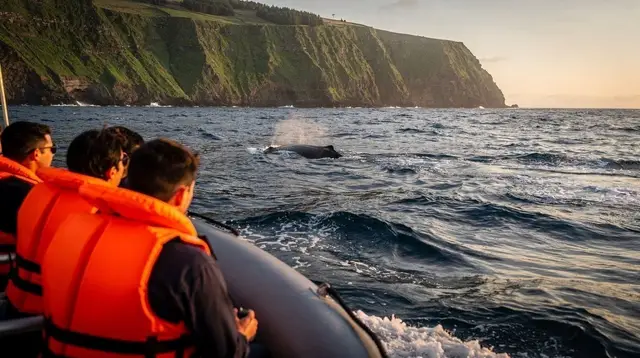
The boat heads toward the vigia’s last reported position, adjusting course as fresh bearings come in by radio. Once cetaceans are spotted, most skippers cut speed early and approach slowly and at an angle, keeping a respectful distance rather than driving straight at the animals — both for the animals’ sake and because a calm approach tends to keep them around longer. Time actually spent watching, once something is found, is usually a fraction of the full trip: expect the boat to circle or hold position for anywhere from a few minutes to half an hour or more with a cooperative pod, then move on to search again or head back if time is running short.
Guides typically narrate what you are seeing — behaviour, rough age or sex where it’s visible, sometimes an individual the crew recognises from a dorsal fin or fluke pattern — which is where a marine-biologist-led trip earns its reputation. a whale watching and islet boat tour with a marine biologist on board adds that layer of explanation to the same basic format, and often combines the search with a pass along the coastline near an offshore islet.
What you might see, and what you should not expect
São Miguel’s waters host different cetaceans on different rhythms. Sperm whales, common dolphins, bottlenose dolphins and Risso’s dolphins are present year-round, which is why boats run out of Ponta Delgada in every month, not just a peak season — see which species are resident all year.
Larger baleen whales — blue, fin and sei whales — pass on a spring migration and are seen on a different, narrower window, covered separately in the spring migration of blue, fin and sei whales. This page is about the mechanics of the trip itself, not about timing one for a particular species; for that, see when to go whale watching on São Miguel.
Whatever the season, no operator worth booking will promise a sighting, and neither will this page. The vigia system makes finding something likely on most trips, but it is still open-ocean wildlife watching: the animals are wild, moving, and under no obligation to appear. A crew that talks in certainties rather than likelihoods is worth being a little wary of.
Sea conditions decide, not the calendar
This is the point most first-time visitors get backwards: a São Miguel whale watching trip can run in January and be cancelled in July. The island has no closed season and no real tourist off-season for this activity — boats go out year-round. What stops a trip is the state of the Atlantic on that particular day: swell height, wind, and visibility for the vigias on shore. A choppy, low-visibility morning can ground boats in high summer, while a calm, clear day in November can go ahead without issue.
If a trip is cancelled or postponed, it is almost always for this reason rather than the month on the calendar. The detail of how operators handle cancellations and rebooking is covered on its own in what to expect from weather cancellations; this page only needs you to know that the sea, not the season, makes that call.
Choosing between boat types
Operators run several styles of boat, and the choice changes the character of the trip more than the odds of a sighting.
| Boat type | Typical duration | Feel on the water | Best suited to |
|---|---|---|---|
| Rigid inflatable (semi-rigid) | 2-3 hours | Fast, low to the water, can feel bumpy in swell | Getting close quickly, a livelier ride |
| Catamaran or motor launch | 2.5-3.5 hours | Stable, covered seating, gentler | Families, less confident sailors, longer trips |
| Sailboat or private charter | Half day or more | Slow-paced, flexible route | Small groups, a relaxed pace, extras like snorkelling or a sunset finish |
A calmer, larger boat also tends to suit children better than a fast rigid inflatable — more on that in whale watching with children. For a broader, slower day on the water that isn’t built purely around the search, a private sailboat cruise with drinks and snacks from Ponta Delgada is a different kind of outing worth knowing about, and a standard cetacean watching trip covers the middle ground between the two extremes.
For a smaller group and a schedule built around you rather than a fixed departure time, a private whale watching and island tour is worth comparing against the standard shared-boat trips above. The format and pricing differ from a scheduled group outing, but the same vigia network and the same sea-conditions rule still apply — a private booking does not buy you a guarantee any more than a shared one does.
What to bring and how to prepare
Pack for the boat, not for the harbour. A windproof layer is worth having even on a hot day in Ponta Delgada, since the wind picks up quickly once you clear the marina, and spray off the bow can cool things further on a rigid inflatable. Sunscreen, a hat with a strap or clip, and sunglasses cut the glare that builds up over open water. Binoculars help but are usually not essential, since boats close the distance for you; a camera with some zoom is more useful than a phone alone if photography matters to you.
Anyone prone to seasickness should take precautions before boarding rather than after leaving harbour — medication timed for departure, or a seat toward the centre of a larger boat where the motion is gentler. There are no dangerous animals to worry about on the water here; the practical hazards on São Miguel are the sea itself, fog and sun, the same ones covered for the island generally in is São Miguel safe: wildlife and hazards.
Booking ahead, and what else to pack for the day
Whale watching is popular enough, especially in the busier months, that turning up on the day and hoping for a free seat is a real risk rather than a formality. What to book in advance on São Miguel covers whale watching alongside a handful of other activities worth reserving ahead of arrival, and the general packing list for the island is a useful check against the boat-specific list above if you are still filling out a suitcase.
Weather cancellations are not unique to whale watching — most boat-based activity on São Miguel runs on the same logic, covered generally in how sea conditions affect São Miguel boat tours. If you are coordinating a whale watching trip around other time on the water, it helps to know that a cancelled morning at sea usually means a cancelled morning across the board, not just for one operator.
Combining a boat trip with the rest of the coast
Because whale watching departs from the same harbours used for other boat activity, it pairs naturally with a wider day on the water. a mixed boat-based activity outing is one way to combine watching with other time on the water in a single booking. If your interest runs wider than one trip, a dedicated whales-and-sea itinerary sketches a few days built around the coast rather than the interior, and the general category page for whale watching on São Miguel lists the fuller range of operators and formats.
The same harbours also serve fishing charters, a different way to spend time on the same water; what to know before booking a fishing charter is a useful comparison if you are weighing the two against each other for a single day at sea. And if whale watching is one piece of a longer visit rather than the main event, how many days you need on São Miguel and a first-time guide to the island both help place a half-day on the water within a fuller plan.
Arriving by cruise ship
Whale watching is a common shore excursion for the cruise ships that call at Ponta Delgada, since the harbour used by tour boats sits close to where cruise passengers disembark. Ponta Delgada as a cruise shore excursion covers the logistics of fitting a few hours ashore into a call, and the cruise-ship-stopover itinerary sketches how a whale watching trip fits alongside other short visits when your time on the island is fixed by the ship’s schedule rather than your own plans. The same sea-conditions rule applies regardless of how you arrived: a rough morning can cancel a trip booked from a cruise berth just as easily as one booked from a hotel.
Frequently asked questions on São Miguel whale watching boat trips
How does the boat know where the whales are?
Through the vigia network: spotters stationed on high ground along the coast scan the water with binoculars and telescopes and radio a bearing and distance to the boats below. It is the same principle the island’s whalers used last century, repurposed for watching rather than hunting.
Is a sighting guaranteed?
No operator can guarantee one, and any that implies otherwise is overselling. The vigia system makes a sighting likely on most outings, but these are wild, moving animals in open ocean, not a scheduled show.
Why would a trip be cancelled?
For sea conditions, not the calendar. Swell, wind and poor visibility can make a small boat unsafe or simply useless for spotting, and skippers will postpone or cancel rather than take a rough, fruitless trip out. São Miguel has no closed whale watching season, so a cancellation is about that day’s sea, not the time of year.
How long does a typical trip last, and where does it leave from?
Most boat trips run two to three hours door to door, with roughly half of that actually spent searching and watching once a sighting is confirmed. Ponta Delgada’s marina is the main departure point; some operators also run from Vila Franca do Campo or Caloura on the south coast.
What kind of boat will I be on?
Options range from small rigid inflatables that move quickly and get relatively close, to larger catamarans or motor launches with covered seating, to sailboats and private charters that run at a gentler pace. Each style trades speed and closeness for stability and comfort differently.
Do I need any experience or fitness to go?
No. You sit or stand on a moving boat and watch the water; no swimming or special skill is involved. Anyone prone to seasickness should take precautions in advance, since the Atlantic swell is felt more on a small boat than a large one.
What should I bring?
A warm, windproof layer even in summer, sunscreen and a hat, sunglasses to cut the glare off the water, and something to hold binoculars or a camera steady. Waterproof shoes are useful for boarding a rigid inflatable from a jetty or tender.
Can children come on a whale watching trip?
Yes, most operators welcome children, though minimum ages and life-jacket sizes vary by boat and are worth checking when booking. A calmer, larger boat tends to suit younger children better than a fast rigid inflatable.
Whale Watching on GetYourGuide
Verified deep-linked GetYourGuide tours. Book through these links and we earn a small commission at no cost to you.
GetYourGuide does not provide a product photo for this activity — the image shows the meeting point, photographed by us.