Private Whale Watching and Island Tour on São Miguel
What is a private whale watching and island tour on São Miguel?
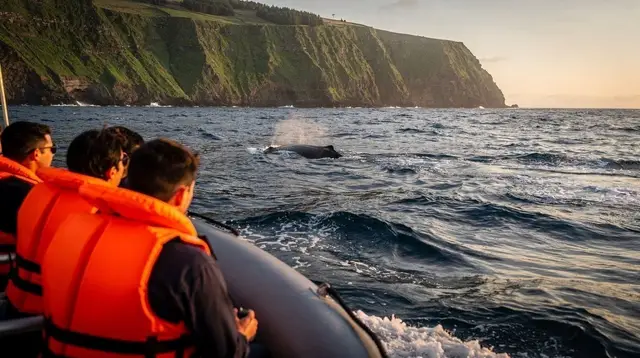
It pairs a private boat trip, guided to whales and dolphins by shore-based spotters called vigias, with a private car or jeep tour of the island on the same day. Sperm whales and dolphins are seen year-round, while blue, fin and sei whales pass mostly between March and June, and no operator can guarantee a sighting on any given outing.
Two Trips in One Day
A private whale watching and island tour is really two separate experiences booked as one: a few hours on the water looking for cetaceans, and the rest of the day on land seeing whatever part of São Miguel you choose. Shared boat trips and shared bus tours do this too, but on their own schedules and with other passengers. Going private mostly buys flexibility — your own pickup time, your own pace on land, and a guide who can adjust the land route around how the sea behaves that morning — not a different set of animals or a better chance of seeing them.
It is worth being clear about what this page covers and what it does not. If you want a land-only day around the island’s highlights, with no boat segment at all, that is a different product covered in the private full-day island tour guide. This page is specifically about tours that combine the two.
How a Private Whale Watching Tour Actually Works
Every whale watching operation on São Miguel, private or shared, leans on the same piece of infrastructure: the vigia network. A vigia is a spotter posted on elevated coastal ground, watching the water through binoculars or a telescope for a blow, a fin, or a splash. When the Azores’ whaling industry ended in the 1980s, the same skill set — reading the sea from land, knowing where animals surface and when — was repurposed for tourism instead of hunting. Today the vigias radio boat skippers with a bearing and a distance, which is how boats can head fairly directly toward an animal instead of searching at random.
This matters for private tours specifically because people sometimes assume that paying for a private charter means a dedicated search, a bigger boat, or some edge that shared trips do not have. In practice a private boat uses the same vigia information as everyone else on the water that day. What changes is the group size, the flexibility of timing, and often the ability to add a marine biologist guide or a slower, more attentive pace once an animal is found — see the vigias and whale spotting history for more on how the system developed around Capelas and the north coast.
What You Might See, and When
São Miguel’s waters host both resident species that stay close to the island year-round and migratory species that pass through on a seasonal route. Sperm whales are the most consistently sighted of the larger animals, along with several dolphin species — common, bottlenose, striped and Risso’s dolphins all turn up regularly. The resident sperm whales and dolphins guide covers this pattern in more detail.
Blue whales, fin whales and sei whales are a different story. These are migratory baleen whales passing the Azores on their way to summer feeding grounds further north, and the best window to catch them is roughly March to June — see the blue, fin and sei whale migration guide. Outside that window they are occasionally reported but far less reliably.
| Species | Pattern | Best months |
|---|---|---|
| Sperm whale | Resident | Year-round |
| Common, bottlenose, striped, Risso’s dolphins | Resident | Year-round |
| Blue whale | Migratory | March–June |
| Fin whale | Migratory | March–June |
| Sei whale | Migratory | March–June |
None of this is a promise. Sightings are frequent enough that most operators run trips with confidence through the season, but an individual outing on an individual day can come back having seen dolphins and nothing else, or vice versa. The whale watching best time to go guide sets out how to think about the odds by month rather than by guarantee.
The Island Half of the Day
What the land portion of a combined tour looks like depends heavily on where the boat departs from, since most operators build the driving day around that harbour rather than sending you across the island and back. Boats leaving from the south coast, near Vila Franca do Campo or Caloura, pair naturally with a look at the Ilhéu de Vila Franca, the sunken crater islet just offshore, and a drive along the coast toward Lagoa. Boats leaving from Ponta Delgada more often build the land segment around Sete Cidades to the west or Furnas to the east, since both are within a reasonable driving loop from the capital.
A private guide can genuinely rearrange this in a way a shared coach tour cannot — if the boat trip runs long, or comes back early because conditions were good, the land stops shift with it. That flexibility is the actual selling point of a private combination, more than any difference in the boat trip itself.
On the west side, a similar logic applies around Mosteiros and Ponta da Ferraria, where the coastline flattens out enough for a hot spring to meet the sea. Boats operating from this side of the island sometimes tie a whale watching leg to a look at the black-sand beach and sea stacks at Mosteiros, or a stop at the hot spring itself, though a private guide will confirm on the day whether that specific pairing is running, since not every operator based near Ponta Delgada covers this stretch of coast.
Choosing Between the Boat-and-Car Combos
A handful of private itineraries combine sea and land in slightly different proportions, and it is worth knowing which kind you are booking before you commit a full day to it.
a full-day private tour of São Miguel that you can shape around your own priorities is the most flexible option, letting a private guide fold in a boat segment alongside stops you choose yourself. For a tour built specifically around combining the water and the road, a private island highlights tour that moves between boat and car through the day is designed exactly for that pairing rather than treating the boat as an add-on.
If your priority is the western side of the island around Sete Cidades and Ponta da Ferraria with hotel pickup included, a private tour of the west of the island with hotel pickup covers that ground, though it is worth confirming with the operator whether a boat segment is included on a given date.
For those whose main interest is the Vila Franca do Campo islet rather than open-water whale watching, a biologist-guided eco boat tour of the Vila Franca islet is a narrower but more focused option, and it can still be combined with a private land itinerary on the same day by arranging both separately. All four differ mainly in how much of the day is spent on the water versus in the car, and in whether the driver is also the guide for both halves.
What Changes With a Smaller Group
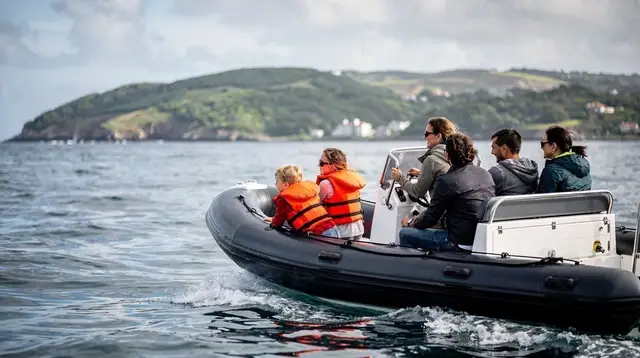
Beyond flexibility, a private booking usually means fewer people on the boat and more room for a guide to explain what is happening rather than managing a full deck of passengers. This matters most with children, who tend to do better with a guide who can slow down and answer questions than with a fixed commentary aimed at a larger group — see the whale watching with children guide for what to expect if you are travelling with kids.
It also matters when the operator is biologist-led rather than run by a general guide: a trip built around close study of the animals, such as the Vila Franca islet snorkeling and boat guide describes for that particular stretch of coast, tends to spend more time on why an animal is behaving a certain way than a standard commentary does. None of this changes what you will see out on the water; it changes how much you understand about it afterwards.
When the Sea Says No
Boat operators cancel or reroute trips more often than land tours do, and this is simply a feature of running small vessels in the North Atlantic rather than a sign of a badly run operation. From November through March especially, swell and wind cancel a meaningful share of scheduled departures — see whale watching and weather cancellations explained for how operators typically handle this.
A private booking usually gives you more room to shift the boat segment to another morning within your stay, or to swap it for extra time on land, than a fixed shared departure does. It does not, however, buy calmer water. If your travel window is short and the boat matters more than anything else on the trip, building in a spare day is the only real insurance.
The same caution applies to the Ilhéu de Vila Franca boat crossing, which runs in season only and stops outright in heavy sea, regardless of how the rest of your day is arranged.
Practical Planning
Full-day private combinations generally run seven to nine hours door to door, factoring in a two-to-three-hour boat segment and the rest on the road, though exact timing depends on which operator and which stops you choose. Most pick up directly from hotels in Ponta Delgada or nearby, which is worth confirming if you are staying further out toward Sete Cidades or on the east side of the island.
Book ahead where you can, particularly from June to September when boats and private guides fill up alongside everything else on the island’s busiest weeks. Bring layers regardless of season — sea spray and shade on a boat feel noticeably cooler than a sunny road stop an hour later — along with sunscreen, a hat, and closed shoes if any of the land stops involve uneven ground.
For general context on what a private day tour without the boat looks like, see the private full-day island tour guide, and for the general shore-side experience of a whale watching trip, from boarding to what guides typically explain on board, the whale watching boat trip guide is a useful companion read before you go.
Fitting This Into a Longer Stay
A combined boat-and-island day works best as one day inside a longer stay rather than the whole visit, since the island rewards more time than a single day allows. The whales and sea itinerary builds a multi-day trip around exactly this kind of pairing, while the Furnas day trip itinerary and the Sete Cidades day trip itinerary show what the other days of a trip might look like if the boat segment leaves you wanting more land time on either side of the island.
For a sense of how many days the island as a whole tends to need, the how many days do you need guide covers that question directly.
Private Whale Watching and Island Tours on São Miguel: FAQ
What is a vigia, and why does a private whale watching tour still need one?
A vigia is a lookout stationed on high ground along the coast, a role carried over from the shore-based whaling that ended in the Azores in the 1980s. Instead of hunting, vigias now radio boat skippers the moment they spot a blow or a pod, which is why even a private charter with one boat and one guide still depends on someone on land.
Can a private tour guarantee a whale sighting?
No reputable operator will promise one, private boat or not. Sightings are usual through most of the year but depend on the animals, the sea state and visibility, and any page or guide claiming a guarantee should be treated with suspicion.
What is the difference between resident and migratory species around São Miguel?
Sperm whales and several dolphin species live in Azorean waters year-round and are seen in most months. Blue whales, fin whales and sei whales are migratory, passing offshore mostly between March and June on their way to summer feeding grounds, so a spring booking raises the odds of seeing one of the larger baleen whales.
How long does a combined boat-and-island private tour take?
Most private combinations run a full day, typically seven to nine hours including a two-to-three-hour boat outing and the rest spent on guided stops around the island. Half-day versions exist but usually cover either the sea or the land, not both in depth.
What happens if the sea is too rough to sail?
Skippers cancel or postpone the boat segment when swell or wind make it unsafe, which happens more often from November to March. A private booking gives more flexibility to reschedule than a fixed shared departure, but it does not change the weather.
Is a private tour better than a shared whale watching trip?
A private tour trades a lower per-person cost for control: your own pace, pickup point, and the ability to fold in island stops that matter to you, such as Furnas or a specific viewpoint. A shared boat trip is cheaper and still uses the same vigia network, so the wildlife side of the experience is not fundamentally different.
Which island stops pair best with the boat trip?
Vila Franca do Campo sits directly on the south coast where several boat departures start, so a whale watching leg from there fits naturally with a look at the islet, the harbour at Caloura, and the drive back through Lagoa. Full-day itineraries also commonly add Sete Cidades or Furnas depending on which coast the boat leaves from.
What should I pack for a private whale watching and island tour?
A waterproof layer, sunscreen and a hat regardless of season, since the Atlantic spray and the sun can both catch you off guard, plus a change of clothes if the boat and the land stops are on the same day. Non-slip shoes help on a rocking boat, and binoculars are useful but not essential since guides carry their own.
Whale Watching on GetYourGuide
Verified deep-linked GetYourGuide tours. Book through these links and we earn a small commission at no cost to you.
GetYourGuide does not provide a product photo for this activity — the image shows the meeting point, photographed by us.