Blue, Fin and Sei Whales: São Miguel's Spring Migration
Which whales migrate past São Miguel in spring, and why only then?
Blue, fin and sei whales pass São Miguel offshore on their spring migration, roughly March to June, moving between feeding and breeding grounds. Outside that window they are elsewhere in the Atlantic; only sperm whales and dolphins stay resident in the island's waters year-round.
Three whales that only pass through once a year
São Miguel’s waters carry two very different kinds of whale story. One is year-round: sperm whales and several dolphin species live in the deep water off the island’s south coast in every month of the calendar, a pattern covered in full in sperm whales and dolphins, resident all year. The other is seasonal, and it is the subject of this page — blue whales, fin whales and sei whales, three of the largest animals on the planet, passing São Miguel on their spring migration and nowhere near the island for the rest of the year.
The distinction matters because it changes what a visitor can honestly expect. A resident species can, in principle, turn up in any month. A migrant cannot. If you are planning a trip around the chance of a blue whale, the calendar is not a detail — it is the whole plan.
Why the Azores sit on a migration route at all
The nine islands of the Azores rise from the middle of the North Atlantic, roughly 1,400 km from mainland Portugal, on a stretch of open ocean that several great whale populations cross twice a year: once heading toward summer feeding grounds in the north, once returning toward winter breeding grounds further south. São Miguel does not sit inside a feeding ground the way, say, a Norwegian fjord does. It sits on the route between two of them, in deep water close to a mid-Atlantic ridge where nutrients rise and food concentrates just long enough to matter.
That is why the encounter here has a particular character. Migrating whales off São Miguel are usually passing, not lingering — feeding briefly, resting, moving on within days. The island is a waypoint, not a destination for the whales themselves, which is also why the window in which they can reasonably be found is short and specific rather than open-ended.
The spring window: roughly March to June
Blue, fin and sei whales pass São Miguel on their northbound spring migration, broadly across March to June, with sightings typically most frequent through April and May. The exact start and end shift a little year to year with sea temperature and food further out in the Atlantic — nobody publishes a fixed opening and closing date, because the whales themselves do not observe one. What can be said with confidence is the shape of the season: numbers build through March, peak in the spring months, and taper off by early summer as the animals continue north.
Outside that window, these three species are not a realistic expectation off São Miguel. This is the one fact worth holding onto above all others on this page: a blue, fin or sei whale sighting promised for August or December is not a spring migration sighting — it would be an exceptional, unpredictable stray, not something any tour is built around. For a full month-by-month picture of the island’s whale-watching calendar, including how the spring migrants fit alongside the resident species, see the best time to go whale watching on São Miguel.
Blue whales, fin whales and sei whales: telling them apart
All three are baleen whales — filter feeders, built for distance rather than the deep, long dives of the resident sperm whale — but they are not interchangeable, and a guide on a spring boat will usually be working hard to tell you which is which from a blow and a sliver of back.
| Species | Typical length | Blow | How it’s usually spotted |
|---|---|---|---|
| Blue whale | Up to 25-30 m, the largest animal alive | Tall, single column, often visible before anything else | A vigia sighting relayed by radio, then a long, low back surfacing well offshore |
| Fin whale | Around 20-25 m, second-largest baleen whale | Tall but slightly less powerful than a blue’s | Fast, straight-line surfacing — sometimes called the greyhound of the sea |
| Sei whale | Around 12-16 m, smaller and slimmer | Lower, easy to miss in any swell | Surfaces briefly and smoothly, often the hardest of the three to confirm |
None of these three is seen close to shore in the way a coastal dolphin pod can be. Sightings happen well out in open water, which is why every operator running spring trips depends on the vigia network rather than simply pointing a boat out to sea. The lookouts who scan the horizon from high ground and call in a position are a direct continuation of the shore-whaling tradition — the same skill, redirected from hunting to watching after Azorean whaling ended in the 1980s, a history told in full in the vigias, the Azores’ whale spotters and in how whaling ended in the Azores.
Where the vigia tradition still works from
Capelas, on São Miguel’s north coast, was one of the island’s working whaling stations and remains one of the places where the vigia lookout tradition is most visible today, alongside the old station buildings themselves — see Capelas’ old whaling station and the wider Capelas destination guide. The south coast, sheltered and facing the deep water where migrating whales pass, is the departure point for most spring tours; Vila Franca do Campo and Ponta Delgada’s marina at Portas do Mar are the two main harbours boats leave from — see Vila Franca do Campo for the town itself.
The full mechanics of how a spotter’s call turns into a boat heading to the right stretch of ocean, and what a typical outing actually involves once you’re aboard, are covered in what to expect on a whale-watching boat trip — worth reading before you book, since it sets expectations that apply to spring trips as much as any other.
Booking a spring whale-watching tour
Spring is the strongest season of the year for whale watching off São Miguel precisely because it is the only season these three migrants are in range, which is also why April and May trips tend to book up faster than midsummer ones. A standard outing runs a few hours from Ponta Delgada or Vila Franca do Campo, working with a vigia’s call rather than searching blind, and most operators combine the watch with some explanation of both the migration and the island’s whaling past.
a full-day whale watching and island tour from Ponta Delgada, with lunch included pairs a spring watch with a look at the island’s volcanic landscape, useful if you want the day to earn its keep beyond the water. For a trip focused purely on the animals, a dedicated cetacean-watching boat trip keeps the itinerary simple.
Families sometimes prefer to depart from the south coast harbour at Vila Franca do Campo, where a whale and dolphin watching trip from Vila Franca islet combines the open-water search with the sheltered water around the islet on the way back in — see also whale watching with children for what makes a trip work well for younger passengers.
Anyone who wants the history alongside the animals — how a hunting tradition became a watching one, and what the old stations along the coast were actually for — is better served by treating it as a separate half-day: Azores whaling heritage tour style outings and land-based visits sit alongside the boat trips rather than replacing them, and whaling heritage and the vigias explained lays out how the two threads connect.
What a spring sighting actually looks like
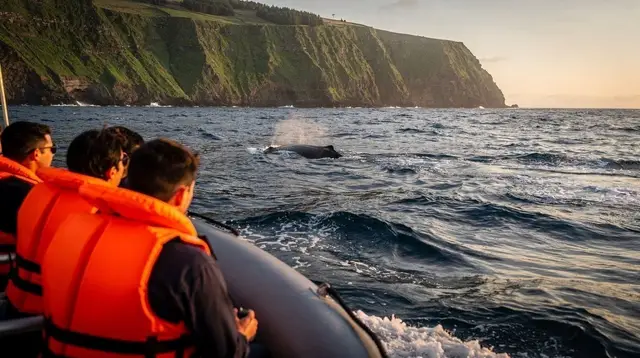
It is worth being precise about what “seeing a blue whale” usually means in practice, because it rarely resembles a wildlife documentary. From several hundred metres, at the distance codes of conduct require, a blue or fin whale in open Atlantic water usually reads as: a tall column of spray on the horizon, a long stretch of dark back rolling at the surface for a few seconds, sometimes a fluke as the animal sounds for a deeper dive.
Sei whales, smaller and quicker to submerge, are often confirmed only by the guide’s experience rather than by anything a first-time visitor would have picked out unprompted. This is normal, not a disappointing version of the encounter — it is simply what watching a genuinely wild, migrating animal in open ocean looks like, as opposed to a captive or habituated one.
No operator worth booking will promise a sighting, on a spring trip or any other, and this page will not either. Spring gives the best odds of the year specifically because it is the only season these three species are present at all, but odds are not guarantees.
Some operators offer a repeat trip if nothing at all is seen on a given outing; ask before booking if that matters to you, and read why whale watching is never guaranteed for the fuller reasoning behind that policy across the industry. Sea conditions can also cancel a trip outright regardless of season — that side of things, separate from the migration question, is covered in whale-watching weather and cancellations explained.
What this page is not about
Two things sit close to this topic and are worth separating out clearly. First, the resident species: sperm whales and several dolphin populations live around São Miguel every month of the year, an entirely different pattern from the seasonal migrants described here — see sperm whales and dolphins, resident all year for that story.
Second, weather-driven cancellations are a real and separate risk to any Azorean boat trip, spring or otherwise, and are dealt with on their own terms in whale-watching weather and cancellations explained rather than here. This page deals only with the question of which whales pass São Miguel in spring, and why the window is what it is.
For a wider view of how a spring whale-watching day fits into a longer São Miguel trip, the Whales and Sea itinerary sketches a route that pairs boat time with the coastal towns the tours depart from, and the whale-watching category page and things to do on São Miguel list the fuller range of operators and activity types across the island.
Blue, fin and sei whale season: questions answered
When exactly is the spring migration season off São Miguel?
Roughly March to June, with the strongest run typically through April and May. Exact dates shift a little each year with sea conditions and food availability further out in the Atlantic, so treat it as a season rather than a fixed calendar window.
Can I see blue whales from land on São Miguel?
Occasionally, from a good clifftop lookout on a clear, calm day, but it takes patience and some luck. Most confirmed sightings come from boats that head out once a vigia has already spotted an animal from shore.
What is the difference between blue, fin and sei whales?
Blue whales are the largest animal on Earth, with a tall, powerful blow. Fin whales are slightly smaller and notably fast, sometimes called the greyhounds of the sea. Sei whales are smaller again and surface more briefly, making them the easiest of the three to miss. All three are baleen whales, distinct from the resident, deep-diving sperm whale.
Are blue, fin or sei whale sightings guaranteed on a spring tour?
No. These are wild animals migrating through open ocean, not a resident or habituated population. Spring is the best season of the year for a sighting, but no operator can promise one on any single trip.
Can these whales be seen outside March to June?
Not reliably. Once the spring migration passes, blue, fin and sei whales move on to other feeding grounds and are not a realistic expectation off São Miguel for the rest of the year. Outside spring, sightings shift toward the island’s year-round residents instead.
How do boats find whales migrating so far offshore?
Through vigias — land-based lookouts on high ground who spot blows and relay positions by radio, a method inherited directly from the whaling era. Boats then head to where an animal has actually been sighted rather than searching open water at random.
Is spring whale watching safe for the whales themselves?
Licensed Azorean operators follow approach-distance and time-limit rules designed to avoid disturbing migrating whales, and will break off an approach rather than crowd an animal. Booking with a reputable local operator matters here more than on most other boat trips.
What is the difference between spring migrants and the resident whales?
Blue, fin and sei whales are seasonal, present only during the spring migration described on this page. Sperm whales and several dolphin species are resident around São Miguel in every month of the year, which follows an entirely different pattern.
Seasonal Guide on GetYourGuide
Verified deep-linked GetYourGuide tours. Book through these links and we earn a small commission at no cost to you.
GetYourGuide does not provide a product photo for this activity — the image shows the meeting point, photographed by us.