Sperm Whales and Dolphins: São Miguel's Year-Round Residents
Can you see whales off São Miguel outside the spring season?
Yes. Sperm whales, common dolphins, bottlenose dolphins and Risso's dolphins live in the waters around São Miguel all year and are not migrating through like the blue, fin and sei whales of spring. Sightings still depend on the sea and are never guaranteed on any given trip.
The Locals of São Miguel’s Deep Water
Most people planning a trip around whale watching ask a single question: when is the season? For São Miguel, that question has two different answers, because the water off this island holds two different kinds of animal. One group is passing through on a long journey and is only here for a few weeks each spring. The other group lives here. It feeds here, it raises young here, and it does not leave when the calendar turns to July or December.
Sperm whales are the headline resident. So are several dolphin species, most often the common dolphin, along with bottlenose dolphins and Risso’s dolphins seen in smaller numbers. None of them migrate away from Azorean waters the way the blue, fin and sei whales do. That single fact reshapes how you should think about planning a trip: outside the spring migration, the absence of the big migratory whales does not mean an absence of whales. For the full month-by-month picture of who passes when, see the separate guide to São Miguel’s whale watching season. This page stays narrower: it is about the animals that never leave.
Sperm Whales: Deep-Water Neighbours, Not Seasonal Visitors
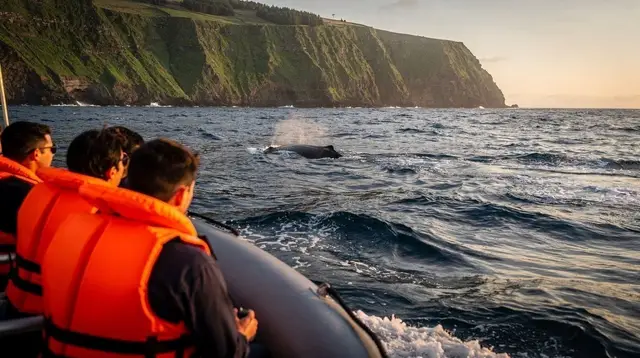
Sperm whales favour the steep drop-off in the ocean floor a short distance off São Miguel’s south coast, where the seabed falls away into deep water close to shore. This underwater geography, rare so close to land, is a large part of why the Azores became a base for sperm whale hunting in the first place, and why the animals are still reliably present today. They dive for squid at depth, often for forty minutes or more, then surface to breathe in a series of shallow breaths before diving again, giving boats and lookouts a genuine, if narrow, window to find them.
Because sperm whales hold this deep water territory year-round, sightings are recorded in every month, including the depths of winter. What changes across the year is not whether the whales are there, but whether the sea allows a boat out to look, and how comfortable that outing is. A flat, calm morning in November can produce a better sighting than a choppy day in August. The animal’s residency is stable; the weather is not, and it is worth reading how weather affects and sometimes cancels boat trips before locking in a date.
Sperm whales here are typically solitary males or small groups, since this is not one of their calving grounds. That means encounters tend to be with individual animals rather than large pods, often identifiable to researchers by the pattern of their tail flukes, which some have been tracking for years.
a speedboat trip out of Rabo de Peixe built specifically around finding sperm whales in their core territoryDolphins: The Animals You’re Most Likely to Actually See
If sperm whales are the resident everyone asks about by name, dolphins are the resident encountered most often in practice. Common dolphins are the species most frequently seen off São Miguel, often in pods of dozens to over a hundred animals, riding a boat’s bow wave or working together to herd fish near the surface. Bottlenose dolphins turn up in smaller, tighter groups, and Risso’s dolphins, distinctive for the pale scarring that covers older individuals, are seen less often but are present through the year rather than on a seasonal pass-through.
None of these dolphin populations migrate away from Azorean waters. They are working residents of the same stretch of ocean the sperm whales use, which is part of why a single outing can turn up both animals on the same morning even outside the spring migration window. For visitors keen to get in the water with them rather than only watch from a boat, dedicated trips exist for exactly that.
an open-ocean swim alongside wild dolphin pods, weather and encounters permittingFamilies weighing whether a boat trip suits younger children, given the open Atlantic swell involved, will find that covered separately in the guide to whale watching with children.
The Spring-Only Visitors, and Why They’re Different
The animals that actually follow a season are the large baleen whales: blue whales, fin whales and sei whales. These species are migrating between feeding grounds, and the Azores sit on their route north in spring, broadly across March to June, with the peak weeks varying year to year depending on ocean conditions further south. Outside that window, they are simply not in Azorean waters at all — not scarce, not hard to find, but genuinely elsewhere.
This is the single most common point of confusion for visitors booking a trip. A blue whale sighting from São Miguel is a spring event. A sperm whale or dolphin sighting is a year-round possibility. The two groups should never be conflated when reading a tour description or setting expectations for a trip booked in, say, October or January. The full detail on the migratory species and their narrow window is covered in the guide to the spring migration of blue, fin and sei whales; this page deliberately stays with the residents.
| Species | Status off São Miguel | Typical presence |
|---|---|---|
| Sperm whale | Resident | Year-round |
| Common dolphin | Resident | Year-round |
| Bottlenose dolphin | Resident | Year-round |
| Risso’s dolphin | Resident | Year-round, lower numbers |
| Blue whale | Migratory | Roughly March–June |
| Fin whale | Migratory | Roughly March–June |
| Sei whale | Migratory | Roughly March–June |
How the Vigias Still Help Find Them
Long before whale watching existed as a tourist activity, São Miguel’s coastline was watched for a different reason. Vigias, shore-based lookouts stationed at high points along the coast, once scanned the ocean for whales to alert the open boats of whaling crews. That industry, centred for decades on stations like the one still standing at Capelas, ended in the Azores only in the 1980s, later than in most of the world.
The lookout tradition did not disappear with the industry it served. Today, the same coastal vantage points and the same skill at reading a distant blow or a change in the water’s surface are used to help whale watching boats find sperm whales and dolphins efficiently, radioing coordinates out to skippers rather than to harpooners. It is one of the more direct lines in the Azores between a working past and a wildlife-watching present, and it is covered in more depth in the history of the vigias and their coastal lookout posts, as well as in the wider account of Azorean whaling heritage and the vigia system.
a tour that walks through that whaling history alongside a modern outing to seaBecause sperm whales are resident rather than migratory, a vigia’s local knowledge of where the animals tend to surface on a given day matters more here than for a purely seasonal species passing through once. It is one reason operators working with active lookout networks tend to have a real edge in finding sperm whales specifically, as opposed to simply going out and hoping.
What a Trip Looks Like, Any Month
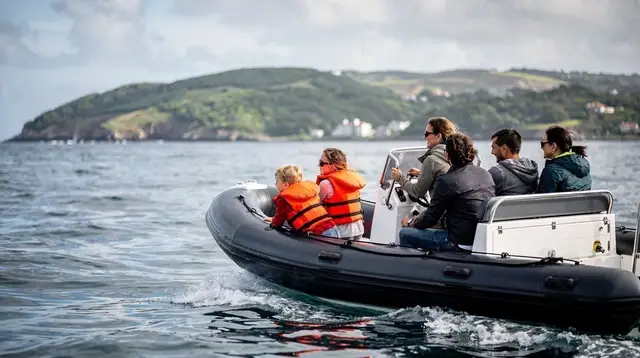
A typical outing leaves from Ponta Delgada’s marina at Portas do Mar, though smaller operators also run from harbours like Rabo de Peixe and from the south coast near Vila Franca do Campo, closer to some of the deep water sperm whales favour. Trips generally last two to four hours, moving out from the coast toward the areas a vigia or the skipper’s own experience suggests, then adjusting course as reports come in.
a shorter three-hour outing that fits more easily around a single day on the islandWhat differs by season is mostly comfort and reliability, not the presence of the animals. Summer seas tend to be calmer, which makes for an easier ride and slightly better viewing conditions, though it is also the busiest and most heavily booked period. Winter seas are rougher and cancellations for weather are more frequent, but a calm winter morning can be just as productive as a summer one, precisely because the sperm whales and dolphins never left. Longer combination trips also exist for visitors who want to pair a whale watching outing with a look at the island’s coastline and volcanic scenery in the same day.
For a step-by-step sense of how a booking, the boat itself, and the on-water routine actually unfold, the guide to what a whale watching boat trip involves covers the practical side in full, and pairs well with reading how conditions can force a trip to be rescheduled or cancelled before you commit to a date.
Trips from Vila Franca do Campo’s stretch of coast, closer to the Ilhéu de Vila Franca, sometimes combine dolphin and whale watching with a look at that crater islet.
a south-coast outing run from near the islet that pairs the coastline with a dolphin and whale search
Setting Expectations Honestly
Resident is not the same word as guaranteed. Sperm whales spend the majority of their time submerged and hunting far below the surface, and no boat, however well positioned by a vigia’s report, controls where an individual animal chooses to surface on a given morning. A responsible operator will describe sightings as likely or usual, never as certain, and any listing that promises a sighting outright is overstating what wild-animal watching can honestly offer.
That said, the odds genuinely favour visitors here. Because sperm whales and the resident dolphin species are present in every month rather than funnelled into a narrow migratory window, the practical chance of an encounter on a given trip stays fairly stable across the year, weather permitting, rather than collapsing to near zero outside a short spring season the way it does for blue, fin and sei whales. That stability, not a guarantee, is the real reason São Miguel’s whale watching operators can run trips twelve months a year rather than for a few spring weeks.
It is also worth remembering that this is wild-animal watching on the open Atlantic, not a controlled park experience. Sea conditions can end a trip early or reroute it, dolphins can move on faster than a boat can follow, and a sperm whale that dives can stay down far longer than any boat will wait. Visitors who come with that understanding tend to enjoy the trip regardless of what surfaces, and are pleasantly surprised more often than not. For a broader read on how the island’s wildlife and outdoor hazards actually work, beyond the water, see is São Miguel safe.
FAQ: Sperm Whales, Dolphins and São Miguel’s Waters
Are sperm whales really around São Miguel every month of the year?
Yes. Unlike the blue, fin and sei whales that pass on a spring migration, sperm whales hold territory in the deep water off the island’s south coast all year, including winter. Sea conditions, not the calendar, decide whether a boat goes out and whether it finds them.
What is the difference between a resident and a migratory whale here?
Resident species, chiefly sperm whales and several dolphin species, live and feed in Azorean waters permanently. Migratory species such as blue, fin and sei whales are only passing through on a longer journey, mostly between March and June, and are not present the rest of the year.
Which dolphins are resident off São Miguel?
Common dolphins, bottlenose dolphins and Risso’s dolphins are present year-round in varying numbers. Common dolphins are the most frequently encountered, often in large, active pods close to the coast.
What is a vigia and do they still work today?
A vigia is a shore-based lookout, a role that dates from the whaling era. Commercial whaling ended in the Azores in the 1980s, but the tradition of scanning the sea from high coastal points continues, now used to help guide whale watching boats toward sperm whales and dolphins rather than toward a hunt.
Is a sperm whale sighting guaranteed because they are resident?
No. Resident does not mean visible on demand. Sperm whales spend long periods diving at depth, and sea state, light and the day’s specific pod movements all affect what a boat actually finds. No operator can promise a sighting on any single outing.
Is winter a bad time to try, since it isn’t the main whale season?
Winter is not the season for the migratory giants, but it is not a dead season either, because the resident sperm whales and dolphins are still in local waters. Trips run less often due to weather and sea conditions, not because the animals have left.
Do sperm whales and the spring migratory whales ever overlap?
Yes, during the spring migration window, roughly March to June, it is possible to see both resident sperm whales or dolphins and passing blue, fin or sei whales on the same stretch of coast, though not necessarily on the same boat trip.
Where do sperm whale trips usually depart from on São Miguel?
Most operators leave from Ponta Delgada’s marina at Portas do Mar, with some smaller operators working out of Rabo de Peixe and other north and south coast harbours closer to the deep water sperm whales prefer.
Whale Watching on GetYourGuide
Verified deep-linked GetYourGuide tours. Book through these links and we earn a small commission at no cost to you.
GetYourGuide does not provide a product photo for this activity — the image shows the meeting point, photographed by us.