Whale Watching with Children on São Miguel
Is whale watching in São Miguel suitable for children?
Many families do it, and sperm whales and dolphins are resident off São Miguel all year, which widens the calendar considerably. But no operator can promise a sighting on any given day, and boats are a genuinely different experience for a five-year-old than for a teenager.
Taking kids out to sea off São Miguel
Parents planning a São Miguel trip with children on the itinerary tend to ask the same question about whale watching before they ask anything else: is this actually something to do with a family, or is it better left to the adults on a separate morning. There is no single answer that fits every child, but there are a few facts worth knowing before deciding either way, and this page sticks to those rather than inventing detail that nobody has actually confirmed.
The first fact that matters for planning is that sperm whales and dolphins live off São Miguel year-round, rather than passing through on a short migration window the way some larger species do. That single detail changes the shape of a family trip considerably, because it means a whale watching excursion is not something that only makes sense in one particular month. Families visiting in November are working with the same resident population as families visiting in July, even though the sea and the weather around them look very different at those two times of year.
That resident population sits alongside a separate, seasonal one. Larger baleen whales, including blue, fin and sei whales, pass on a spring migration, and the calendar question around them is covered on its own page rather than here, since it is a genuinely different planning question from what resident species mean for a family trip any time of year. Anyone weighing up exactly when to go, in detail, is better served by the dedicated best-time-to-go guide than by this one.
What a family should actually weigh up
None of the operators bookable through this site publish a minimum age or a fixed trip length that this page can respectfully repeat as fact, and guessing at either would do families a disservice rather than a service. What can be said honestly is that these are boat trips on the open Atlantic, out of a working harbour, watching for animals that owe nobody a sighting. That combination suits some children very well and asks more of others, and the difference tends to come down to things a general guide cannot know about a specific child: how they handle time on a moving boat, how they handle waiting for something that may or may not happen, and how they handle sun and spray for an unspecified stretch of a morning or afternoon.
The most useful step for a parent is a direct conversation with the operator at the time of booking. Whale watching companies on the island run these trips constantly and have a far better sense than any article of what a given boat, route and typical outing actually involves for a young child, an older one, or a teenager who would rather be doing something else entirely. Asking directly also means getting an answer specific to the actual boat a family would be on, rather than a generic answer written for every reader at once.
a whale watching trip with a marine biologist aboard is one of the options bookable through this site, and having a biologist along tends to turn the waiting time between sightings into something more engaging for curious children, since there is usually someone on hand fielding questions about what the boat is looking for and why.
Setting expectations honestly
The single most important thing to tell a child before boarding, arguably more important than anything about the boat itself, is that nobody can promise what the sea will show them that day. Sightings on São Miguel are frequent but never guaranteed, and that has been true since long before whale watching existed here as a tourist activity — it was equally true of the vigias, the shore lookouts who once guided whaling boats before the practice ended in the Azores in the 1980s and their skill was redirected toward guiding watching boats instead.
A boat can search skilfully, in good weather, in a season when resident animals are reliably present, and still come back having seen little. That is not a failure of the trip; it is simply what wild-animal watching in open ocean is.
Framing that honestly with a child before setting out tends to make the actual outcome, whatever it is, land better. A family that has been told sightings are likely but not certain generally enjoys a quiet trip more than one that was promised something no operator can actually deliver. It is worth pairing that conversation with a look at how weather affects these trips more broadly, since conditions can lead to a cancelled or rescheduled departure regardless of season, which is its own kind of disappointment worth preparing a child for separately from the question of sightings.
a whale watching trip that combines the coastline near Vila Franca with time looking for cetaceans gives a family something to see and talk about even in a stretch of the trip without a sighting, which some parents find takes the pressure off the “will we see something” question a little.
Where whale watching fits into a family itinerary
For families building out a full itinerary around the island rather than a single activity, the dedicated São Miguel with kids guide and the broader list of family-friendly activities are the better starting points, with this page filling in specifically on the whale watching question rather than the whole trip. A family itinerary built around the island’s pace can slot a whale watching morning in alongside gentler activities on the same day or the day after, which tends to work better than treating it as the single centrepiece of a trip.
It is also worth reading briefly about the island’s real hazards before any activity involving the sea, since São Miguel has no snakes and no dangerous land animals, but the sea itself, cliff edges and changeable weather are the genuine considerations, on a boat or on the coast path. The emergency number across the island, and across Portugal, is 112, and it is a sensible number to have saved on a phone before any day that involves boats or coastline, not because trouble is likely but because it costs nothing to have it ready.
Families based in or near Ponta Delgada will usually find the shortest run out to the whale watching grounds, since most operators leave from the capital’s harbour. Those wanting to see whale watching set alongside the island’s other marine activities on a single page can look at the whale and dolphin watching overview, or at an itinerary built specifically around whales and the sea for a multi-day frame rather than a single outing.
a general cetacean watching trip is a straightforward option for families who want the core activity without extra add-ons, and it sits alongside the marine biologist trips as a simpler alternative worth comparing before booking.
A resident population, not a seasonal gamble
The detail worth carrying away from all of this is the one at the top: because sperm whales and dolphins are resident off São Miguel throughout the year, a family is not backed into one particular travel month the way they would be for a species on a short migration. That does not remove the uncertainty of any single trip, and it does not substitute for a direct conversation with an operator about a specific child, but it does mean the underlying question — can our family reasonably plan a whale watching morning into this trip — has a genuinely open answer across most of the calendar, not just a narrow window.
For families curious about the birdlife side of the coastline as well, a marine birdwatching expedition with a biologist guide run alongside cetacean trips can be an easier-paced alternative for a morning, and a marine birdwatching expedition is bookable through this site as its own trip rather than only as an add-on.
Reading a little about the whaling history behind today’s watching trips beforehand can also give older children some context for why these boats exist in the form they do, and why a shore lookout tradition that once served whaling boats now serves watching ones instead.
Where the boat actually leaves from, and what the morning looks like
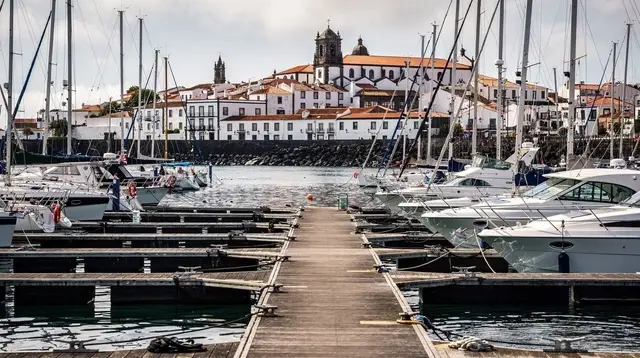
Most of the whale watching operators bookable through this site leave from Ponta Delgada, and specifically from the harbour area around Portas do Mar, the marina and cruise front on the edge of the old town. For a family staying in or near the capital, that usually means the shortest and simplest run down to the boat, without a long drive beforehand to add to a morning that already asks a young child to wait patiently for a sighting. Families based further out, in Furnas or on the north coast, are weighing an earlier start and a longer drive against staying closer to a quieter base, and that trade-off is worth thinking through the night before rather than the morning of.
Beyond the harbour itself, a general sense of what the trip involves — time motoring out to open water, time spent watching and waiting, and the return leg — is covered on its own page about what a whale watching boat trip actually involves, since that shape of a morning matters as much to a family’s planning as the destination does. Nothing about the specific timing or boat used here should be assumed from that page, since it varies by operator, but the general rhythm of the outing — waiting being a real part of it, not a flaw in the trip — is worth reading with a child in mind before booking.
Group trips, private trips, and what actually changes for a family
The four tours named on this page are general whale watching trips, run as group excursions rather than tours built specifically around families. For a family that would rather set its own pace, or that has a child whose comfort on the boat is enough of an unknown that the adults would rather not be managing a full boatload of strangers at the same time, a private whale watching and island tour is worth comparing against the group options before booking, since the trade-off is usually cost against flexibility rather than one option being simply better than the other.
Whichever kind of trip a family books, the resident sperm whales and dolphins mean the choice is rarely forced by the calendar. A family choosing a private tour in October is looking at the same resident population as a family on a group boat in June, so the decision comes down to what suits the specific children on board that day, not what the season allows.
If open water is not the right first step for a particular child
Not every child is ready for a few hours on the open Atlantic before they have spent any time at all in or near São Miguel’s water, and there is no reason a family has to start with the biggest outing on the list. Calmer, closer-to-shore alternatives exist for building up to it, or for children who simply prefer a gentler morning. Terra Nostra’s thermal pool and the island’s other family-friendly thermal pools are a warm, contained, easy introduction to being in São Miguel’s water rather than just looking at it from a boat rail.
For families weighing calmer paddling against open water, the comparison between caldera-lake kayaking and open-Atlantic conditions lays out honestly how different those two settings are, which is useful context even for a family that ultimately chooses the whale watching boat over either.
Swimming inside the sunken crater at Ilhéu de Vila Franca is another option some families use as a gentler, closer-to-shore day on the water, seasonal and dependent on conditions rather than a year-round substitute, but a useful contrast for a parent trying to gauge how a particular child handles boats and open water before committing to a longer whale watching morning.
Fitting a whale watching morning into the rest of the trip
A whale watching excursion is usually one line in a longer family itinerary, and it is worth weighing against the rest of the trip rather than in isolation. Families still working out how many days the island actually needs or building a running sense of the overall budget may find it easier to place a whale watching morning once those bigger questions are settled, since it is one of the pricier single activities on most family itineraries and sits more comfortably in a trip that has already been mapped out day by day.
It is also one of the activities worth booking ahead rather than leaving to chance once on the island, alongside a short list of other things that fill up — a point covered on the page about what to book in advance on São Miguel. Beyond the booking itself, a general packing list for the island is worth a glance the night before, since sun, spray and a few hours of open water call for slightly different preparation than a day spent on land.
São Miguel with children, whales included
Whale watching with children on São Miguel is neither a guaranteed hit nor something to avoid outright — it is an activity built around a genuinely wild, resident population of animals, on the open Atlantic, with an outcome nobody can fix in advance. Families who go in with that understood, and who have asked their chosen operator directly about their own child rather than relying on assumptions, tend to come away satisfied whether or not the boat finds what it was looking for that day.
Family on GetYourGuide
Verified deep-linked GetYourGuide tours. Book through these links and we earn a small commission at no cost to you.
GetYourGuide does not provide a product photo for this activity — the image shows the meeting point, photographed by us.