Whale Watching Is Never Guaranteed, and That's the Point
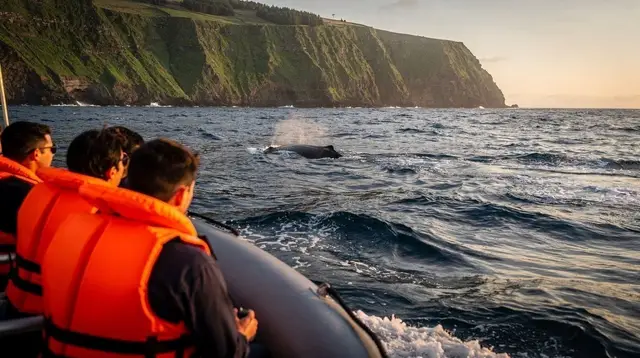
I booked my first whale watching trip on São Miguel the way I book most things: I picked a morning, paid online, and assumed the rest was someone else’s problem. It isn’t. Ninety minutes before departure I got a text asking me to confirm I understood sightings weren’t guaranteed. I remember being mildly annoyed by it, the way you’re annoyed by a waiver you don’t really read. By the end of that morning, bobbing off the north coast with a pod of common dolphins riding the bow wave and not a single large whale in sight, I understood exactly why they’d sent it.
That’s the thing nobody tells you clearly enough before you go: a whale watching trip out of Ponta Delgada or Capelas is not a ticket to a show. It’s a few hours spent looking for wild animals in the open Atlantic, and the ocean doesn’t sell tickets. What you’re actually buying is expertise, a boat, and a genuinely strong chance — not a certainty.
Why nobody can promise you a whale
The Azores sit on a stretch of ocean that happens to be extraordinarily good for cetaceans — deep water close to shore, a position on migration routes, a food chain that still works the way it did before the archipelago was fished hard. That’s the geological luck of it. But luck isn’t the same as a guarantee, and every operator I’ve spoken to on this island says the same thing in different words: they’re not running an aquarium, they’re running a search.
What tips the odds in your favour is a method that predates the tour industry by decades: the vigia system. Vigias are shore-based lookouts, working from elevated stations along the coast — Capelas has one of the better-known ones — scanning the water with binoculars and, these days, a radio to the boats. It’s a direct descendant of the job that once spotted whales for the whaling stations, before whaling ended here in the 1980s. The skill didn’t disappear when the industry did; it just changed purpose, from hunting to watching. A good vigia can pick out a blow or a fin from a distance most of us would need binoculars just to focus on, and can guide a boat toward an animal far faster than searching blind.
I mention this because it changes what you’re actually paying for. You’re not paying to be driven to a spot where whales live, the way you’d drive to a lookout point. You’re paying for a search method that’s been refined for the better part of a century, run by people who read the sea the way I read a map. It works often. It doesn’t work every time. Both of those things are true at once, and any trip description that skips the second half is selling you something it can’t deliver.
Resident animals versus passing ones
Part of managing your own expectations is understanding that “whale watching” on São Miguel actually covers two quite different situations, and they don’t behave the same way.
Sperm whales and several dolphin species — common, bottlenose, Risso’s, sometimes more — are resident here year-round. They don’t migrate through; this is where they live, feed and raise young, in the deep water just off the island’s coast. That’s why you’ll see trip logs with sightings in November as well as July. Resident animals are the backbone of the whole industry here, and they’re the reason a well-run boat has a strong baseline chance of showing you something on almost any outing.
The larger baleen whales are a different story. Blue whales, fin whales and sei whales aren’t residents; they’re passing through, following plankton blooms north on a migration that runs roughly from March to June. They’re staggering animals to see — a blue whale off the bow puts most other wildlife encounters in perspective — but they’re only reliably around for that spring window. Book a July trip hoping for a blue whale and you’re hoping against the calendar, not just against luck.
If a specific species matters to you more than the outing in general, that distinction should drive your dates, not the other way around. I’d rather tell a friend “go in April for the best shot at a blue whale” than let them assume any month is the same as any other, because it isn’t.
Choosing a period instead of chasing a guarantee
The honest way to plan this, I’ve come to think, is to stop asking “will I see a whale” and start asking “what are my odds this month, and am I comfortable with that.” April through October is generally the strongest stretch on the whole, stacking the spring migration on top of calmer seas and the year-round residents. Deep winter brings rougher water and more weather cancellations, though the resident species are still out there — you’re trading a bit of probability for a much quieter boat and a lower price.
Weather matters as much as season, maybe more, on any given day. A trip can be cancelled outright for sea state, which is a different disappointment from a trip that runs but sees nothing — and it’s worth asking an operator’s cancellation and rebooking policy before you pay, not after a rough morning at the harbour.
I ended up going out again two days after that first flat morning with the dolphins. Same operator, different vigia on shift, and forty minutes in, a sperm whale surfaced close enough that the guide cut the engine and just let us watch it breathe. Nothing about that second trip was more “guaranteed” than the first. The odds had simply worked in my favour that time, the way they’re built to, most of the time, for animals that were never mine to promise.
If you’d rather build a wildlife-focused morning around a naturalist who can talk you through what you’re seeing while you’re out there, a marine biologist-led outing is worth the extra structure: a marine wildlife expedition with a biologist guide pairs the search with real explanation rather than just a running commentary of “there it is.” And if you’re only ashore for a few hours off a cruise call, it’s still worth checking what’s feasible from the harbour itself: shore excursions departing straight from Ponta Delgada can be built around the tide and your ship’s clock rather than a full-day plan.
For everything else that shapes your odds — which months favour which species, how the vigia network actually works, and what a cancelled trip means for your money — I’d start with when to go for whale watching, then read up on the resident sperm whales and dolphins and the spring migration of blue, fin and sei whales before you pick a date.
The history of the vigia lookouts at Capelas is worth a read too, if you want to understand who’s actually finding the animals for you. And before you book anything, it’s worth knowing how weather cancellations actually work, so a rough forecast doesn’t catch you off guard.
None of this is meant to talk you out of going. Whale watching here remains one of the best wildlife experiences on the island, and most trips do see something worth the morning. I just think it’s worth going in with the right expectation: you’re watching wild animals in the wild Atlantic, guided by people who’ve been reading this coast for generations, not walking into an enclosure with a schedule.
For general context on the island’s whale and dolphin watching scene, or how it fits into a broader three-day itinerary or a longer full-island plan, the rest of this site can help you build a realistic week — and if you want the fuller island picture beyond a single boat trip, São Miguel itself is worth the extra reading before you land.
Whale Watching on GetYourGuide
Verified deep-linked GetYourGuide tours. Book through these links and we earn a small commission at no cost to you.
GetYourGuide does not provide a product photo for this activity — the image shows the meeting point, photographed by us.