Ponta Delgada Cruise Shore Excursion: What a Port Day Actually Allows
What can a cruise passenger do in Ponta Delgada in one port day?
Ponta Delgada's cruise berths at Portas do Mar sit an easy walk from the Portas da Cidade arches and the historic centre, so a few hours ashore comfortably covers the old town on foot. With more time, a half-day shore excursion can reach Sete Cidades or the Furnas valley and back before reboarding, but neither fits into a short call.
A Small Capital, Docked at Its Own Front Door
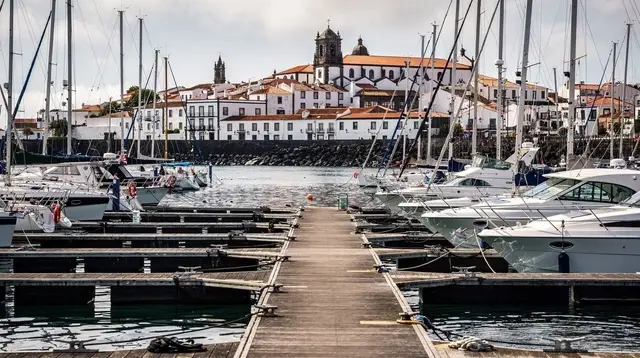
Cruise ships calling at Ponta Delgada tie up or tender at Portas do Mar, the marina and cruise front that also holds the town’s main harbour traffic. This is not a container port bolted onto the edge of somewhere else — it sits directly against the old town, close enough that the whole question of “what can I actually do” changes shape. On most Azorean or transatlantic itineraries, São Miguel is one call among several, and Ponta Delgada is the only town on the island most passengers will see. Understanding what is realistically within reach, on foot or by vehicle, is the difference between a rushed dash back up the gangway and a port day that actually worked.
This guide is written for the ship’s clock, not the island’s. It does not attempt to plan a full, unhurried day in the city the way a land-based visitor would — for that, a Ponta Delgada city day trip written for travellers without a departure horn to listen for is the better read. It also does not attempt to plan a proper Sete Cidades outing; the dedicated half-day trip to Sete Cidades from Ponta Delgada covers that in the depth it deserves. What follows instead is scaled deliberately to a port call: what is within walking distance, what needs wheels, and how to judge which is realistic for the hours you have.
Getting Ashore at Portas do Mar
Portas do Mar is both a working marina and the cruise interface for the island — fuel and provisioning happen a short distance away, cruise tenders or gangways land closer to the pedestrian front. Depending on ship size and berth assignment, some vessels dock directly; others anchor off and tender passengers in. Either way, once ashore you are already at the waterfront edge of town, with the historic centre a few minutes’ walk inland.
The scale here matters more than it first appears. Ponta Delgada’s municipality holds roughly 68,000 people, which makes it the largest town in the Azores by a wide margin, yet it remains small enough to cross on foot in well under half an hour. The cruise quays and the João Paulo II airport sit almost symmetrically around the centre, each about two to three kilometres out — a fact that is oddly useful for gauging distance: if a landmark feels airport-adjacent on a map, you are probably still within an easy walk or a short taxi ride of the ship.
There is no need to pre-book transport just to reach the old town. The walk from Portas do Mar to the Portas da Cidade arches, the traditional gateway into the historic core, is flat, paved, and typically covered in under ten minutes at an unhurried pace.
On Foot: The Historic Centre in a Few Hours
For a call of three to five hours, walking is usually the better plan than any vehicle-based excursion, simply because so much of what defines Ponta Delgada sits within a compact, walkable core.
The Portas da Cidade arches are the obvious first landmark, a black-and-white basalt gateway that once marked the town’s edge and now frames the main square. From there, the Igreja Matriz de São Sebastião, the town’s principal church, and the surrounding streets of black-and-white Azorean paving give a fast sense of the historic centre’s character — a full walking guide to the old town lays out a route if you want one rather than wandering.
The Forte de São Brás, the old fortress guarding the harbour approach, sits close to the waterfront and is worth a look even from outside if time is short. Inland a little further, the Mercado da Graça is the town’s produce and food market — a genuinely useful stop for anyone who wants a sense of what the island actually eats and grows, from pineapple to local cheeses, and a guide to the market explains what to look for and when it is busiest.
On the edge of town, reachable by a longer walk or a short taxi, the Gruta do Carvão is a lava tube you can descend into on a guided visit — an unusual thing to find within a town’s limits, and one of the few places in Ponta Delgada where the island’s volcanic origin is visible rather than implied. A lava tube walking guide covers what the visit involves.
Back at the water, the Portas do Mar front itself is worth returning to before reboarding — cafés, the marina, and short boat trips depart from here, and a guide to Portas do Mar’s boat tours is useful if a short time on the water rather than more time on land appeals more.
None of this requires a car, a guide, or advance planning beyond knowing your ship’s return time. It is the version of Ponta Delgada that rewards a short call well.
a half-day shore excursion timed around Ponta Delgada’s cruise schedule is worth comparing against a self-guided walk before you decide — some passengers prefer the town at their own pace, others prefer a fixed itinerary with transport and a return time built in.
When a Shore Excursion Makes More Sense
The calculation changes once a call runs a full day, or once the goal shifts from the town itself to somewhere further out. São Miguel’s interior — the crater lakes, thermal valleys and coastline — is not walkable from the port, and public buses run on local schedules built for residents and workers, not for a ship’s departure time. A rental car is the island’s normal way of getting around, but arranging one, driving unfamiliar mountain roads, and getting back with margin to spare is a lot to take on in a single port day with a hard deadline at the end of it.
This is where an organised shore excursion earns its cost: it removes the two biggest risks of a short call, which are getting the timing wrong and getting the route wrong. A guided or private vehicle knows the roads, builds in a buffer, and is contractually oriented around getting you back to the ship — not around lingering at the next viewpoint.
a private excursion into the Furnas valley built specifically for cruise days is the more efficient of the two big interior destinations to fit into a limited window, since Furnas concentrates caldeiras, a thermal park and a caldera village into one compact area rather than a scattered loop.
Furnas and Sete Cidades by Excursion, Not on Foot
Both of the island’s signature interior landscapes are reachable from Ponta Delgada in roughly forty minutes to an hour’s drive, which means either one, done properly, consumes most of a half-day call once travel time both ways is counted.
Furnas sits in an active caldera in the east, with steaming ground, the lake where cozido is slow-cooked underground, and the Terra Nostra thermal garden. A Furnas day trip guide covers the destination in full for readers with a whole day; on a cruise clock, the realistic version is a shorter, guided pass through the caldeiras and the thermal park rather than the complete circuit.
Sete Cidades, in the west, is built around a caldera holding twin lakes seen from above at Vista do Rei — visually the more famous of the two, and often the one passengers ask for by name.
a shore excursion to the Sete Cidades crater lakes routed for a cruise return and a half-day tour built around the same viewpoints and villages both exist for exactly this timing problem — getting to a landscape that photographs best from above and back to the ship inside a single window.
Whichever of the two you choose, choose one, not both. Attempting Furnas and Sete Cidades on the same port call, on top of driving time and any stop for food, is the single most common way a shore day runs late.
What a Port Call Does Not Have Time For
It is worth being explicit about what a normal cruise call does not comfortably reach, so expectations are set correctly before you leave the ship. Lagoa do Fogo, the crater lake in the island’s centre, has no facilities of any kind and is frequently sitting inside cloud — a detour there adds real driving time for a view that may not even be visible on arrival. Nordeste, at the island’s eastern tip, and its viewpoints and waterfall park are a distinct day out in their own right, not a stop to bolt onto a Furnas or Sete Cidades run. The north coast’s tea plantations and the Ribeira Grande area are also better suited to a full day than a port afternoon squeezed against a reboarding deadline.
None of these are unreachable in principle — a private full-day charter, arranged for a very long call, could in theory cover more ground. But for a standard half-day or even most full-day calls, picking one destination and doing it properly beats trying to see the whole island in a single pass.
Weather, Tides and a Realistic Port Day
São Miguel’s weather does not behave the way a single forecast implies. It is entirely possible for the quay at Portas do Mar to be dry while Furnas, up in its caldera, sits under cloud, or the reverse. Nothing about a rainy morning ashore should be read as a verdict on the rest of the island, and nothing about a sunny quay guarantees clear skies inland.
Sea conditions also matter directly to how a call unfolds. Portas do Mar handles Atlantic swell like any open-facing Azorean harbour, and on a rough day a ship may anchor off and tender passengers in rather than dock — which changes both the time available ashore and the logistics of getting back. This is entirely a ship and port decision, communicated through onboard announcements, and no independent guide can anticipate it. Building in margin, rather than planning to the last possible minute, is the only real defence against a shortened or delayed call.
If your interest runs to the water itself rather than the land, an evening sailing trip out of Ponta Delgada’s marina is worth knowing about for an overnight call or a late departure, when the harbour and coastline are seen from the water rather than from the quay.
On Foot vs Organised Excursion, at a Glance
| Option | Realistic for | What it covers | Time needed |
|---|---|---|---|
| Walking from Portas do Mar | Any call length | Portas da Cidade, old town streets, Igreja Matriz, Mercado da Graça, Forte de São Brás | 1.5-3 hours |
| Gruta do Carvão add-on | Calls of 4+ hours | Lava tube on the edge of town | 45-60 minutes including transfer |
| Sete Cidades shore excursion | Half-day or longer calls | Crater lakes, Vista do Rei viewpoint | 4-6 hours round trip |
| Furnas shore excursion | Half-day or longer calls | Caldeiras, thermal park, caldera village | 4-6 hours round trip |
| Evening sailing from the marina | Overnight or late-departure calls | Harbour and coastline from the water | 2-3 hours |
Treat the time column as a guide, not a promise — actual duration depends on group size, traffic on the day, and how long you choose to linger at any one stop.
Money, Connectivity and Small Practicalities
The currency is the euro, and displayed prices already include VAT, so there is no sales tax added at the till the way there might be elsewhere. Tipping in Portuguese Portugal and the Azores runs to a round-up or roughly five to ten percent for good service, not the fifteen to twenty percent expected in North America — a detail worth knowing before a quick lunch or coffee near the market. A guide to tipping and VAT covers this in more depth for anyone staying longer.
English is widely understood in shops, cafés and anywhere used to cruise traffic, though Portuguese is the working language and Azorean Portuguese has a distinct sound from mainland Portuguese. Sockets are the European type C/F standard at 230V, relevant mainly if you are stepping into a café or shop to charge a phone rather than for anything on the ship itself. Azores time runs one hour behind Lisbon year-round, which occasionally trips up passengers checking mainland-based flight or ferry connections against local Azorean clocks — worth double-checking if your cruise itinerary continues to or from continental Portugal.
For anyone extending their stay beyond the ship, whether pre- or post-cruise, a broader look at how to get to São Miguel, at renting a car on the island, or at what to book in advance fills in the planning a single port day does not need but a longer visit does. Whale watching, if it interests you and your call is long enough to fit it, deserves its own read too: sightings are never guaranteed on any single trip, and a guide to whale and dolphin watching on São Miguel explains what a realistic trip looks like rather than promising an encounter.
For a broader multi-stop view of how cruise days on São Miguel typically get planned, the cruise ship stopover itinerary lays out a fuller set of options across different call lengths.
Deciding Before You Leave the Ship
The single most useful thing to settle before walking down the gangway is not which sight to see first, but which category of day this is: a walking day in town, or a vehicle-based day out of it. Mixing the two — a long walk through the centre followed by an improvised attempt at a taxi to Sete Cidades — is how port days go wrong. Pick one shape for the day based on how many hours you actually have, confirm your ship’s documented return time before you leave, and build in a buffer rather than planning to the final minute. Ponta Delgada rewards a well-scoped few hours; it punishes an overambitious one.
Cruise Day Questions for Ponta Delgada
How long do cruise ships typically stay in Ponta Delgada?
It varies by cruise line and itinerary, from a few hours to a full day. Your ship’s documented schedule is the only reliable source — the port itself does not set a standard call length, and no general guide can safely tell you when to be back aboard.
Can I walk from the cruise terminal into the historic centre?
Yes. The Portas do Mar quays open directly onto the marina and waterfront, and the Portas da Cidade arches at the edge of the old town are a short, flat walk away, well inside ten minutes for most passengers.
Is there realistically time to visit Sete Cidades or Furnas on a port call?
Only on a longer call, and only by vehicle. Both are roughly forty minutes to an hour’s drive each way, so a return trip plus any time on site needs several hours in total — workable on an all-day stop, tight to impossible on a half-day one.
What should I do if it is raining on my port day?
Ponta Delgada’s museums, the Mercado da Graça, churches and cafés all work in the rain, and the town itself is compact enough to duck in and out of shelter. Weather on São Miguel changes by the hour and can differ between the coast and the interior, so a wet quay does not rule out a dry afternoon inland.
Do I need a taxi from Portas do Mar, or is everything walkable?
The historic centre is walkable. A taxi or transfer only becomes useful once you are heading beyond town — to Sete Cidades, Furnas, or the airport, which sits about as close to the centre as the port does, roughly two to three kilometres either way.
Should I book a shore excursion or explore independently?
It depends on your time and your goal. Independent walking suits passengers who want the town itself — churches, the market, the waterfront. An organised shore excursion suits those who want to reach Sete Cidades, Furnas or the whales offshore and be back at a predictable hour, since transport, routing and the return to the ship are handled for you.
What happens if my ship’s call is shortened by weather?
Atlantic swell and wind occasionally affect berthing or tendering at Portas do Mar, and lines sometimes trim a call as a result. This is a ship and port operations matter, not something a shore guide can predict — always follow your cruise line’s onboard announcements over any printed itinerary.
Boat Tours on GetYourGuide
Verified deep-linked GetYourGuide tours. Book through these links and we earn a small commission at no cost to you.
GetYourGuide does not provide a product photo for this activity — the image shows the meeting point, photographed by us.