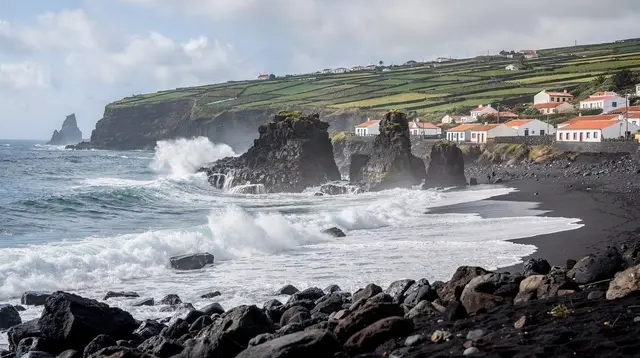
A Car-Free Day in Ponta Delgada, Capelas and Rabo de Peixe
Why this route works without a rental car
São Miguel has no train, and for most of the island a car is genuinely the practical way to get around — the loops to Sete Cidades and Furnas both assume you can drive between viewpoints on your own schedule. This day is different. It stays close to Ponta Delgada, the island capital and home to roughly 68,000 people across its municipality, and it uses the one motorised alternative to driving yourself: the local bus network run by Auto Viação Micaelense.
The idea is simple. Spend the morning on foot in the historic centre, where everything worth seeing sits inside a walkable core around the harbour. Spend the afternoon on a short bus hop up the north coast to Capelas, a former whaling station, and then on to Rabo de Peixe, a working fishing town that sees far fewer visitors than the postcard corners of the island. Come back to Ponta Delgada by early evening. No car, no rental desk, no parking to find — just a day of walking and a couple of short bus rides on São Miguel.
This is not the day to also attempt Sete Cidades’ caldera lakes or the Furnas cozido villages. Both are built around a car — for a fuller sense of what a self-drive day covers, see the guide to renting a car on São Miguel or the reasoning behind why the rental car is the default and the bus is not a shortcut. If you’re travelling without one for the whole trip, the multi-day itinerary without a car plans around that constraint properly. Today is one clean, low-effort loop that plays to the bus network’s actual strength: short, frequent-enough hops along the coast near the capital.
Day 1: Ponta Delgada on foot, then Capelas and Rabo de Peixe by bus
Morning: the historic centre of Ponta Delgada, on foot
Start at the Portas da Cidade, the three-arched gate that has marked the entrance to Ponta Delgada’s old town since the 18th century and remains the town’s most recognisable landmark. From here the centre unfolds in a compact grid of black-and-white cobbled streets, easily covered without any transport at all — the full Ponta Delgada old town walking route takes a couple of hours at an unhurried pace.
Walk to the Igreja Matriz de São Sebastião, the town’s main parish church, then continue toward the Forte de São Brás, the 16th-century harbour fortress that once defended the port from pirate raids and now houses a small military museum. From the fort, the waterfront opens up: this is where Portas do Mar, the marina and cruise terminal, meets the sea, with a long promenade that’s pleasant to walk regardless of the weather.
Mid-morning, head inland a couple of blocks to the Mercado da Graça, the covered municipal market. It’s the easiest place on the island to see Azorean produce, cheeses, bread and fish stalls in one stop, and a good spot for an early lunch or a coffee before the afternoon bus. The Mercado da Graça food market guide covers what’s worth trying there.
If you’d rather have the old town narrated than self-guided, a short walking tour covers the same ground with local history worked in — the Ponta Delgada Lagarta Historic Tour runs through the fort, the gate and the old streets in a couple of hours, which leaves the rest of the morning free.
For those arriving by cruise ship rather than staying overnight, the same centre is reachable straight off the Portas do Mar terminal — see the Ponta Delgada city day trip guide for a version built around a single port call, or the shore excursions from Ponta Delgada if you’d rather have transport arranged directly from the ship.
Before you leave the centre after lunch, it’s worth a five-minute detour to the edge of town for the Gruta do Carvão, a lava tube a short walk from the old streets — see the Gruta do Carvão lava tube walk if you have an extra half hour to spare before catching the bus north.
Early afternoon: the bus to Capelas
This is the step that needs planning ahead, not improvising on the day. Auto Viação Micaelense runs the routes along the north coast, and — this is the single fact that decides whether this day works — these are workday and school timetables, not tourist shuttles. Departures cluster around commuting hours, thin out in the early afternoon, and can leave long gaps exactly when a visitor would want to travel. Check the current timetable, ideally the evening before, and note the return times from Rabo de Peixe before you leave Ponta Delgada — not after. The São Miguel bus guide explains how the network is organised stop by stop.
The ride to Capelas takes roughly 20 minutes. Capelas is a small parish that most self-drive itineraries pass on the way to somewhere else, which is exactly why it rewards a slower visit. Its old whaling station is one of the more tangible reminders of an industry that ended in the Azores only in the 1980s — the buildings, slipway and lookout point where the vigias once scanned the sea for spouts are still there to see. The Capelas old whaling station guide covers the site in more depth, and the Capelas coastal trail is a short, flat walk along the shore if your bus connection leaves you 30 to 40 minutes to fill before the next leg.
Late afternoon: Rabo de Peixe
From Capelas, a second short bus hop — around 15 minutes — continues to Rabo de Peixe, the island’s principal fishing town and one of the least polished stops on São Miguel’s map, in the best sense. This isn’t a village dressed for visitors: it’s a working harbour where the day’s catch still shapes the rhythm of the streets, brightly painted boats line the small port, and daily life carries on largely as it would if no tourist ever passed through. Walk down to the harbour to watch boats coming in, and take a slow loop through the town before heading back toward the bus stop.
If the idea of stitching together two separate bus connections feels like more coordination than you want, the Rabo de Peixe, Mosteiros and Capelas Super Expedition covers this same north-coast stretch — and further west toward Mosteiros — with transport and a guide included, which removes the timetable question entirely.
Evening: back to Ponta Delgada
This is where the day either closes cleanly or turns into a long wait, depending on whether you checked the return schedule that morning. Buses back from Rabo de Peixe to Ponta Delgada follow the same working-week logic as the outbound trip, and once the last useful departure of the afternoon has gone, the next one may not be for a while. Build in a buffer: aim to be at the Rabo de Peixe stop at least one departure earlier than you strictly need to be, rather than cutting it to the final bus of the day.
Back in Ponta Delgada by early evening, the Portas do Mar waterfront is a natural place to end the day with dinner looking out over the marina, closing the loop where the morning began.
Practical notes for a car-free day
| Leg | Mode | Approx. time | Notes |
|---|---|---|---|
| Ponta Delgada centre | On foot | 2-3 hours | Portas da Cidade, Forte de São Brás, Mercado da Graça, Portas do Mar |
| Ponta Delgada to Capelas | Local bus (Auto Viação Micaelense) | ~20 minutes | Confirm return times before departing |
| Capelas to Rabo de Peixe | Local bus | ~15 minutes | Same operator, check onward connection |
| Rabo de Peixe to Ponta Delgada | Local bus | ~30-40 minutes | Last useful departure varies by day of week |
A few things worth knowing before you set out:
- There is no train on São Miguel. The bus is the only motorised option that isn’t a rental car, a taxi or an organised tour, so treat the timetable with real respect rather than checking it as an afterthought.
- Buses run less frequently on weekends and holidays than on weekdays — if your visit falls on a Sunday, verify that afternoon services to Rabo de Peixe exist at all before planning around them.
- Carry small change or a rechargeable card if the operator offers one locally; card payment on board isn’t guaranteed.
- Ponta Delgada’s João Paulo II airport (PDL) sits only 2-3 km from the centre, so this itinerary also works well as a first or last day of a trip, bracketing an arrival or departure without needing a car at all.
- For a longer car-free stay, the how to get to São Miguel guide and the multi-day itinerary without a car build out further days along similar lines.
Why Sete Cidades and Furnas aren’t part of this day
Both of São Miguel’s signature loops — the caldera lakes at Sete Cidades and the thermal villages of Furnas — are built around having a car for the day. Sete Cidades needs a drive up to Vista do Rei and down into the caldera itself; Furnas spreads its sights (the caldeiras, Terra Nostra, Poça da Dona Beija) across a village that public buses don’t serve on a timetable a day-tripper can rely on. Trying to bolt either onto a bus-based day from Ponta Delgada usually means arriving late, leaving early, or missing the connection altogether.
If those two are on your list for later in the trip, plan them as separate days with a rented car, or book them as guided day trips that handle the driving for you — the Furnas Valley Day Trip is a straightforward way to see the caldera villages without needing wheels of your own on that particular day either.
Frequently asked questions about a car-free day from Ponta Delgada
Do I need a car to see Ponta Delgada, Capelas and Rabo de Peixe in one day?
No. Ponta Delgada’s historic centre is fully walkable, and Auto Viação Micaelense buses connect the capital to Capelas and Rabo de Peixe along the north coast. The whole loop is doable on foot and by local bus in a single day.
How do I get from Ponta Delgada to Capelas and Rabo de Peixe by bus?
Local buses run by Auto Viação Micaelense cover this route. Ponta Delgada to Capelas takes roughly 20 minutes, and continuing on to Rabo de Peixe adds about 15 minutes more. Check the current timetable before you set out, since schedules vary by day of the week.
What is the biggest risk with this car-free itinerary?
Missing the return bus. Local routes follow school and work timetables rather than tourist demand, so afternoon and evening departures from Rabo de Peixe can be sparse. Check the return schedule before leaving Ponta Delgada in the morning, not after you’ve already reached the coast.
Can I also fit Sete Cidades or Furnas into a car-free day?
Not realistically on the same day. Both destinations are built around having a car to move between viewpoints and villages on your own schedule, and public buses don’t serve them on a timetable that supports a day trip. Plan them separately, either with a rental car or as a guided tour.
How much does the bus cost compared to renting a car?
A single local bus fare is a small fraction of a day’s car rental plus fuel, making this route one of the cheapest full days out on the island. The trade-off is flexibility: you move on the bus network’s schedule, not your own.
Is Rabo de Peixe safe and worth visiting?
Yes. Rabo de Peixe is a working fishing town, not a tourist village, and it’s a normal, safe place to walk around during the day. It’s worth visiting precisely because it shows a side of São Miguel that the more polished stops don’t — an active harbour and daily life largely unchanged by tourism.
What should I do if I miss the last bus back to Ponta Delgada?
Build in a buffer by aiming for an earlier departure than the final one of the day, since missing the last bus from Rabo de Peixe can mean a long wait or the need for a taxi back to Ponta Delgada. Confirming the return timetable before you leave in the morning is the simplest way to avoid this altogether.
tours.1 days
Verified deep-linked GetYourGuide tours. Book through these links and we earn a small commission at no cost to you.
GetYourGuide does not provide a product photo for this activity — the image shows the meeting point, photographed by us.