Looking for the Priolo, Europe's Rarest Bullfinch
I spent a whole afternoon near Salto do Prego, in the hills above Faial da Terra, absolutely certain I’d hear a priolo before the day was out. I’d read the descriptions, I knew the call to listen for, and I was standing at the edge of exactly the right kind of forest. I heard nothing but wind, a few common blackcaps, and the waterfall. That was the trip I learned that this bird does not work the way I assumed it would.
Why one forest, and not the whole island
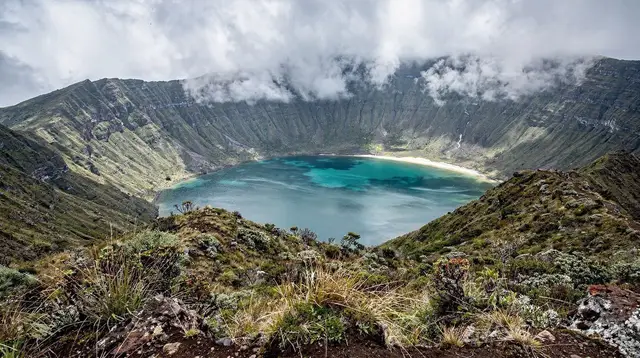
Most of what people picture when they imagine Azorean wildlife — hydrangeas, whales, black cliffs — is spread generously across São Miguel. The priolo is the opposite kind of story. This small, russet-brown finch, also called the Azores bullfinch, breeds nowhere on Earth except the native laurel forest of the Serra da Tronqueira, a single block of native woodland in the island’s far east, folded around the slopes below Pico da Vara, São Miguel’s high point at 1,103 m.
That’s it. Not the pastures around it, not the coast at Nordeste, not the viewpoints tourists stop at. One forest. For a long stretch of the twentieth century the priolo was believed close to extinction, hanging on in a fragment of habitat so small that a single bad storm or a further wave of forest clearing could plausibly have ended it. It hasn’t ended, but the margin is still thin, and the range hasn’t grown to match the population’s slow recovery.
The mistake I nearly made, and the one I see other people make
Before that afternoon at Salto do Prego, I’d assumed — without really examining the assumption — that a “rare native bird” on a small Atlantic island would behave the way, say, a buzzard or a heron does: visible if you’re patient, likely if you’re driving the right road at the right hour. I planned my first attempt around a scenic drive through Nordeste, stopping at Ponta do Sossego and Ponta da Madrugada with binoculars on the passenger seat, half expecting a bullfinch to hop across the road.
That’s not how it works, and it’s worth saying plainly because I’ve watched other visitors make the same assumption at those same viewpoints. The priolo isn’t a roadside bird. It lives inside closed-canopy native forest — the tangle of Azorean laurel, heather trees and holly that once covered far more of the island and now survives mostly as this one relict block — and it forages quietly, low and inconspicuous, nothing like a gull wheeling over a harbour or a buzzard riding a thermal. You don’t spot a priolo the way you spot a whale blow. You have to go into the forest, on foot, usually with someone who already knows its call and where it’s been feeding that week, and even then a sighting is a genuine event, not a guarantee.
What actually gives you a chance
The realistic route into priolo territory is the Serra da Tronqueira trail system, reached from the Nordeste side or via Faial da Terra and the approach toward Salto do Prego. Core parts of the habitat are managed for conservation rather than open tourism, so this isn’t a case of turning up with a checklist — a local guide who walks these paths regularly, and who can read the forest’s quiet signals, is worth far more than persistence alone.
If your main interest is Azorean wildlife more broadly rather than one specific bird, a marine-focused outing led by a biologist is a much more bookable way to spend a morning with someone whose job is reading the island’s wild animals for a living — I’d sooner recommend the marine birdwatching expedition with a biologist guide to most visitors than send them chasing a priolo with no local knowledge at all.
If you’re building a full day around the east of the island, pairing a Tronqueira attempt with the Ribeira dos Caldeirões waterfall trail or a slower loop through Furnas makes more sense of the drive out — the full-day tour through Furnas covers the caldera villages on the way, even though it won’t take you into priolo habitat itself.
For visitors without a rental car who still want to reach the remoter eastern trailheads, a private jeep tour is the more flexible option, since a driver-guide can adjust the route to weather and road conditions on the day, which matters more here than almost anywhere else on the island.
Why the comparison to alpine wildlife doesn’t hold
I think part of why I got this wrong at first is that São Miguel’s terrain — a green massif with a summit over a thousand metres, mist rolling through forest — looks like it should have the wildlife to match: a mountain raptor, maybe, or something with real presence. It doesn’t, and that’s not a gap, it’s the actual character of the place. There’s no dangerous or large land animal here at all — no snakes, no predators, nothing that changes how you plan a walk. The island’s wildlife story isn’t about size or drama; it’s about scarcity and endemism.
The priolo is the sharpest example: a small, plain-looking finch that happens to be one of the rarest birds on the continent, surviving because one forest block was protected in time, not because the island is some untouched wilderness. São Miguel is farmed and inhabited almost everywhere else — cattle on the roads, hedgerows, small towns — which makes this one relict forest feel less like a nature reserve you stumble into and more like something you have to seek out on its own terms.
I didn’t hear a priolo that afternoon at Salto do Prego. I went back a second time, later in the trip, with a guide who’d worked the Tronqueira trails for years, and about ninety minutes in, low in a stand of holly, there it was — quiet, brief, gone again in seconds. If you go looking, go with that expectation: not a sighting on demand, but a chance worth the walk.
tours.Nature
Verified deep-linked GetYourGuide tours. Book through these links and we earn a small commission at no cost to you.
GetYourGuide does not provide a product photo for this activity — the image shows the meeting point, photographed by us.