Sailing to Other Azores Islands from São Miguel: The Reality
Can you sail or take a boat from São Miguel to other Azores islands?
Not as a day trip. São Miguel sits apart from the rest of the archipelago, and reaching Pico's vineyards or Terceira's old town takes a flight, or in high summer an infrequent, long seasonal ferry of several hours. Sailing trips that leave from São Miguel itself stay on its own coastline.
What “sailing to the other islands” actually means here
Every year, visitors standing on the waterfront in Ponta Delgada look south-west across the Atlantic and assume the rest of the Azores must be somewhere just over the horizon, reachable the way you might sail across a bay. It is a reasonable guess and it is wrong. The Azores are nine islands scattered across roughly 600 km of open ocean, arranged in three widely spaced groups, and São Miguel — together with tiny Santa Maria — makes up the Eastern Group entirely on its own. The Central Group (Faial, Pico, São Jorge, Graciosa, Terceira) and the Western Group (Flores, Corvo) lie far enough away that nothing about visiting them resembles a day trip from here.
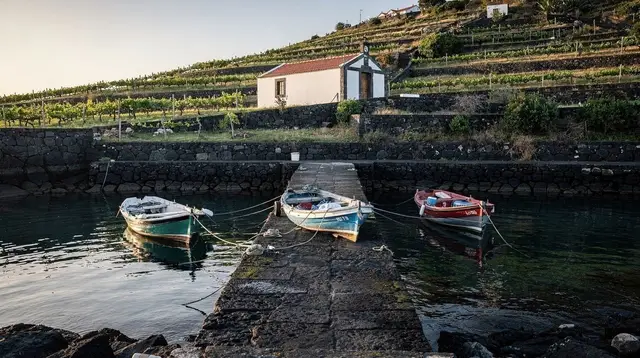
This matters because two of the archipelago’s headline sights live outside São Miguel, and it is worth naming them plainly. The UNESCO World Heritage vineyards, the extraordinary grid of black basalt walls that shelter vines from salt wind, are on Pico. The UNESCO World Heritage old town, with its fortified harbour and layered colonial streets, is Angra do Heroísmo, on Terceira. Neither is a short hop from São Miguel’s coast. Both require either a flight or a long, seasonal sea crossing, and neither fits into a spare afternoon squeezed between other plans.
This guide exists to answer one honest, frequently asked question: is there a boat, a ferry, or a sailing trip that gets you from São Miguel to another Azores island and back in a day? The short answer is no, and the rest of this page explains why, what does exist instead, and what sailing from São Miguel actually looks like once you set that expectation aside.
The geography that rules out a day trip
Distances in the Azores are deceptive on a map because the islands look close together against the scale of the whole Atlantic. In the water, they are not close at all. From Ponta Delgada, the nearest island of the Central Group — usually São Jorge or Terceira, depending on the route — sits somewhere between roughly 150 and 200 km away across open sea, with Faial and Pico a little further again. Santa Maria, the only other island in São Miguel’s own Eastern Group, is about 55 km south-east, and even that short hop has no scheduled tourist ferry.
Open Atlantic water between the groups is not sheltered coastal sailing. It is genuine ocean passage, subject to swell, wind shifts and the kind of weather that can close São Miguel’s own Lagoa do Fogo pass on a bad day. A private yacht with an experienced skipper can and does make these crossings, but that is offshore passage-making, not a tourist excursion, and it is measured in the better part of a day each way under good conditions — sometimes considerably longer.
None of this means the other islands are unreachable. It means the two realistic ways to reach them are a flight or a long, seasonal ferry — never a same-day sail out and back from São Miguel.
Flying is the practical option, and locals use it too
Azores Airlines operates a dense network of short inter-island flights, most of them well under an hour in the air, connecting Ponta Delgada’s airport to every other inhabited island in the archipelago, including Terceira, Faial, Pico, São Jorge, Graciosa, Flores, Corvo and Santa Maria. This network exists first for Azoreans themselves — it is how island residents commute, visit family, and reach hospitals and services — and visitors use the same flights.
The practical upshot for trip planning is straightforward: if São Miguel is one stop on a longer Azores itinerary, structure the trip as separate legs. A common, sensible pattern is several days based on São Miguel, then a short flight to Terceira or on to the Central Group for a few more days there, treating each island as its own destination rather than a side trip from the last. Trying to compress a visit to Pico’s vineyards or Angra do Heroísmo into a single day alongside anything on São Miguel simply does not work with the flight schedules or the distances involved, and no amount of an early start changes that.
The seasonal ferry: real, but narrow
A ferry service does sometimes connect the Eastern Group to the Central Group, but it is worth being precise about what that means so it does not get mistaken for a day-trip option. In the height of summer — broadly July and August — an inter-group crossing has historically run a few times a week, linking Ponta Delgada or Vila do Porto (on Santa Maria) with ports in the Central Group. The crossing itself takes several hours each way across open water, the schedule is thin, and it is not a year-round or even a full-summer service in the way a mainland coastal ferry would be.
This kind of crossing suits a traveller who is relocating from one island to the next as part of a longer, slower trip — someone happy to spend the better part of a day at sea to arrive somewhere new and stay a while. It does not suit anyone hoping to see Pico in the morning and be back in Ponta Delgada for dinner. Sailings are also weather-dependent and get cancelled in poor conditions, the same way any small boat trip along São Miguel’s own coast does — see the notes on weather and cancellations for boat trips here for how that plays out locally.
Anyone planning around this ferry should treat published timetables as provisional until close to travel and confirm directly with the operator for the season in question, since frequency and even the route itself can shift from one year to the next.
What sailing from São Miguel actually offers
None of this means sailing itself is a dead end on São Miguel — it just happens along the island’s own coast rather than across the ocean to a neighbour. Several operators run genuine sailing trips out of Ponta Delgada, under sail rather than just engine power, and they are worth booking on their own terms rather than as a substitute for something they were never going to be.
An evening sail out from the capital, timed for the light over the water is one of the more atmospheric ways to see São Miguel’s south coast from the sea rather than the road. For a smaller, more flexible outing, a private sunset sail along the same stretch of coastline lets a small group set the pace rather than following a fixed group schedule.
And for those with more of the day free, a half-day sailing trip that stays along São Miguel’s own shoreline, often with a stop to swim gives a longer taste of the island’s coast under canvas. All three sail along São Miguel, not away from it, and none of them cross toward another island.
For a broader look at boat-based options along the south coast, including harbours beyond the capital, the guide to Caloura’s harbour and south coast boat trips covers smaller-scale operators working out of Caloura itself.
Comparing the real options, side by side
| Route | Realistic method | Approx. time | Frequency |
|---|---|---|---|
| São Miguel to Santa Maria | Flight | Well under 1 hour | Several times daily, most of the year |
| São Miguel to Terceira | Flight | Under 1 hour | Daily, year-round |
| São Miguel to Pico or Faial | Flight (via Terceira or direct, seasonally) | 1-2 hours total | Daily, year-round |
| São Miguel to Central Group | Seasonal inter-group ferry | Several hours, one way | A few sailings a week, summer only |
| Any São Miguel to other-island day trip by sea | Not offered | — | Does not exist |
| Sailing tour along São Miguel’s own coast | Half-day, evening or sunset sail | 1.5-4 hours | Regular, weather permitting |
The table is deliberately blunt on that fifth row. No operator sells a same-day sailing excursion from São Miguel to another Azores island, because the distances and open-water conditions make it impractical, not because nobody has thought of it.
Why this trips people up
Part of the confusion comes from how compact the Azores look in photographs and on small-scale maps, where nine islands fit neatly into one frame. Part of it comes from genuine inter-island ferry networks elsewhere in the world — the Greek islands, for instance — that condition travellers to expect frequent, cheap, short hops between neighbouring islands. The Azores are not built that way. The islands are further apart than they look, the population and infrastructure are concentrated for flights rather than ferries, and the ocean between the groups is the open Atlantic, not a sheltered strait.
It also helps to remember what São Miguel itself is not, beyond the inter-island question. It is not a wilderness — it is a farmed, inhabited island of pasture and small towns. It is not the Caribbean — the water is markedly cooler and the beaches are volcanic black sand. And, as this guide has set out, it is not a base from which the rest of the archipelago is a quick errand. Treating it as its own complete destination, and treating any other island as a separate leg of the trip, avoids the disappointment of an itinerary built on a same-day crossing that was never realistic.
Planning a trip that includes more than one island
If Pico’s vineyards or Angra do Heroísmo’s old streets are genuinely on the list, the honest way to plan is to give them their own days, reached by their own flight, rather than folding them into a São Miguel itinerary as a side excursion. A first-time visitor spending, say, a week in the Azores might reasonably spend four or five days based on São Miguel — covering Sete Cidades, Furnas, the north coast around Ribeira Grande and a day trip to Nordeste — and then fly onward for two or three days on Terceira or in the Central Group as a distinct second half of the trip.
For visitors arriving by cruise ship with a single day in port, the inter-island question does not really apply at all — a ship’s call in Ponta Delgada is time enough to see the capital and perhaps one nearby sight, covered separately in the guide to shore excursions from a Ponta Delgada cruise stop, and is not the moment to attempt any inter-island crossing regardless of season.
Anyone weighing up how to actually get to São Miguel in the first place, including the well-established fact that there is no car ferry from mainland Portugal, will find the fuller picture in the dedicated guide to getting to São Miguel and the companion piece on why there is no mainland ferry and what that means for boat tours here. The short version is consistent across both mainland and inter-island travel in the Azores: flights carry the traffic that ferries would elsewhere, and São Miguel’s own boats and sails stay close to home.
For travellers curious about Pico specifically, including the vineyard landscape that draws people there in the first place, the overview of Pico’s wine terraces and how they relate to São Miguel is a useful next stop before booking a flight. And for a wider sense of how São Miguel differs from the archipelago it is often mistaken for, this piece on São Miguel not being the whole Azores lays out the same distinction from a different angle.
The takeaway
There is no boat, ferry or sailing excursion that turns Pico’s vineyards or Terceira’s old town into a day trip from São Miguel. The islands are genuinely far apart, the connecting infrastructure is built around short flights rather than ferries, and the one seasonal sea crossing that does exist is long, infrequent and meant for travellers relocating between islands, not for a return trip inside a single day.
Sailing that departs from São Miguel itself — an evening sail, a private sunset trip, or a longer half-day tour combining São Miguel’s coastline and highlights by both boat and road — is a genuinely good way to see this island from the water. It is just not, and was never going to be, a way to reach the next one over.
Sailing on GetYourGuide
Verified deep-linked GetYourGuide tours. Book through these links and we earn a small commission at no cost to you.
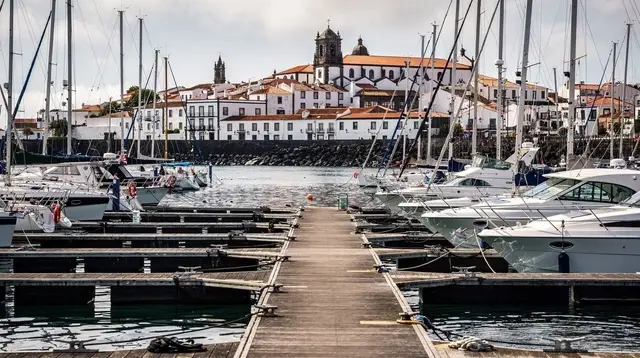
GetYourGuide does not provide a product photo for this activity — the image shows the meeting point, photographed by us.