Pineapple Greenhouses of Fajã de Baixo
Why do pineapples on São Miguel grow in greenhouses instead of open fields?
The Atlantic climate on São Miguel is too cool and too changeable for pineapples to ripen outdoors. Growers instead use glass and stone estufas, low greenhouses clustered mainly around Fajã de Baixo near Ponta Delgada, where smoke, shading and controlled watering coax a single fruit to maturity over roughly two years.
Why São Miguel’s Pineapples Grow Under Glass
Pineapples are a plant of the tropics, and São Miguel is not tropical. Sitting in the middle of the North Atlantic, roughly 1,400 km from mainland Portugal, the island gets mild temperatures and reliable rain, but not the sustained heat and light a pineapple needs to fruit on its own timetable in an open field. So on this island the fruit is not grown the way it is in Central America or Southeast Asia at all. It is grown under glass, in low, stone-walled structures called estufas, where growers can hold in warmth, cut the wind, and manage light and water by hand through every stage of a plant’s life.
This is the detail that trips up a lot of first-time visitors planning a stop at a pineapple plantation: there is no rolling field of spiky green rows to photograph from a road. What there is instead is a cluster of greenhouses, mostly concentrated around the parish of Fajã de Baixo on the eastern edge of Ponta Delgada, where a handful of family growers have kept the practice going since the nineteenth century, when pineapples first became a profitable Azorean export to a Europe hungry for anything exotic. The method survives today largely as it always has: labour-intensive, slow, and entirely under cover.
Fajã de Baixo: Where the Estufas Cluster
Fajã de Baixo sits just inland from the coast, a short drive from central Ponta Delgada and close enough to the airport approach that the low glasshouses are sometimes visible from the road without a traveller realising what they are looking at. It is not a single farm or a fenced attraction; it is a residential parish where several growers still keep working estufas among houses, gardens and smaller fields of other crops.
That means a pineapple greenhouse visit here feels different from a big single-site attraction. Some growers keep a small shop attached to their estufa and welcome visitors during opening hours; others operate mainly as suppliers and are easiest to see as part of an organised stop on a wider tour. Either way, the area rewards a short, unhurried visit rather than a long one — most people spend twenty to forty minutes walking the narrow paths between the glass beds before moving on to the rest of a Ponta Delgada day.
Inside an Estufa: How a Pineapple Takes Two Years to Ripen
The two-year timeline is the single most important fact to carry into a visit, because it is also the one most visitors get wrong, assuming the fast, tropical-field growth cycle they may have seen elsewhere. On São Miguel it works differently, and slower, by design.
A grower starts with a shoot, or coroa, taken from the crown of a previous fruit, and plants it in a bed inside the estufa. For roughly the first year, the plant simply grows leaves, building up the size and strength it will need to support a fruit later. At this stage there is nothing to see but a low rosette of spiky green foliage, no different in appearance from a young plant anywhere else.
The turning point comes when the grower forces flowering artificially, traditionally by exposing the plant to smoke, which triggers the hormonal response that starts fruit formation. From flowering, the fruit itself then takes several more months to develop and ripen fully under the glass, shaded and watered by hand through the island’s changeable weather. Add it up, from planted shoot to picked fruit, and the whole cycle runs to approximately two years — roughly double what a pineapple takes in genuinely tropical conditions, where warmth and light do the work the estufa has to substitute for here.
The result is a fruit locals describe as smaller, sweeter and less acidic than the imported tropical pineapples sold in mainland supermarkets, the trade-off for all that patience. This guide covers only how and where the fruit is grown; what it tastes like on a plate, and how it turns up in Azorean cooking, is covered separately in the guide to tea and pineapple as local ingredients.
None of these steps can be rushed, which is exactly why the practice has stayed small and family-run rather than industrialising. Smoke-forcing has to be timed to a plant that is already strong enough to support a fruit, watering has to be managed by hand bed by bed rather than by a single automated system, and every estufa’s rows end up slightly out of sync with its neighbour’s, since no two growers force flowering on the same schedule. That is also why a single visit never shows a uniform crop: what a visitor actually sees is a working farm at many different points in a two-year cycle, all under the same glass roof at once.
Visiting the Greenhouses: What to Expect
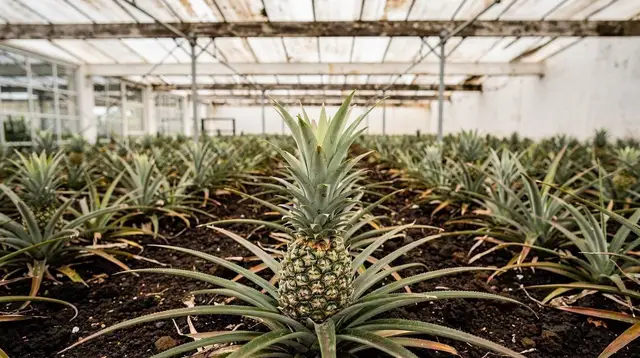
A visit to an estufa is a quiet, low-key stop rather than a polished visitor centre. Expect narrow paths between raised beds under glass and wooden lattice, warm still air even on a cool day, and rows of plants at every stage side by side — some just leaves, some flowering, some carrying a single ripening fruit at the centre. Many growers keep a small shop by the entrance selling fresh pineapples, jams, liqueurs and pineapple sweets, which is often the easiest way to taste the difference for yourself.
| Question | What to expect |
|---|---|
| Setting | Low stone-and-glass greenhouses (estufas), not open fields |
| Location | Mainly around Fajã de Baixo, near central Ponta Delgada |
| Typical visit length | 20-40 minutes |
| Ripening time per fruit | About two years, shoot to harvest |
| What’s on site | Growing beds at mixed stages, often a small shop |
| Best paired with | A Ponta Delgada city stop or a Sete Cidades route |
Because the growers are small, family-run operations rather than a single managed attraction, opening hours and which estufas welcome drop-in visitors can vary. A booked tour that already includes a stop removes that guesswork, which is why most visitors see the greenhouses as one stop on a wider itinerary rather than as a standalone destination.
Getting There from Ponta Delgada
Fajã de Baixo is close enough to central Ponta Delgada that a rental car or short taxi ride covers it in a matter of minutes, making it an easy addition to a morning that also takes in the old town or the stalls of the Mercado da Graça. It also sits conveniently along routes that many organised city day trips already run, which is one reason it turns up so often as a short add-on stop rather than a booked destination in its own right.
Travellers building a car-free day in Ponta Delgada can still reach the area without driving, though a guided option removes the need to plan bus timings around a grower’s opening hours. For a wider view of how a pineapple stop fits into island-wide planning, the São Miguel overview and the general things to do around Ponta Delgada page both place it in context alongside the city’s other short excursions.
Who a Pineapple Stop Suits
The greenhouses work well for almost anyone with a spare half hour in Ponta Delgada, but they suit some travellers more than others. Families tend to like the stop because it is short, indoors on a wet day, and gives children something concrete to look at up close — a plant that takes two years to fruit is an easy story to tell — and it slots naturally into a wider family-friendly activities day or a broader São Miguel with kids plan.
First-time visitors reading a first-time guide to São Miguel often add it simply because it is close to the airport and the old town, an easy way to fill dead time between a flight and a hotel check-in. Cruise passengers on a Ponta Delgada shore excursion benefit for the same reason: it is one of the few sights on the island that fits comfortably inside a single port call without a long drive.
Travellers chasing hikes, whale watching or the island’s big caldera viewpoints will find less to hold their attention here — the estufas are a short curiosity, not a half-day outing, and sit better as an add-on than as the reason to plan a morning.
Tours That Include a Pineapple Greenhouse Visit
Several Ponta Delgada tours build in a stop at the estufas as part of a longer city or island route, which is the most reliable way to see one without chasing individual growers’ hours.
A half-day Ponta Delgada city tour that pairs the old town with a pineapple greenhouse stop covers both in one outing, useful for a first morning on the island or a cruise call at Portas do Mar. Travellers heading west the same day can combine the greenhouses with the caldera lakes on a private half-day tour linking Sete Cidades with a pineapple plantation visit, which folds the estufa stop into a route many people are already planning.
Anyone who prefers to explore central Ponta Delgada independently, and simply walk past or into an estufa on their own schedule, can use a self-guided Ponta Delgada city tour with an audio guide as a flexible base for the day. For context on how a plantation stop compares with the island’s tea estates, see the guide to tea versus pineapple, which plantation to visit.
What Not to Expect
A pineapple stop on São Miguel disappoints only when visitors arrive expecting the wrong picture. There is no open field of pineapple rows to walk through here — the entire point of the estufa method is that the climate rules that out, and every plant on the island is grown under glass or lattice cover. There is also no fast harvest cycle to watch unfold in a single visit; the roughly two-year timeline from shoot to fruit means any single visit only ever shows a cross-section of plants at different stages, never a field ripening together.
And this is not the same stop as a tea plantation: the Gorreana and Porto Formoso estates are separate businesses on the island’s north coast, unrelated to the pineapple growers around Fajã de Baixo beyond both being small, old Azorean agricultural traditions worth a short stop.
For a side-by-side look at both crops as part of island’s wider farming story, see the Gorreana and Porto Formoso tea guide and the broader piece on how São Miguel is not the rest of the Azores in scale or produce. A short explainer on the timeline itself is also covered in why Azores pineapples take two years in a greenhouse.
Travellers researching the wider category of estates on the island can also browse the tea and pineapple plantations category page for every related stop in one place, alongside the best of São Miguel tour pairing Sete Cidades, Lagoa do Fogo and a pineapple plantation style itineraries that some operators run as a single long day. One such option is the full-day tour combining Sete Cidades, Lagoa do Fogo and a pineapple plantation stop, useful for visitors who want the greenhouses folded into a bigger west-of-the-island day rather than a Ponta Delgada city morning.
Fitting the Stop Into a Longer Stay
Because the visit is so short, it rarely changes how many days a trip needs — that decision comes down to the rest of the island, covered in how many days you need on São Miguel. It does, however, fit easily into most standard frameworks: travellers following a classic two-day itinerary or a classic three-day itinerary can drop it into a Ponta Delgada morning without reshuffling anything else, since it adds only twenty to forty minutes rather than a half-day detour.
Anyone still deciding whether to base themselves in Ponta Delgada or Furnas should note that the greenhouses lean the argument slightly toward Ponta Delgada, simply because a Furnas base makes this particular stop a longer drive rather than a short one.
Pineapple Greenhouses of Fajã de Baixo: Frequently Asked Questions
Why don’t São Miguel’s pineapples grow in open fields?
The island’s average temperatures and cloud cover sit below what a pineapple needs to fruit reliably outdoors. Estufas trap warmth, cut the wind, and let growers control light and moisture by hand, effectively building a small tropical microclimate the open Atlantic air cannot provide on its own.
How long does a pineapple actually take to ripen on São Miguel?
About two years from planting a shoot to picking a ripe fruit — roughly double the time a pineapple takes in a genuinely tropical field, because the estufa method trades speed for reliability in a marginal climate.
Where exactly are the greenhouses near Ponta Delgada?
The main concentration is around Fajã de Baixo, a parish just east of central Ponta Delgada, an easy short drive or taxi ride from the city centre and close to routes many day tours already use.
Can visitors walk into the greenhouses themselves?
Some estufas welcome independent visitors and small groups on a self-guided or lightly guided basis, usually with a small shop at the end; hours vary by grower, so a booked tour that includes the stop is the more reliable way to see one.
Is this the same place as the Gorreana or Porto Formoso tea plantations?
No. Tea and pineapples are grown by different producers in different parts of the island. Gorreana and Porto Formoso are tea estates on the north coast; the pineapple estufas around Fajã de Baixo are a separate, unrelated visit near Ponta Delgada.
Do the greenhouses smell or look like a typical farm?
Not really. Inside, rows of low, spiky plants sit under glass and wooden lattice in warm, still, faintly sweet air; from outside, the low stone-walled glasshouses look more like garden structures than fields.
Is a pineapple greenhouse visit worth adding to a Ponta Delgada day?
For anyone curious about how an unlikely tropical fruit survives in the Atlantic, yes — it is a short, low-effort stop, often paired with a city tour or a Sete Cidades route, rather than a destination in its own right.
Tea & Pineapple Plantations on GetYourGuide
Verified deep-linked GetYourGuide tours. Book through these links and we earn a small commission at no cost to you.
GetYourGuide does not provide a product photo for this activity — the image shows the meeting point, photographed by us.